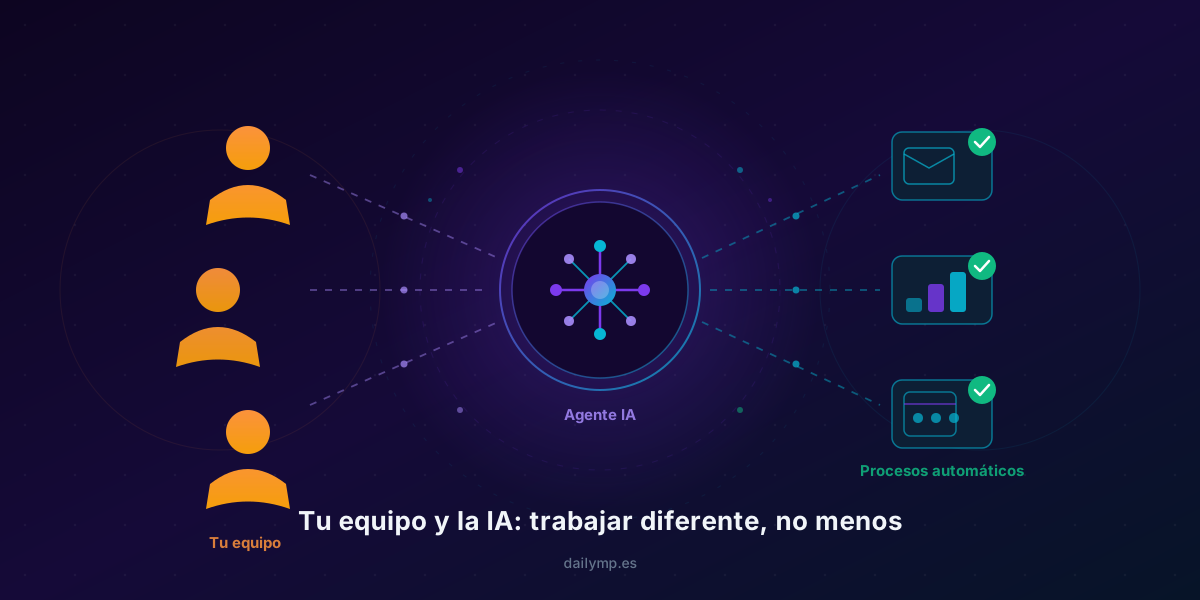
What Happens to Your Team When You Automate
You haven't automated yet. And it's probably not because you don't know what to automate, or because you can't afford it.
It's something harder to admit: you're not sure how your team will react.
You've been thinking for a while that certain processes could run on their own. But every time you're about to act, the same mental image appears — your team's faces when you tell them a machine is going to handle part of what they do. That invisible discomfort blocks more decisions than anyone wants to admit.
The Fear Nobody Names Out Loud
The owner or manager of a small business usually has a clear picture of the problems: repetitive tasks eating up hours, processes that break whenever someone is out, information that never arrives in time. And they usually know, in the abstract, that "some of this could be automated."
But between knowing it and doing it, there's a gap that rarely gets named: fear of the conversation with the team.
It's not irrational. These are people you've worked alongside for years. They've carried difficult projects, they know your clients, they keep operations running when you're pulled in a dozen directions at once. And now you're going to tell them a machine will handle part of what they do.
What we imagine: they'll feel expendable. They'll think you're setting them up to let them go. The atmosphere will change.
What actually happens is quite different.
What Your Team Is Really Thinking (and Not Saying)
When automation gets mentioned in a small or medium-sized business, the team's first reaction usually isn't panic. It's skepticism mixed with one question nobody says out loud:
Does this mean my job won't be needed anymore?
Here's the key insight: people who've spent time doing repetitive tasks aren't doing them because they enjoy it. They do them because it's part of their job, because nobody's freed them from it, and because as long as it works, nobody questions it.
When you tell them that process will now run on its own, the real question they have is: what's my role now?
It's not fear of replacement. It's a need to understand where they fit in the new picture. And the answer to that question depends almost entirely on how you frame the transition.
If you approach it as "we're cutting costs," your team will connect the dots in a way that breeds distrust. If you approach it as "we're freeing up time for the work that actually matters," everything shifts.
The Conversation You Need to Have Before Implementing Anything
There's a clear difference between automation projects that generate resistance and ones the team ends up actively championing.
The difference isn't the technology. It's whether the team was consulted before, or informed after.
Before implementing any automation, there's a question worth asking the people inside those processes: which tasks eat the most of your time and give you the least back?
This question changes the dynamic entirely. When the team identifies their own pain points, automation stops being something that happens to them and becomes something that solves their problems. Nobody pushes back against getting freed from work they don't value.
What typically comes up when you ask this question in an SME:
- Preparing weekly reports that always follow the same structure
- Copying data between tools that don't connect
- Answering the same FAQ from clients over and over
- Sending follow-up reminders that should happen automatically
- Updating records by hand when the information already exists somewhere else
That work exists in nearly every company. Nobody created it deliberately — it accumulated over time. And now someone does it because it has to get done. When it disappears, what remains is the work that person actually does well: the kind that requires judgment, context, and human relationship.
What Gets Automated and What Never Gets Touched
One of the most useful conversations you can have with your team before starting is explaining, very concretely, what AI does well and what it can't replace.
AI automates well:
- Tasks that repeat with the same rules every time
- Communications that follow a pattern (reminders, confirmations, status updates)
- Moving information between systems that don't talk to each other
- Generating standard reports from existing data
AI doesn't replace:
- Negotiating with a client in a difficult moment
- Decisions that require knowing the company's history and context
- The trust built over time between people
- The judgment to recognize when a situation needs special attention
What makes someone valuable in your company isn't how fast they can copy data into a spreadsheet. It's their knowledge of your business, their relationships, their judgment. That doesn't get touched. When your team understands this — and they understand it quickly — the whole conversation shifts in tone.
If you want to see exactly which processes are typically automated first, you can explore how we approach this in our AI agents and automation service.
What Changes in the First 30 Days
When automation starts working, there's an effect few people anticipate: the team becomes its biggest advocates.
Because what happens in the first few weeks is very concrete. The proposal follow-ups someone used to track manually now happen on their own. The Monday reports are ready when people arrive at the office. Client questions get answered after hours without anyone having touched them.
And the time those people free up doesn't disappear. It shows up as space to do what was always being postponed: giving proper attention to the clients who matter most, building better commercial proposals, finally resolving the problems that have been sitting on the to-do list for months with no bandwidth to tackle them.
The initial resistance turns into something different when the team sees their work became more interesting — not more threatened.
What used to be the filler task nobody wanted — the Friday report, the payment reminder, the follow-up on the quote sent last week — no longer exists. And the space it leaves is real.
To understand the actual cost of the hours your team has been spending on automatable tasks, you can read this piece on the work that shouldn't exist in your company.
The Real Cost of Waiting
There's a direct cost to delaying the conversation. It's not just the hours lost to manual processes — which, calculated annually, usually turn out to be far larger than anyone expects.
It's also the cost of capable people doing work that gives them nothing back. That contributes to burnout and turnover in quiet, steady ways. Good professionals don't leave for salary. They leave when their work stops moving them forward.
And there's a third cost that almost nobody names: processes don't improve on their own. If your team is spending four hours a week on automatable tasks today, in two years it'll still be four hours. Work volumes will grow, but the way things are done won't change.
The Conversation That Isn't the Obstacle
The conversation with your team is not the obstacle. Handled correctly, it can become the starting point for something that works better for everyone — including them.
The moment a team sees that automation frees them for the work that matters to them, the initial skepticism turns into something different. I've seen teams go from distrust to asking themselves what else could be automated — within 30 days.
That doesn't happen by accident. It happens when the transition is set up right from the start.
If you'd like to talk through how to do this in your business without it becoming a difficult process for anyone, I can walk you through how we approach it in a 30-minute call.