Your Business Has Unwritten Rules. Your AI Ignores Them.
Your best client has worked with you for five years. They have negotiated pricing. The team knows exactly how to handle them. Two weeks ago, your AI agent replied to their inquiry: standard pricing, fifteen-day turnaround, generic first-contact tone.
Technically, the AI did its job. The problem is nobody explained your company's unwritten rules.
The Rules That Run Your Business — Written Nowhere
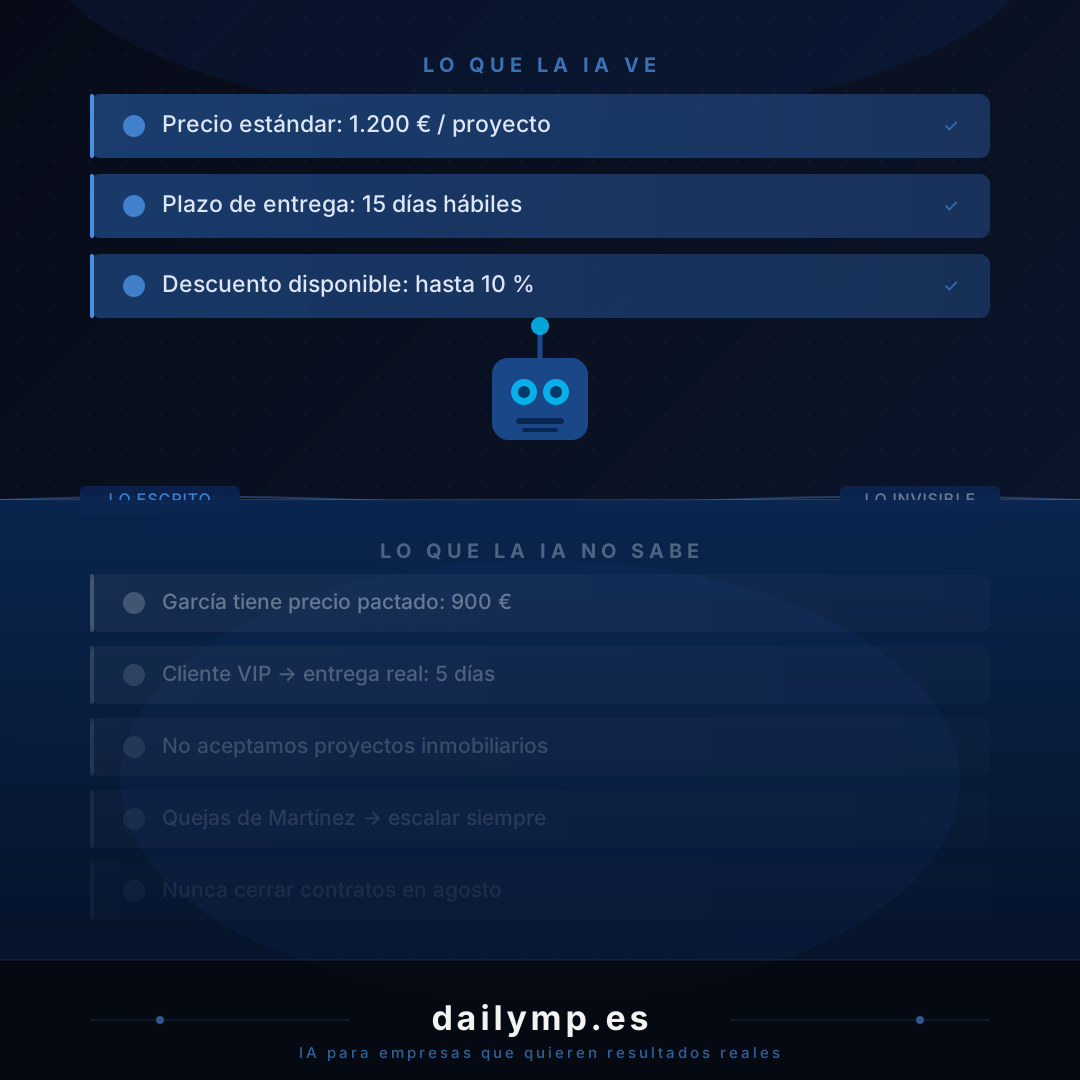
Every business has two layers. The visible layer: prices on the website, timelines in the contract, steps in the manual. And the invisible layer: everything that works perfectly but nobody ever documented because "everyone knows it."
- García has a custom rate agreed three years ago that never made it into any system
- Any complaint from a large account goes directly to you, not the standard support flow
- You don't take clients who pay on 90-day terms
- That type of project always takes twice the time the estimate says
- Contract terms with your main supplier are always closed in September, never before summer
Nobody wrote these down because they didn't need to. The team learned them through experience, through examples, through corrections that happened informally. They passed from person to person over months. They work perfectly when everyone executing is human.
When you add an AI, that context doesn't exist anywhere the AI can access.
What the AI Does When It Doesn't Know the Rule
It doesn't stop. It doesn't ask for help. It improvises with what it has.
It quotes the catalogue price because it doesn't know that client has special terms. It gives the standard timeline because it doesn't know that type of project always runs long. It says yes to a project in a sector you decided six months ago you wouldn't work with. It gives a discount because someone asked politely, without knowing your actual policy is different.
The AI does the best it can with the information available. The problem isn't that the AI is wrong. The problem is nobody onboarded it.
Think of it as hiring someone new. No matter how capable they are: if nobody explains the particulars of your business, the first few months they'll make the same mistakes. Not from lack of talent — from lack of context.
With an employee, that context arrives naturally: someone corrects them, explains it, copies them in. With AI, that process doesn't happen on its own. You have to do it deliberately, before you activate anything.
Why Most AI Implementations Fail Here
They don't fail because the technology is bad. They fail because the system gets installed and switched on, but the real business context never gets transferred.
This is the most common pattern I see when companies come to DAILYMP with an automation that "doesn't quite work the way we expected": the AI is connected to the systems, responds in seconds, takes actions. But it does so without the context that turns a generically correct response into the right response for your specific business.
There's a fundamental difference between an AI that can act inside your business — connected to your tools, able to query and execute — and an AI that knows the rules of how to use them. If you have the first but not the second, you have a system that works with impressive efficiency in the wrong direction.
This is exactly what we covered in the article on when your AI chatbot talks but doesn't act on your business: having connected systems is the first step. Having those systems know your business rules is the second — and that's where most implementations stop.
What Changes When the AI Actually Knows Your Business Rules
When the implementation process includes real context transfer, the result looks different:
The VIP client gets the treatment they're entitled to. Without anyone having to intervene. Because the AI knows they're a special client and acts accordingly.
Pricing applies correctly based on client type, volume and agreed conditions. The difference between quoting García 900€ and a new contact 1,200€ — the AI handles that itself.
Exceptions don't improvise. When a case falls outside the normal pattern, it goes to human review with a summary of the context, rather than getting a generic response that might be wrong.
The rules "everyone knows" stop depending on the one person who remembers them being available. They work the same on a Monday morning as they do on a Friday in August.
This is exactly what we do before activating any AI automation agent for SMEs: the context phase. It's not the longest technical step — but it's the most important one and the one that determines whether the result is useful or not.
How Business Context Gets Built
The process isn't complicated, but it requires real conversation.
-
Map the implicit rules: we interview the owner and the team. We ask about cases that "everyone knows how to handle" and document them.
-
Identify exceptions and special clients: who has negotiated terms, what type of project gets turned down even if it could technically be done, which sectors are off the table.
-
Define autonomy limits: what the AI decides alone, what always involves a human, what gets escalated automatically and to whom.
-
Test with real scenarios from the company's history: concrete situations where the AI has to apply the unwritten rules, not just the written ones.
-
Update when the business changes: rules evolve. A new client with special terms, a sector that comes in or goes out. The AI's context gets updated the same way you'd update a new employee's knowledge.
All of this happens before anything goes live. Because an AI that doesn't know your business rules doesn't work for your business. It works for a generic company that happens to look like yours.
A Signal the Problem Is Already There
Have you ever reviewed a message or action from your AI and thought "that's not what I would have done"?
That's not a technical failure. It's an unwritten rule nobody has explained yet.
Every "strange" decision the AI makes has a concrete cause: missing context specific to your business. And that's fixable.
Let's look at what your AI doesn't know about your business →