Gemma 4 by Google: Integrate It in Your AI Projects
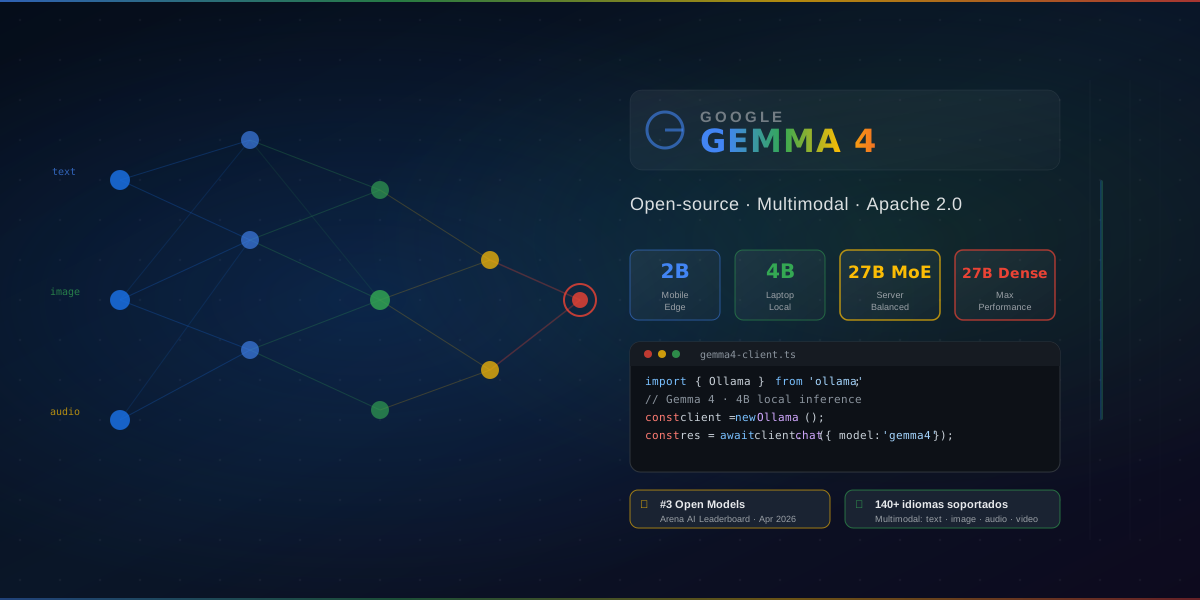
On April 3, 2026, Google dropped Gemma 4 as an "Easter surprise" — and within 24 hours it had already claimed #3 on the Arena AI open models leaderboard. If your project relies on paid proprietary models, this is the signal you've been waiting for.
Gemma 4 is open-source under Apache 2.0, natively multimodal (text, image, audio, and video), supports over 140 languages, and ships in four sizes designed for very different scenarios. This article covers when to use each variant and how to integrate it into a React or Next.js project in minutes.
Why Gemma 4 Reshapes the Open Model Landscape
Until now, choosing an open-source model meant accepting a quality trade-off versus GPT-4o or Claude. Gemma 4 breaks that equation on three fronts:
1. Genuinely competitive performance. The 27B Dense model sits in the global top 3 — not the top 3 "among free models", but the actual global leaderboard.
2. Native multimodality. Text, images, audio, and video in a single model. No separate pipelines, no adapters. For projects combining document analysis with visual extraction or audio transcription, this massively simplifies your architecture.
3. Apache 2.0 with no commercial restrictions. You can deploy Gemma 4 in production, ship it inside a SaaS product, modify it, and redistribute it. No fair-use clauses, no provider-tied API rate limits.
The Four Sizes — and When to Use Each
Picking the wrong size is the most common mistake. Gemma 4 isn't "bigger = better": each variant has a clear niche.
2B — Edge and On-Device Inference
At 2B parameters, it runs comfortably on modern Android devices and edge hardware (Raspberry Pi 5, NPU chips). Great for:
- Offline chatbots inside mobile apps
- Form autocompletion without connectivity
- Client-side user intent classification
Latency is under 200ms locally. Server inference cost is essentially zero.
4B — The Sweet Spot for Laptops and Small Servers
The 4B is the default choice for most projects. It runs on any laptop with 8GB RAM via Ollama or LM Studio, and on servers with a modest GPU (RTX 3060 or better).
It's a massive quality leap over the 2B and covers 80% of typical use cases: text generation, summarization, structured data extraction, RAG over documents.
27B MoE (Mixture of Experts) — Server Efficiency
The 27B MoE activates only a fraction of its parameters per inference, making it cheaper to serve than a dense 13B at higher quality. Perfect for:
- Internal APIs with multiple concurrent users
- Batch processing pipelines (contract analysis, content moderation)
- Cost-sensitive projects where per-token cost matters
27B Dense — Maximum Precision for Critical Tasks
The 27B Dense uses more resources but delivers the highest accuracy available in open-source. Use it for critical tasks: complex code generation, medical or legal analysis, chained reasoning.
Integrating Gemma 4 into a Next.js Project
Three main paths depending on your infrastructure:
Option 1: Ollama on Local or Self-Hosted Server (recommended to start)
# Install Ollama
curl -fsSL https://ollama.com/install.sh | sh

# Pull Gemma 4 4B
ollama pull gemma4:4b
From Next.js, using the official Ollama library:
// lib/gemma.ts
import { Ollama } from 'ollama';

const ollama = new Ollama({ host: process.env.OLLAMA_HOST ?? 'http://localhost:11434' });

export async function askGemma(prompt: string): Promise<string> {
  const response = await ollama.chat({
    model: 'gemma4:4b',
    messages: [{ role: 'user', content: prompt }],
  });
  return response.message.content;
}
In a Next.js Route Handler with streaming:
// app/api/chat/route.ts
import { NextRequest } from 'next/server';
import { Ollama } from 'ollama';

export async function POST(req: NextRequest) {
  const { message } = await req.json();
  const ollama = new Ollama();

  const stream = await ollama.chat({
    model: 'gemma4:4b',
    messages: [{ role: 'user', content: message }],
    stream: true,
  });

  const encoder = new TextEncoder();
  return new Response(
    new ReadableStream({
      async start(controller) {
        for await (const chunk of stream) {
          controller.enqueue(encoder.encode(chunk.message.content));
        }
        controller.close();
      },
    }),
    { headers: { 'Content-Type': 'text/plain; charset=utf-8' } }
  );
}
Option 2: Hugging Face Inference API (no infrastructure management)
If you'd rather not manage servers, Hugging Face hosts Gemma 4 on its Inference API with a generous free tier:
// lib/gemma-hf.ts
export async function askGemmaHF(prompt: string): Promise<string> {
  const res = await fetch(
    'https://api-inference.huggingface.co/models/google/gemma-4-4b-it',
    {
      method: 'POST',
      headers: {
        Authorization: `Bearer ${process.env.HF_TOKEN}`,
        'Content-Type': 'application/json',
      },
      body: JSON.stringify({ inputs: prompt }),
    }
  );
  const data = await res.json();
  return data[0]?.generated_text ?? '';
}
Option 3: Vertex AI (Google Cloud, Enterprise Production)
For enterprise-grade scale with guaranteed SLAs, Gemma 4 is available in Vertex AI Model Garden. Benefits: per-token billing, automatic scaling, no GPU management.
Concrete Use Cases Where Gemma 4 Beats Paid Alternatives
RAG over internal documents with full data privacy. With Gemma 4 on your own server, documents never leave your infrastructure. Ideal for law firms, clinics, or companies with sensitive data. In our AI integration projects we pair it with pgvector and achieve high-precision retrieval without sending data to third parties.
Multilingual content generation at scale. 140+ languages from a single model means no more deploying separate models per market. For international e-commerce, this dramatically cuts infrastructure costs.
Image analysis in moderation pipelines. Native multimodality lets you process product images, detect inappropriate content, or extract text from invoices without bolting on a separate vision model.
Fast prototyping with zero API costs. The 4B running locally is ideal for rapid iteration during development — no per-call costs, no rate limits, no provider dependency when testing ideas.
What to Keep in Mind Before Migrating
- Gemma 4 lacks extensive RLHF for complex instruction-following. For highly elaborate multi-step reasoning with tool use, Claude or GPT still have the edge. Combine both depending on the task.
- The 27B Dense requires at least 24GB VRAM GPU for smooth inference. CPU-only is too slow for production.
- Video multimodality is still in beta in some Ollama builds. Validate before committing to it in production.
Conclusion
Gemma 4 is the first open-source model that genuinely competes head-to-head with top proprietary models — and does so under Apache 2.0 with native multimodality. The 4B is the new default entry point for any AI project: capable enough, runnable locally, and free of API costs.
If you're evaluating whether to integrate it in your stack or migrating from a paid model, we've been doing this from day one at DailyMP. Tell us about your use case and we'll help you choose the right architecture.