Claude Code Skills: Write SEO Articles with AI
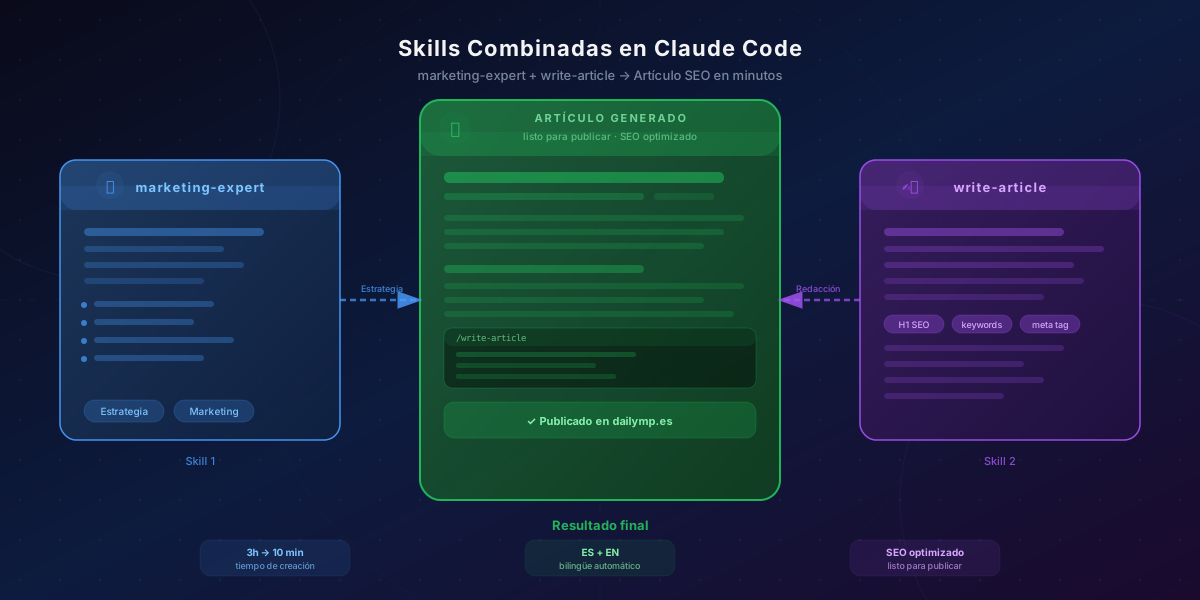
Last year, writing a blog post took me two to three hours: research, structure, draft, SEO review, translation. A draining process that made consistent publishing practically impossible. Today, the same output is ready in under 10 minutes — not because quality dropped, but because I automated the part that consumed 80% of the time using two combined Claude Code skills.
In this article I'll show you exactly how this flow works: what skills are, how they combine, and what real results they produce.
Why SEO content creation is still a bottleneck
Businesses, freelancers and agencies all know that blog content is essential for organic growth. The problem is that producing quality articles consistently is expensive in time:
- A well-crafted article requires keyword research, structure planning, original writing, SEO optimization, and proofreading.
- Add an English version and the effort doubles.
- Outsourcing to a copywriter can cost anywhere from $100 to $400 per article — and often the result lacks the technical depth your audience actually needs.
The consequence: most businesses publish once a month at best, or simply abandon their blog. And organic traffic never materializes.
The solution isn't to write faster. It's to automate the workflow without sacrificing quality — and for that, Claude Code offers a feature most teams are still ignoring: skills.
What skills are in Claude Code
Skills are specialized system prompts you invoke directly in Claude Code using /skill-name. They're not simple text shortcuts — they're roles with full context: behavioral instructions, business rules, and predefined workflows.
On the dailymp.es project, two skills handle the entire content creation pipeline:
marketing-expert: Defines the marketing strategy for the article — narrative angle, value proposition, primary keywords, recommended structure, and CTA.write-article: Takes that strategy and executes the full creation process: audits existing articles to avoid duplicates, plans SEO, generates a custom SVG image, writes Spanish and English versions, and commits and pushes to the repository.
Each skill has full access to business context: who the author is, who the audience is, which services exist, what the absolute CTA rules are, the brand tone, and the technical structure of the blog.
How they combine: the step-by-step flow
The process has two steps, with the second feeding directly from the first.
Step 1: Run marketing-expert
Provide the topic and target audience. The skill returns a complete strategy:
/marketing-expert I need a strategy for an article about
[TOPIC]. Audience: [PROFILE]. Define angle, keywords,
structure and CTA.
The output includes: the narrative angle, the value proposition with a measurable benefit, primary and long-tail keywords, recommended section structure, and a personalized WhatsApp CTA with a message adapted to the topic.
Step 2: Run write-article with the generated strategy
Take the output from Step 1 and pass it to the writing skill:
/write-article
[Paste the full marketing-expert output here]
From that point, write-article works autonomously:
- Audits existing articles in
content/blog/to avoid overlapping content, examples, or sections. - Plans SEO: defines slug, category, title under 60 characters, meta description between 120-160 characters, and keywords.
- Creates a custom SVG image in
public/images/. - Writes the Spanish article (800-1200 words) with H2/H3 structure, internal links, and WhatsApp CTA.
- Writes the English version, not as a literal translation but adapted to an English-speaking context.
- Commits and pushes to the repository with a descriptive commit message.
The result: two publishable MDX files, an original SVG image, and the code already in the repository. All without opening a text editor, touching a CMS, or waiting on a copywriter.
What changes when you automate this way
The impact isn't just time. It's consistency and process quality:
- Guaranteed brand coherence: every article follows the exact tone, CTA rules, and structure defined in the skills — no variation depending on who writes it or what day it is.
- Systematic SEO: the quality checklist runs every time — title under 60 characters, description between 120-160, keywords in the first paragraph and at least two H2s, minimum two internal links.
- Zero duplicates: the skill reads the actual content of existing articles, not just titles, and adjusts the angle if it detects overlap.
- Bilingual at no extra cost: Spanish and English are generated in the same flow, with adaptation to the English-speaking context, not just translation.
For businesses that need to publish regularly — and nearly all of them do to grow organically — this changes the calculation entirely. If publishing two articles per month used to take 6 hours, it now takes 20 minutes.
What you need to replicate this flow
Skills in Claude Code are configuration files that live in your repository. You can build them yourself if you have a clear picture of your business context and the workflow you want to automate — or you can work with someone who does.
What you need:
- Claude Code installed and configured in your project.
- A skills directory with system prompts for each role.
- Documented business context: who you are, who your audience is, what services you offer, what your brand rules are.
- A blog in MDX or a similar format that Claude can write directly — like dailymp.es, built on Next.js.
If you're curious about how AI integration works in real-world React and Next.js projects, that's exactly what we build: AI workflows that deliver measurable results, not polished demos.
Conclusion
Automating SEO article writing with combined Claude Code skills isn't a future promise — it's working in production today at dailymp.es. The marketing-expert → write-article flow eliminates the content bottleneck: from 3 hours to 10 minutes, with brand consistency, systematic SEO, and automatic publishing.
If you want to implement something like this in your business — whether for your blog, social media, or any other content process — let's talk.
Message me on WhatsApp and tell me what you want to automate →