MCP Certified: Connect LLMs to Any App or API
The most advanced AI in the world can't read your files, query your database, or send an email without a secure way to connect to your systems. That's exactly what the Model Context Protocol (MCP) solves — and I just completed the most comprehensive course available to master it from scratch.
Santiago Hernández's "MCP Course: Connect LLMs and AI Agents with External Apps" on Udemy is 8 hours of 100% hands-on training: real servers, working clients, projects built for production. In this article I'll share what MCP is, what I learned, and why it matters if you run or develop a business that wants to use AI in a meaningful, practical way.
What Is the Model Context Protocol and Why Does It Change Everything
Imagine you hire the world's best analyst but don't give them access to any system — not the CRM, not the database, not the emails. What good is their talent if they work in a vacuum?
That's exactly what happens today with LLMs — Claude, ChatGPT, Gemini — when they have no real integration with your systems. They reason brilliantly, but they're completely blind to everything happening inside your business.
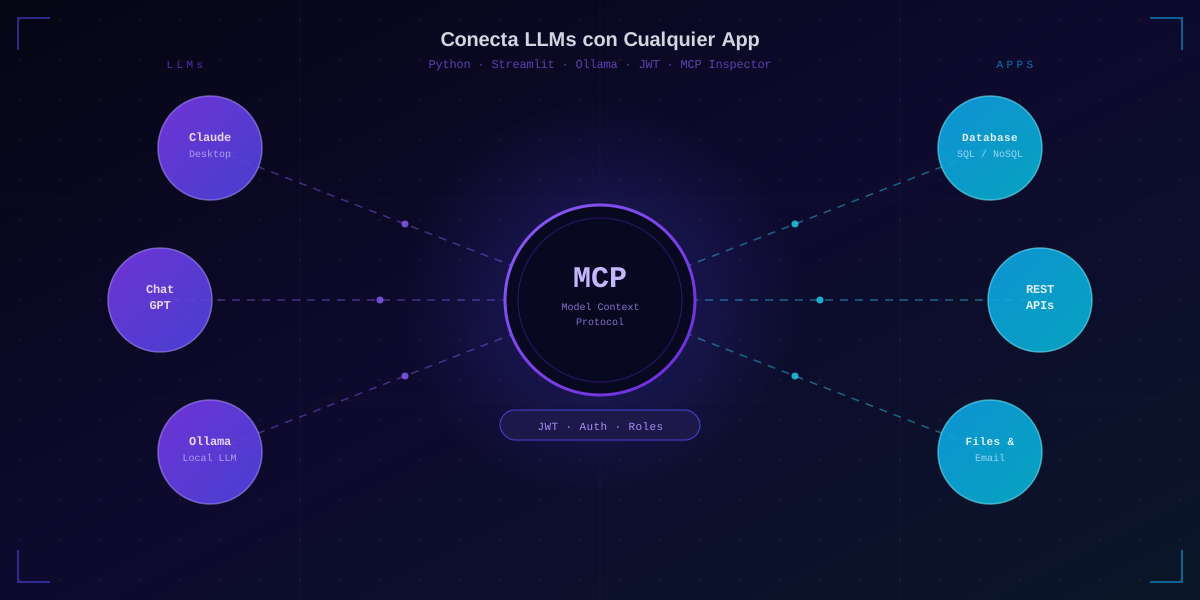
MCP is the standard protocol that solves this problem. Think of it as a universal USB connector for AI: it defines a unified, secure way for any language model to connect with databases, APIs, file systems, email, management tools — any information source or service in the real world.
What makes it especially relevant right now is the massive adoption already underway: Claude Desktop, ChatGPT, and dozens of productivity tools use it in production today. This isn't future technology — it's what the most advanced AI teams are shipping right now.
What I Learned: From Zero to Enterprise MCP System
The course starts from the ground up but reaches serious, production-ready architectures. Here's what I built and mastered across the 8 hours:
- Full MCP architecture: servers, clients and transports (stdio and HTTP/SSE), and how they communicate with each other
- MCP servers with Python and UV: custom tools the LLM can invoke, resources that expose structured data, and reusable prompts
- Integration with Claude Desktop and ChatGPT: connecting local and remote servers to the most widely-used models, including No-Code integrations with Zapier
- MCP Inspector: the debugging tool that lets you test any MCP server before deploying it
- Intelligent email manager with Google: the LLM reads, classifies, and responds to emails based on business rules you define
- MCP clients with Streamlit: web interfaces that let anyone on your team use AI tools without writing code
- Local LLMs with Ollama: completely free models running on your own infrastructure, no data sent to third parties — essential for sensitive information
- Enterprise security with JWT: public/private key authentication and role-based authorization to control exactly what each user can do with each tool

The course projects are functional and real: a server managing a file system, a video game store database the LLM can query and update, and an intelligent email manager with Google. No filler exercises — everything has direct application in production environments.
What MCP Can Do for Your Business Today
If you run an SMB, a startup, or a technical team, these are the most immediate applications of the Model Context Protocol:
Connect your database to an AI assistant: instead of requesting reports from the IT team, anyone in the business can ask in plain language "which are the 10 customers with the most purchases this quarter?" and get the answer in seconds, directly through Claude or ChatGPT.
Automate email management: an MCP server connected to Gmail or Outlook can classify messages, extract data from quotes, detect urgencies, and reply with the right templates — with no human intervention for 80% of incoming volume.
Give your LLM access to internal documentation: manuals, contracts, product sheets. The model reads them, understands them, and answers questions about them, with access controlled per user role.
Local LLMs for confidential data: with Ollama and an MCP server, you have an AI assistant that accesses sensitive data without that information ever leaving your infrastructure. Zero dependency on external APIs.
If you want to implement this type of architecture in your organization, our AI Integration service covers the full design and deployment of complete MCP systems adapted to your existing tech stack and current processes.
Security That's Actually Production-Ready
One of the most valuable modules in the course covers enterprise security. Many AI implementations you see in the market are prototypes that should never reach production: no access control, all tools exposed to every user, no audit trail of who does what.
MCP enables JWT authentication (JSON Web Tokens) and role-based authorization: you define exactly what each user profile can do with each tool, resource, or prompt. The same granular control you'd expect from any serious enterprise system.
A basic authentication middleware for an MCP server looks like this:
from functools import wraps
import jwt

def require_auth(roles=None):
    def decorator(func):
        @wraps(func)
        async def wrapper(ctx, *args, **kwargs):
            token = ctx.request.headers.get("Authorization", "").replace("Bearer ", "")
            payload = jwt.decode(token, PUBLIC_KEY, algorithms=["RS256"])
            if roles and payload.get("role") not in roles:
                raise PermissionError("Access denied for this role")
            return await func(ctx, *args, **kwargs)
        return wrapper
    return decorator
This is what separates an AI project that stays in demo mode from one that scales in real production.
From Certificate to Real Projects
Getting certified is the first step. What I'm really taking from this course is the ability to design and implement complete MCP systems: from the server that exposes data, to the web-interface client, all the way through the security layer that protects the entire stack.
If your team is evaluating how to connect your systems to AI in a controlled and secure way, let's talk. I also offer AI training for technical teams tailored to your technologies and specific use cases.
Is your business ready to connect its AI to the real world? Let's chat — no commitment.