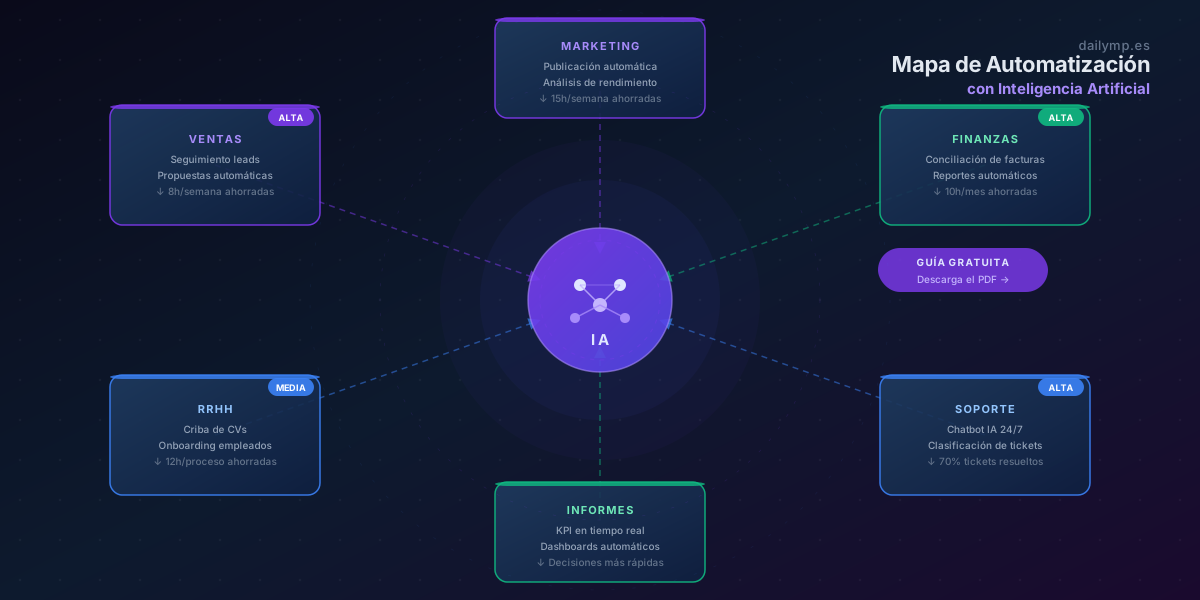
AI Automation Map: Which Business Processes to Fix First
Most companies know AI can help them. But they get stuck at the same question: Where do I even start?
Without a clear answer, one of two things happens: either they do nothing and keep wasting hours on repetitive tasks, or they jump in without a strategy and spend money on projects that don't generate any return. That's exactly why we built the AI Automation Map — a practical framework for identifying which processes in your business have the highest automation potential.
Why order matters more than the tool
Before discussing n8n, Make, LangChain, or any other platform, you need to answer a strategic question: which process, if automated today, generates the greatest impact in the least time?
The answer isn't the same for everyone. A 15-person company losing 3 hours daily managing support emails has a very different problem than an agency billing hourly that spends 40% of its time on client reports.
Automating the wrong process is worse than not automating at all. You invest resources, create friction with your team, and see no results. Automating the right process — even a small one — proves value in weeks, not months.
The 4 Dimensions of the Map
The map classifies your business processes across four key dimensions:
1. Frequency
How often does this process repeat? Daily or weekly tasks deliver higher ROI than monthly ones, because the savings compound faster.
High-frequency examples: responding to customer inquiries, updating the CRM, posting on social media, classifying incoming emails, issuing invoices.
2. Time volume
How many hours does this process consume per week? A process that takes 20 minutes a day adds up to more than 80 hours per year — nearly two full work weeks per person.
Processes that often surprise teams: weekly report generation (4–6 hours), following up with unclosed leads (3–5 hours), scheduling coordination (2–3 hours).
3. Human error rate
How often does the process fail due to manual mistakes? Accounting reconciliation, inventory updates, or data entry from forms are all areas where human error has a direct cost.
Warning signal: if someone on your team manually reviews a step "just to make sure," that's a prime automation candidate.
4. Key person dependency
Is there a process only one person knows how to do? That's both an operational risk and a bottleneck. Automation here has a double benefit: it frees up time and reduces critical dependencies.
The 5 processes SMBs automate most
Based on our experience working with companies of 10 to 100 employees, these are the processes where AI automation delivers results fastest:
-
Customer support — Chatbots that resolve 60–70% of inquiries without human intervention. Complex cases are automatically escalated with full context attached.
-
Proposal generation and follow-up — Agents that personalize templates, send follow-ups, and alert sales reps at the right moment. See AI Integration service →
-
Social media publishing and analysis — Content generated, scheduled, and analyzed automatically based on previous performance. See AI Social Agent service →
-
Reports and dashboards — Connecting data sources (CRM, billing, web analytics) to generate automatic reports with executive summaries in plain language.
-
Client and employee onboarding — Automatic welcome sequences, information gathering, and task assignment with zero manual touchpoints.
How to use the Map in your company
The process is straightforward:
- List the processes of a specific department (start with the one that hurts most)
- Score them across the 4 dimensions: frequency, time, error rate, dependency
- Identify the process with the highest total score — that's your entry point
- Define the expected outcome: hours saved, errors eliminated, money recovered
- Implement, measure, and expand to the next process
This approach avoids the most common mistake: automating what's technically easy instead of what generates the most value.
Download the free guide
We've condensed this methodology into a downloadable PDF with the full map, a scoring template, and real-world examples by industry.
Download the AI Automation Map →
It's free. You just need your email to receive it.
Conclusion
AI automation isn't a race to see who implements the most tools. It's a strategic decision about where to focus first. Companies that start with the right process see measurable results in 4–6 weeks. Those who start without a framework typically give up before the 3-month mark.
If you'd like to review your process map together and define where to begin, message us on WhatsApp. The first conversation is free.