Reasoning Models: When to Use Slow-Thinking AI in Business
When your fast AI makes the wrong call
Every CTO I work with eventually asks the same question when designing AI automation pipelines: do I use the fastest model or the smartest one? In 2026, that question finally has a new answer — because there are now models that think before they respond.
Reasoning models aren't simply larger LLMs. They're models trained to generate internal chains of thought before producing an answer. Claude Opus 4.6 with extended thinking, OpenAI o3, DeepSeek R1 — they all share the same principle: take the time to reason carefully before committing to a response.
And that fundamentally changes which business decisions you can reliably automate.
What sets a reasoning model apart
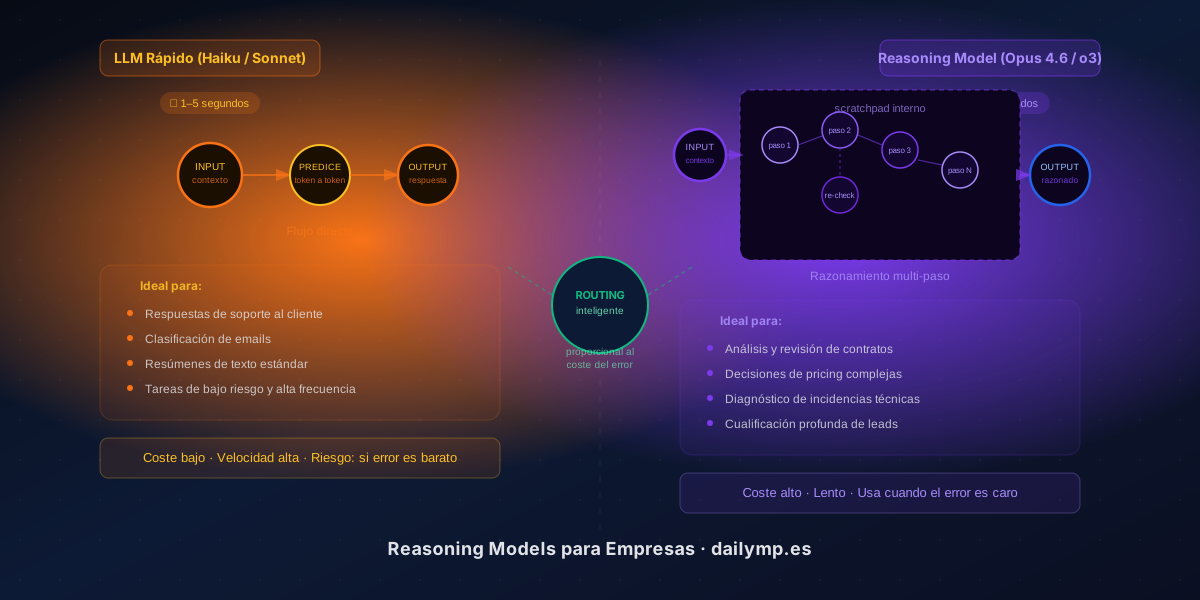
A standard LLM like GPT-4o or Claude Sonnet generates tokens sequentially: it takes the context, predicts the most likely next token, and delivers a result in seconds. This works brilliantly for the 80% of business automation tasks that are relatively straightforward.
A reasoning model does something different: it generates an internal scratchpad — a step-by-step reflection that may not be visible in the final response — before committing to an answer. It can reconsider, detect contradictions in the input data, or identify missing critical information before responding.
| Feature | Standard LLM | Reasoning model |
|---|---|---|
| Response time | 1–5 seconds | 15–120 seconds |
| Cost per call | Low | 5–20× higher |
| Simple tasks | Excellent | Overkill |
| Complex decisions | Error-prone | Significantly more accurate |
| Inconsistency detection | Limited | High |
The general rule: if a model error carries high cost — financial, legal, reputational — reasoning models reduce that risk measurably.
4 use cases where reasoning models transform automation
1. Contract review and analysis
Spotting problematic clauses, inconsistencies between sections, or conditions that conflict with internal policy is exactly the type of task where fast LLMs fail silently — producing plausible but incorrect responses.
With Claude Opus 4.6 in extended thinking mode, you can automate the first pass of contract review with paralegal-level precision:
const response = await anthropic.messages.create({
  model: 'claude-opus-4-6',
  max_tokens: 16000,
  thinking: {
    type: 'enabled',
    budget_tokens: 10000  // deep internal reasoning
  },
  messages: [{
    role: 'user',
    content: `Review this vendor contract and flag:
1. Disproportionate indemnification clauses
2. Missing or vague SLA definitions
3. Unfavorable termination conditions
4. Cross-section inconsistencies

CONTRACT:
${contractText}`
  }]
});
For companies processing 20+ contracts per month, this automation typically saves 8–15 hours of legal review per week.
2. Complex pricing decisions
Dynamic pricing that weighs product cost, customer-specific margins, historical volume, competitor pricing, and market conditions is too complex for hardcoded rules — and too high-stakes to leave to an LLM that might hallucinate a plausible-sounding number.
A reasoning model processes all those variables, flags anomalies, and recommends a price with explicit justification — something a human can review in seconds rather than calculate in minutes.
3. Technical incident diagnosis
When a production pipeline fails and logs are contradictory, the task demands causal reasoning: what caused what? Standard LLMs tend to suggest the statistically most likely cause. Reasoning models explore multiple causal hypotheses and eliminate them systematically.
Routing only unresolved escalations to a reasoning model — the fast LLM filters 90% of alerts; the reasoning model diagnoses the rest — is an AI integration architecture we're already deploying in real projects.
4. Deep lead qualification
An 8-field form isn't enough to decide whether a lead deserves a 45-minute sales call. But cross-referencing that data with the history of similar customers, the project description, and web behavioral intent signals does require reasoning — and the precision of a reasoning model here reduces the opportunity cost of misqualified leads.
Smart routing: when to use which model
The right strategy isn't replacing all your LLMs with reasoning models. It's building pipelines with intelligent routing:
async function routeToModel(task: string, context: Record<string, unknown>) {
  // A lightweight classifier decides complexity first
  const complexity = await classifyTaskComplexity(task, context);

  if (complexity === 'simple') {
    // Response in < 3 seconds, minimal cost
    return anthropic.messages.create({
      model: 'claude-haiku-4-5-20251001',
      max_tokens: 1024,
      messages: [{ role: 'user', content: task }]
    });
  }

  if (complexity === 'complex') {
    // Deep reasoning for high-impact decisions
    return anthropic.messages.create({
      model: 'claude-opus-4-6',
      max_tokens: 8000,
      thinking: { type: 'enabled', budget_tokens: 8000 },
      messages: [{ role: 'user', content: task }]
    });
  }

  // Middle tier: Sonnet without extended thinking
  return anthropic.messages.create({
    model: 'claude-sonnet-4-6',
    max_tokens: 4096,
    messages: [{ role: 'user', content: task }]
  });
}
This pattern can reduce your pipeline's total API cost by 40–60% compared to using reasoning models for everything, while maintaining accuracy where it matters most.
The ROI of thinking before acting
The financial case for reasoning models in business automation isn't about the API call cost — it's about the cost of the error avoided:
- A problematic contract clause missed: €5,000–50,000 in legal costs
- Incorrectly priced enterprise deal: €2,000–20,000 in lost margin
- Production incident diagnosed 3 hours late: direct SLA and reputational cost
When the cost of an error significantly outweighs the cost of a more capable model, the decision is straightforward.
If you'd like to explore how reasoning models fit into your current automation stack, our AI Driven Development service designs these architectures from scratch around real business use cases.
The principle: match the model to the cost of being wrong
Model selection should be proportional to the cost of a mistake. Repetitive low-stakes task → fast model. High-impact decision with complex input → reasoning model. The goal isn't to always use the most powerful option, but to use the right one.
In 2026, the businesses winning with AI aren't the ones with the most advanced models. They're the ones who've learned to use the right model at the right moment.
Want to design this kind of architecture for your business? Let's talk →