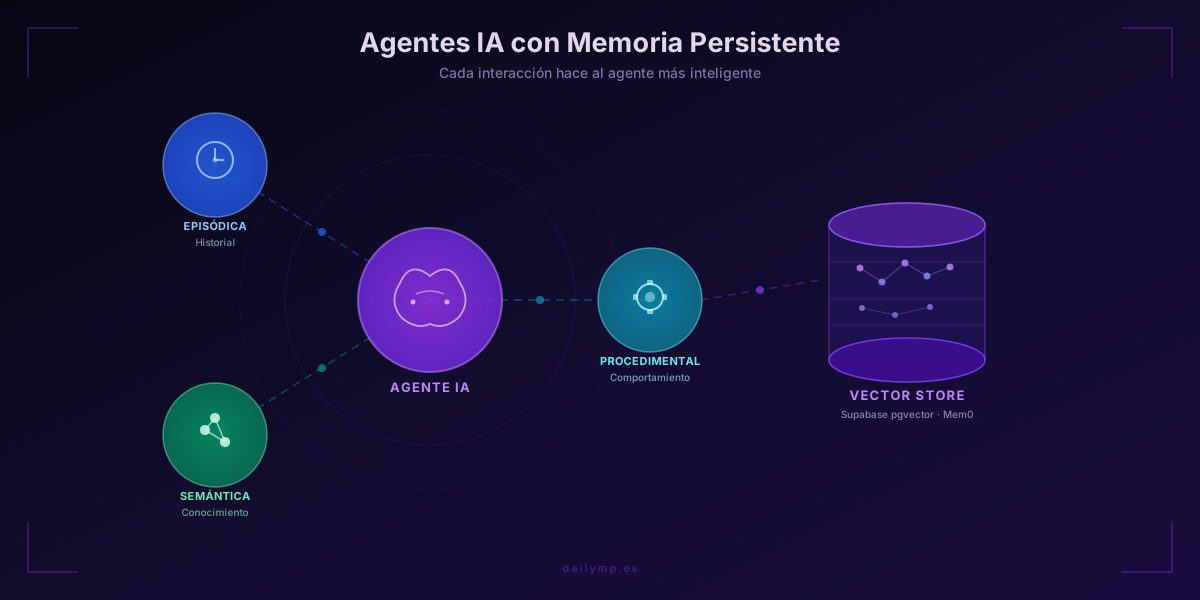
AI Agents with Persistent Memory: Business AI That Learns
The agent that forgets everything, every day
Picture hiring an extraordinarily capable assistant — one that arrives each morning with zero memory of yesterday. It doesn't know your clients. It doesn't remember that Sarah called three times last week about the same issue. It has no idea that your operations lead prefers reports in PDF, not Excel.
This is exactly how most production AI agents behave today. Brilliant in the moment. Amnesiac between sessions.
In 2026, this no longer needs to be the case. Persistent memory for AI agents is the layer that turns a sophisticated chatbot into a system that genuinely learns from your business over time.
The real cost: stateless agents are expensive to maintain
Every conversation a stateless agent has starts from scratch. For businesses, this has direct, measurable consequences:
- Customers repeat context on every interaction — generates friction and measurable frustration
- The agent doesn't improve with use — you pay the same quality cost indefinitely
- No real personalization — every customer gets the same generic treatment
- Your human team compensates — someone is still manually taking notes
A business with 200 support interactions per month easily loses 40 hours monthly on context that the system should handle automatically. That's 40 hours your team could spend on work that actually moves the needle.
What persistent memory actually is
Persistent memory isn't just expanding the prompt context window. It's storing information outside the model and retrieving it intelligently when needed.
Every enterprise AI agent should have three types of memory:
Episodic memory (what happened)
A history of past interactions with a specific customer, company, or project. The agent knows that two weeks ago this client had a billing issue and that it was resolved in a specific way. The client doesn't need to explain it again.
Semantic memory (what it knows)
Structured facts and preferences: the customer prefers WhatsApp communication, they're in hospitality, they have 25 employees. They don't need to repeat this in every conversation because the agent already has it.
Procedural memory (how it operates)
The agent learns which approaches work best for certain problem types. With each iteration, it adjusts behavior based on what has worked before.
Practical implementation: Mem0 + Supabase
The most pragmatic architecture for growing businesses combines Mem0 (open-source memory layer) with Supabase pgvector (vector storage). Here's the core TypeScript implementation:
import { Memory } from "mem0ai";

const memory = new Memory({
  vectorStore: {
    provider: "supabase",
    config: {
      supabaseUrl: process.env.SUPABASE_URL!,
      supabaseKey: process.env.SUPABASE_KEY!,
      tableName: "agent_memories",
    },
  },
  llm: {
    provider: "anthropic",
    config: {
      model: "claude-sonnet-4-6",
      apiKey: process.env.ANTHROPIC_KEY!,
    },
  },
});

// Store information from an interaction
await memory.add(
  [{ role: "user", content: "I prefer reports in PDF format, not Excel" }],
  { userId: "client_123", metadata: { company: "Acme Ltd", sector: "retail" } }
);

// Retrieve relevant memory before responding
const memories = await memory.search("report format preferences", {
  userId: "client_123",
  limit: 5,
});

// Inject into agent context
const contextualPrompt = `
Relevant information about this client:
${memories.map((m) => `- ${m.memory}`).join("\n")}

User query: ${userMessage}
`;
With this pattern, each interaction automatically enriches the client profile. The agent next month will be more useful than today's — without anyone writing additional code.
Use cases with measurable ROI
Automated customer support
An agent with memory recalls each customer's previous issues. Average resolution time drops 30–45% because there's no context re-gathering at the start of every ticket. Customers notice: satisfaction rises because they feel "remembered."
Sales assistant
The agent knows what stage of the sales cycle each prospect is at, what objections they raised on the last call, what proposal was sent. Your sales team delegates follow-up without losing quality — and prospects don't notice they're talking to an AI.
Automated onboarding
For businesses with high new client volume, the agent remembers exactly where each client is in the process. Clients progress without explaining their situation every time they reach out. Well-designed implementations reduce onboarding time by up to 60%.
Internal team assistant
For technical teams using agents internally: the assistant remembers project architecture decisions, bugs reported this week, team coding preferences. Every session picks up where the last one ended.
What you need to get started
No complex infrastructure required. Minimum requirements for a growing business:
- An LLM provider with API access — Claude, OpenAI, or any compatible model
- Supabase with pgvector enabled — free tier covers early volumes
- Mem0 as the abstraction layer — open-source, self-hostable at zero cost
- A unique identifier per user — to segment memories between clients
Initial implementation takes 2 to 4 development days. After that, the system improves on its own.
The difference between a tool and a collaborator
An agent without memory is a tool. An agent with persistent memory starts behaving like a collaborator who knows your business, your clients, and your way of working.
Well-designed AI integration isn't just connecting an LLM to your system — it's building an intelligence layer that grows with every interaction. If you already have AI agents in your business and they're still starting from scratch in every conversation, you're leaving the most valuable part on the table.
Want to add persistent memory to your AI agents? Tell me which agent you want to improve and I'll tell you exactly what you need.