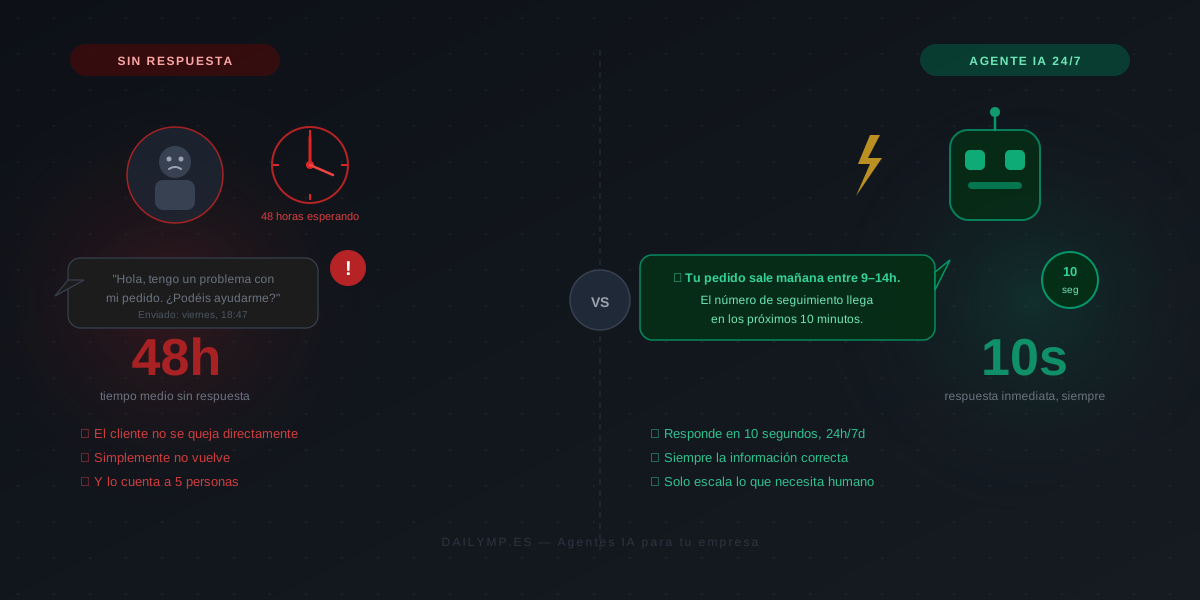
Your Client Has a Problem. Nobody Answers.
Think about the last time you contacted a company with a problem.
You call. A recorded voice: "all lines are busy." Hold music. Someone finally picks up, asks for your name and order number, transfers you. You repeat everything from the beginning. The agent doesn't have your history. Eventually they tell you they'll call back. They don't.
Now ask yourself: how many of your clients are going through exactly this with your business right now?
The Problem You Don't See Because Nobody Tells You
Here's the trap: the client who has a bad customer support experience almost never complains directly. They don't call to tell you your support is a disaster. They just stop coming back.
And then they tell two people what happened. Sometimes five.
More than 60% of consumers have stopped buying from a business after a poor support experience. The most painful stat: most don't leave a negative review. They simply disappear.
Your business can have the best product, the best price. But if a client can't find a fast and useful response when something goes wrong, none of that matters.
What Actually Happens in a Real SMB When a Client Needs Help
The most common scenario isn't that nobody is available. It's that there's no system that works without depending on a specific person.
When the person who normally handles support emails is on holiday or having a busy day, messages pile up. When a client writes at 7pm on Friday, nobody sees it until Monday. When three people are handling messages on rotation, each gives a slightly different answer to the same question.
The result: the client doesn't know when they'll get a response, whether the information is accurate, or whether anyone is actually dealing with their case.
That's not a people problem. It's a systems problem.
And the distinction matters, because the solution isn't to try harder or hire someone to watch the chat — it's to build a system that doesn't depend on someone being available.
What Changes With Automated Customer Support
An AI support agent doesn't replace your team. It handles everything that doesn't require human intervention — which, in most businesses, is between 60% and 80% of all enquiries:
- When does my order arrive?
- How do I cancel or make changes?
- What's the return process?
- Something isn't working — what do I do?
- Are you available on this date?
The agent responds in seconds — at 3am if needed — with accurate information about your business, through whichever channel your client already uses: WhatsApp, email, your website. Only when the query is genuinely complex or requires a human decision does it escalate to your team.
And it's always consistent. No off days. No forgotten follow-ups. No "I'll call you back" that never comes.
You can learn more about how this works on our AI agents and automation for businesses service page.
The Real Difference in Your Client's Experience
Before: your client sends a message, waits, doesn't know if anyone has seen it, asks again, gets frustrated, starts considering alternatives.
After: your client sends a message. In 10 seconds they have a useful response. If they need more, they know exactly what will happen and when. The feeling they're left with is of a business that has things under control.
That's invaluable in terms of trust. And it has a very calculable cost when it's missing.
If you have 50 active clients and lose 3 per year due to poor support — conservatively — and each client generates €1,500 annually, that's €4,500 per year disappearing without anyone in your business logging it as "loss due to poor support." That client just isn't there anymore.
How We Implement This in Your Business
You don't need to rebuild your customer support from scratch. When we work on this with a business, the typical process is:
- We analyse the enquiries you receive: emails, WhatsApp messages, frequent calls. In most businesses, 70% are variations of the same 10 questions.
- We build the agent with your company's knowledge: policies, products, pricing, processes. If you use Odoo, HubSpot, Notion, or any other tool, we connect it.
- We integrate it where your client already is: no need to change channel.
- Your team stays involved for cases that genuinely need them — with more time available and better context when they step in.
For more on how this connects to your existing tools, our AI integration for businesses page covers the full process.
Most businesses have the agent live in under three weeks.
Real Results
Businesses that have implemented this system have seen response times drop from hours to seconds, their support teams freed from repetitive queries, and measurable improvements in client retention.
The comment we hear most after the first month: "I didn't imagine it would be this simple to set up."
The irony is that before automating, that same business was living exactly the chaos we've described above.
What to Do Next
If your business serves clients — and if you've read this far, it does — at some point someone will have a problem and won't find a quick answer. How often that happens each week, and what it's costing you, you probably don't know exactly.
But you can start changing it today.
Want to talk about setting this up for your business?