What Your Business Has Been Doing Wrong for Years
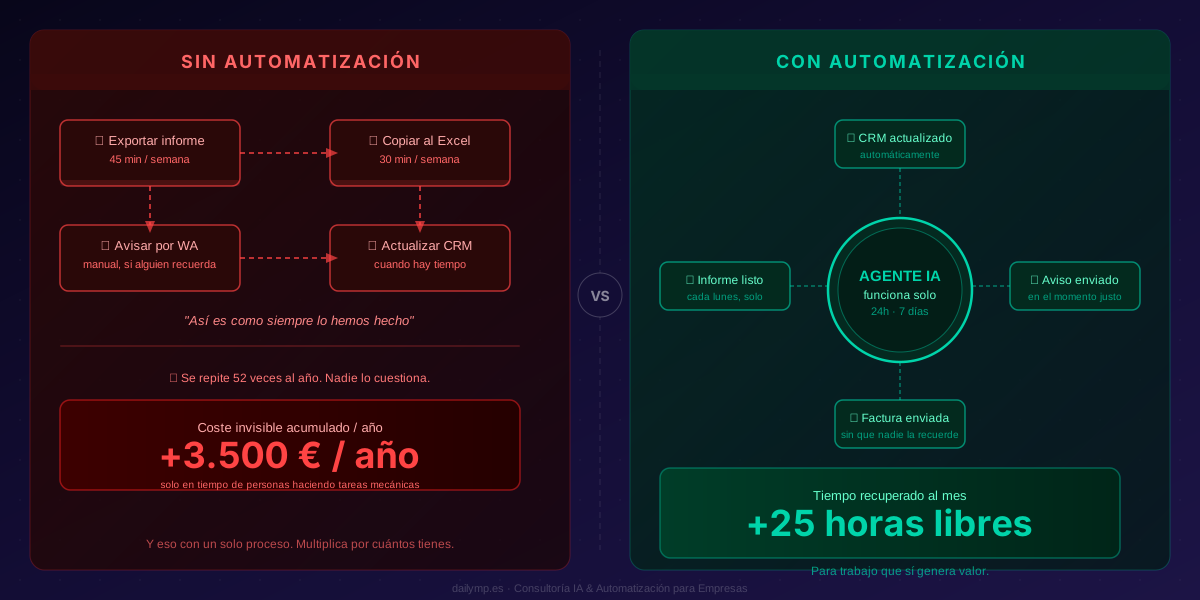
There's a process in your business that's been done the same way for years. Nobody quite knows why it works that way. "That's just how we do it here," "it's always worked," "it doesn't really take that long." And so, week after week, someone spends time on something that either shouldn't exist or could run on its own.
That's normalized chaos. Not the dramatic crisis kind. The other kind — the one that no longer looks like chaos because you've lived with it so long it's become invisible.
What Normalized Chaos Sounds Like
It has very recognizable phrases:
- "First thing Monday, someone manually exports that report and sends it by email."
- "When a new order comes in, we have to message Sarah so she can log it."
- "If I'm not in the office, nobody knows how to handle that."
- "We should automate it eventually, but for now we do it this way."
Sound familiar? Probably. And you've probably stopped seeing it as a problem, because the business keeps running anyway.
That's exactly the issue. These phrases carry a price nobody has calculated.
What This "Normal" Chaos Actually Costs
Let's run the numbers with a concrete example.
Suppose someone in your business spends 45 minutes every Monday morning putting together last week's sales report. They pull data from three different places, paste it into a spreadsheet, add a couple of charts, and email it to the management team.
It's routine. Nobody questions it.
But 45 minutes a week is 39 hours a year. If that person earns £30,000 a year, that's roughly £800 in salary spent exclusively on moving data that already exists in other systems. No analysis. No judgment. Just copy and paste.
And that's just one process. Now think about how many processes like that your business has. Five. Ten. Twenty.
The "that's how we do things here" has a real cost. It's spread across people, across tasks, across hours nobody labels as "inefficiency" because they're just part of normal work. But they add up. And they add up to far more than they seem when you look at each one in isolation.
Why Nobody Questions It
There's a very clear reason normalized chaos survives: it works well enough.
Not well enough to be ideal. But well enough that it doesn't feel urgent. The business moves forward, clients pay, the team works. Why change what isn't broken?
The problem is that "not broken" and "working well" are different things.
A process that costs three times what it should isn't broken. It works. But it carries a hidden cost that grows with time, with volume, and with team size.
And there's another factor almost nobody mentions: the person doing it has no incentive to question it. It's their job. Changing it would mean admitting they've been doing something suboptimally for years. Or worse — that their role might evolve. So the process survives. And the business pays for it.
The Three Broken Process Types We Always Find
When we analyze a business's operations, three patterns appear almost without exception:
The bridge process. Someone transferring information from one system to another because the systems don't talk to each other. The CRM and the spreadsheet. The order management system and the invoicing software. Email and the project tool. There's always a human acting as the connector between tools that could be integrated.
The manual reminder process. Someone who has to remember to do things: send a quote follow-up, remind a client that their invoice is due, notify the team when a project status changes. If that person drops the ball — or goes on holiday — nothing happens. The sale falls through. The client drifts. The project slips.
The weekly report process. Someone who collects data from different places, consolidates it, and presents it. Every week. The same thing. With enough variation that you can't even record a tutorial and walk away.
All three have something in common: they don't require human judgment. They're mechanical processes that a person executes because nobody ever configured them to run on their own. And meanwhile, that person could be doing something only they can do.
What Changes When You See It for the First Time
Most business owners and managers who work with us say the same thing after the first analysis session: "I had no idea how much time this was taking."
It's not that they didn't know the process existed. It's that nobody had ever added up the hours. Nobody had calculated the annual cost. Nobody had asked the obvious question: could this run on its own?
At DAILYMP, the first thing we do with every business is identify exactly those processes. Not the ones that are obviously candidates for automation — those tend to be on someone's to-do list already. The other ones. The ones that have been "normal" for so long they've become invisible.
With the integration of tools you already use, many of these processes can disappear within weeks. Not by replacing systems. Not by training your team on new tools. Just by connecting what already exists so it works without anyone having to intervene.
Real Results
In the projects we carry out, the normalized processes we identify and automate free up an average of 15 to 30 hours per month per business. Often considerably more, when several bridge processes have been accumulating for years.
Time that goes back to the team for real work: serving clients, improving the product, closing more deals.
And the most common thing we hear after implementation: "We'd been doing it that way for three years. Now we can't understand why we ever did it that way."
The Question Worth Asking Today
What process in your business has been done "this way" for more than a year without anyone questioning it?
That specific task — the one you just thought of while reading — is almost certainly automatable. It doesn't require a big project. It doesn't require changing what works. It just requires someone to look at it with fresh eyes and ask: what would happen if this no longer needed a person to run?
In 30 minutes, I can tell you how many hours and how much money that process is costing your business — and whether there's a fix. There almost always is.