You Have Clients Who Cost More Than They Pay.
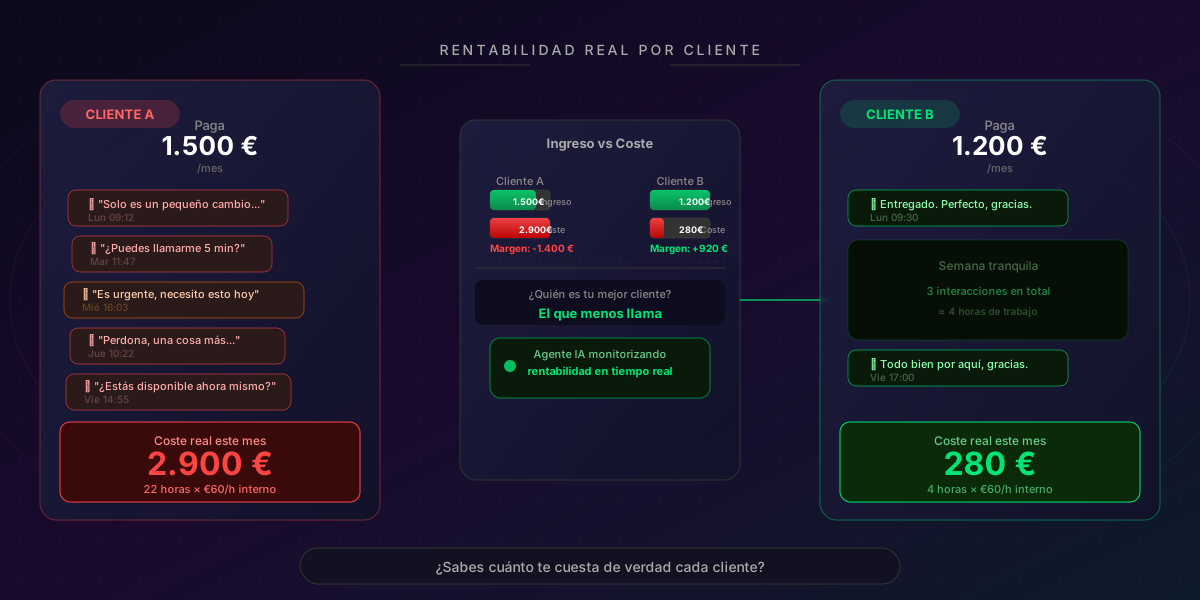
It's Monday morning and the first thing you see when you open your phone are four messages from Client A.
One from Friday evening you never got to. Two from the weekend — "no rush, just when you can." And one from forty minutes ago: "sorry, can you call me when you get in?"
You've had that client for three years. They always pay on time. You consider them a good client. But if you could add up the hours you and your team have spent on them this month — follow-up calls, last-minute changes, clarifications on things already explained, adjustments that "weren't much" — you'd be in for a surprise.
Almost nobody tracks that. And that's exactly the problem.
The Invisible Time That Never Shows Up on an Invoice
There's a gap between what your business charges and what it costs to serve each client.
What you charge is on the invoice. What it costs is spread across dozens of small interactions that nobody adds up: a fifteen-minute call here, an email that needed thirty minutes to answer there, a "quick update" meeting that took an hour from two people, an urgent fix that interrupted someone's more important project.
Each one, on its own, seems minor. Added up over the month, they can be twenty hours. Twenty-five. Sometimes more.
At an internal cost of €40 to €60 per hour, those twenty hours are between €800 and €1,200 that never appear on any invoice.
That client paying €1,500 per month could be costing you €2,500. The margin you thought you had doesn't exist. You're working with almost no profit on that account — or outright at a loss — without knowing it.
Why Businesses Don't Catch This
It's not a lack of interest. Measuring the real cost per client would require someone to manually log every interaction with every account. That doesn't happen in any 10 to 50-person company because no one has time to do it — and because in the moment each interaction happens, it seems like a minor expense not worth tracking.
The result: all decisions about pricing, renewals, and client portfolio are made based on perception, not data.
"They're a good client" because they pay on time. "It's an important account" because they've been with you for years. "We can't raise the price" because of the relationship. But nobody knows whether that relationship is actually worth it.
Meanwhile, Client B — the one who barely calls, requests changes within the agreed scope, and signs off on invoices without pushing back — gets the same level of attention as the one interrupting your team three times a week with urgencies.
What Happens When You Don't Have This Information
The year ends. Renewals come around. What do you base next year's price on?
What you charged last year. Maybe with a small inflation bump. With zero data on what it actually cost to serve that account.
If the client was especially demanding that year, that's not recorded anywhere. The renewal price doesn't reflect that extra service. The next contract year starts the same: same rate, same client, same behavioral pattern, same hole in your profitability.
And without that visibility, it's impossible to know who your most profitable clients are. So when you look to grow, you might be chasing more clients exactly like the ones that cost you the most — because they're the most vocal, the ones who refer others, the ones who feel like they value you.
Without data, expansion can make things worse.
How AI Makes Visible What You Can't Track by Hand
This is where a well-planned integration comes in.
We're not talking about your team starting to log hours in an app — that won't happen consistently. We're talking about systems that capture effort automatically, without anyone needing to do anything extra.
An AI agent connected to your existing tools can automatically log:
- Emails exchanged with each client (volume, response time, complexity)
- Support or follow-up conversations by channel (WhatsApp, Slack, internal chat)
- Video calls and their duration, linked to the corresponding client
- Support tickets or changes requested outside the agreed scope
All of that becomes a monthly report per client: how much they brought in, how much they cost, what the real margin was. Without anyone filling it in manually.
With that AI integration into your current operations, the information you needed to make good pricing and portfolio decisions starts to exist. And it does so without changing how your team works.
What Changes When You Have That Visibility
First, you identify the problem accounts. There are usually two or three in any mid-sized portfolio that consume disproportionately.
With that information, you have real options. You can adjust the price at the next renewal, adding a component for the actual service level being delivered. You can redesign the contract so out-of-scope work has an explicit cost. You can have the conversation with the client from a completely different place: not "we want to raise prices" but "look at what we've done for you this year — and what the rate should reflect."
And if the client doesn't accept the new terms, you have data to evaluate whether that account is worth the effort it requires. Sometimes the answer is no. That's also valuable information.
On the other side, you identify your most profitable clients — the ones who pay well, generate little support overhead, and trust your judgment. Those are the clients you want to attract more of. You can use them as a benchmark to sharpen your commercial positioning and look for similar profiles.
Your team's time goes to the clients who actually pay for it.
The Cost of Staying in the Dark
Every month that passes without this visibility is a month of lost margin that won't come back.
It's not money that was taken from you. It's money you stopped earning because of missing information — a subtle but important distinction, because the solution isn't to work harder or ask more of your team. It's to understand what's happening with the data that already exists in your business.
Most businesses we work with discover in the first few weeks that they have two to four clients consuming 40% of their support time while generating only 15% of revenue. Once seen, that ratio can't be ignored.
Want to know what that analysis would look like for your business? Tell me where you're at and we'll work through it together: reach me directly on WhatsApp.