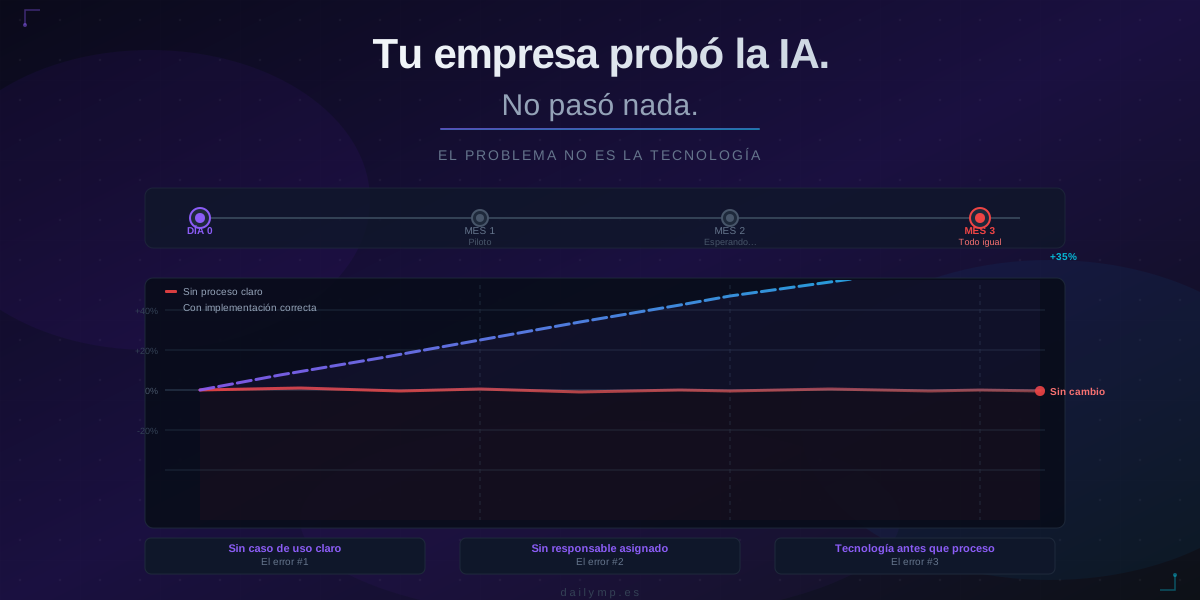
Your Company Tried AI. Nothing Happened.
This may sound familiar: for months you had been hearing that AI was going to transform businesses. At some point this year, you decided it was time. There was a meeting. Someone suggested ChatGPT, someone else mentioned automations. You signed up for a couple of tools. You ran a pilot.
Three months later, everything is exactly the same.
It is not that you failed. It is that nobody told you what it actually takes for AI to work inside a business.
Why AI does not produce results in most SMEs
The problem is not the technology. ChatGPT works. AI agents work. Automations work. The problem is almost always the same: the company starts with the technology instead of starting with the problem.
When a business says "we want to use AI", it is often looking for answers before it has defined the questions. And that usually ends the same way: lots of tests, zero impact.
What works is exactly the opposite: first identify a specific process that costs time or money, and then decide which part of that process a machine can do better than a person.
The three most common mistakes in the first few weeks
1. No clear use case
"We want to use AI to improve customer service" is not a use case. "We want to automate the first response to enquiries that arrive by email outside business hours" is.
The difference between those two sentences is what separates companies that see results from those that do not.
2. No clear owner
If AI implementation is everyone's responsibility, it is nobody's responsibility. In most projects that do not move forward, the process was delegated to someone who already had too much on their plate, or it stayed in limbo because nobody clearly owned the initiative.
3. Expecting results without changing processes
AI does not improve a broken process. It accelerates it. If your customer management is already chaotic, adding an AI tool to that chaos will not bring order. You need to understand the process first, simplify it, and then automate it.
The mistake nobody warns you about before you start
Most companies that fail with AI start by asking: "What tools are available?"
The companies that get results start by asking: "Which process is costing us the most right now?"
It may sound like a small difference. It is not.
When you start from the tool, you end up adapting your business to the technology. When you start from the problem, the technology adapts to your business. That shift in orientation changes everything.
How to find your first real AI use case
The right question to find where to start is this:
What task does someone on your team repeat three or more times per week, with the same type of input, producing the same type of output?
If you can answer that with a specific activity, you have your first use case. These are some examples we see again and again in SMEs:
- Answering frequent customer questions that are always the same: opening hours, prices, availability, order status
- Generating weekly reports by copying data from one tool to another
- Following up on quotes sent with no response
- Classifying and routing incoming emails to the right department
- Creating meeting summaries with assigned tasks and owners
None of these require advanced technology or an internal development team. All of them can be solved with AI agents and automations that are already running in companies similar to yours.
Real results when the starting point is right
When the implementation process is properly designed, the first results do not appear in six months. They appear in two or three weeks.
A service company automated the follow-up process for pending quotes. Result: its close rate went from 18% to 47% in the first month, without hiring anyone new and without changing its pricing.
A logistics company connected its systems to an agent that automatically replies to shipment tracking enquiries. Result: the customer service team went from handling more than 40 daily emails to reviewing only 8 cases that actually needed human attention.
These are not exceptional cases. This is what happens when AI integration is done with a clear process, a specific use case and someone who has already done it before.
What determines the result
The difference between companies that fail with AI and those that get results has nothing to do with size, sector or budget. It has to do with the starting point.
The ones that fail start with: "How do we use AI?"
The ones that work start with: "Which process is costing us the most money or time right now?"
If you have spent months without seeing results, it is not too late to start again. You just need to start from the right place.
What is your next step?
The first conversation costs nothing. In 30 minutes, we identify together which process in your company makes the most sense to automate first, which solution fits the way you work, and what you can realistically expect to see in the first few weeks.
No jargon. No selling you something you do not need. Just an honest conversation about whether AI can help you and how.