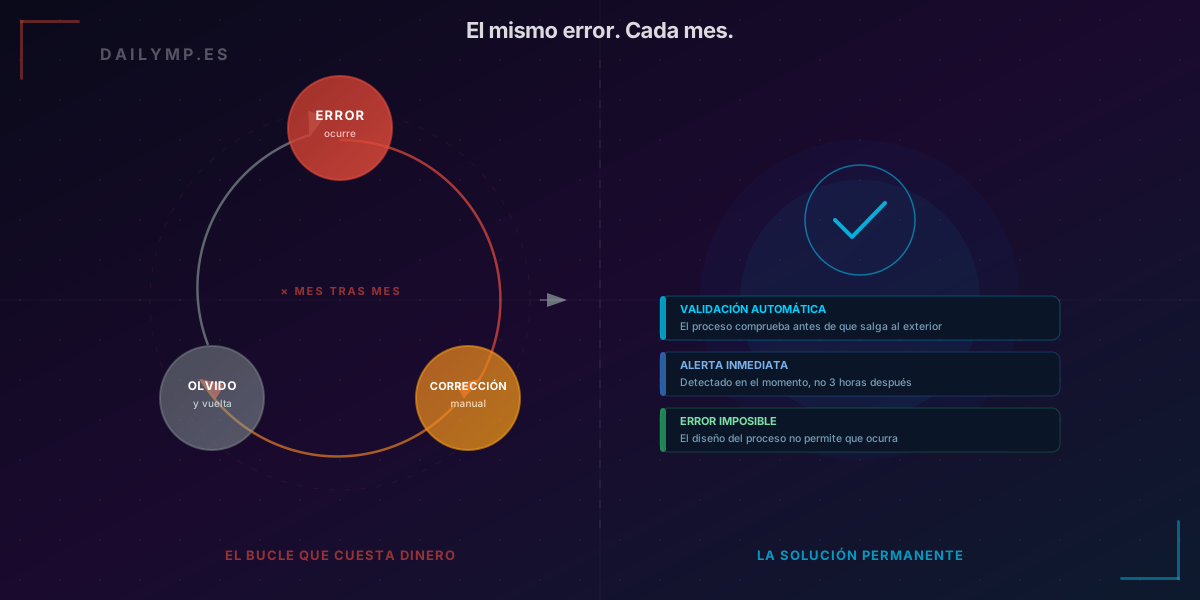
Your Business Makes the Same Mistake Every Month
At some point in the last three months, someone on your team said these exact words: "Not this again."
Maybe it was an order that went out wrong for the same reason as last time. A report sent to the wrong client. An invoice with last year's pricing. A double booking someone had to sort out at 5pm on a Friday.
The mistake isn't new. It happened before. It got fixed, someone apologised, it came up in the next team meeting. And then it happened again.
This isn't a criticism of your team. It's a description of what happens when a process has no automatic checkpoint — and almost no process does by default.
A recurring mistake is not a people problem
The typical response when a repeated error surfaces is to find out who's responsible. Who did it this time? Why didn't they check? Why did it happen again after we discussed it?
Those questions miss the real issue.
If a mistake happens once, it could be an isolated slip. Twice — bad luck. Three or more times under similar conditions? That's a process design problem, not a people problem.
The process has no point where anything automatically checks that each step is being done correctly before the output reaches the customer, supplier, or finance system. It relies entirely on someone remembering every step, in the right order, without skipping anything — regardless of whether they're having an overwhelming day, covering for a colleague, or juggling three urgent things at once.
That works fine under ideal conditions. In a real business, ideal conditions are the exception.
What that "familiar" mistake actually costs
Here's something curious about recurring errors: because everyone's seen them before, they create a false sense of control. "Oh, we know what this is. We handle it." But handling is not the same as solving.
The mistake is still happening. And it has four layers of cost that most businesses have never calculated — because they're spread across tasks that feel like normal work:
The direct cost. The order that needs re-processing. The service you can't bill because it was delivered wrong. The materials wasted. The discount offered to make it right. In most cases, somewhere between €50 and several hundred euros each time.
The correction cost. The person who notices, the person who flags it, the person who manages the client fallout, the person who reprocesses it, the person who updates the system. Often two to four people, each spending between thirty minutes and two hours fixing something that shouldn't have happened. That time has a real cost even if it doesn't appear on any invoice.
The trust cost. A client seeing it once might chalk it up to a one-off. Seeing it twice starts to look like a pattern. The trust you spent months building erodes with repetition. Clients often don't say anything — they just quietly take their business elsewhere.
The team morale cost. A team that corrects the same errors repeatedly, without the underlying conditions changing, develops cynicism. "This always happens" isn't just a complaint. It's a signal that someone has stopped believing things can actually work better. That has a measurable cost in productivity and retention.
Why manual processes always fail the same way
There's a specific reason recurring errors don't disappear even when everyone knows they exist: the process depends on someone's memory.
When the critical check — the one that would prevent the error — isn't automated, one of three things happens:
Someone does it when they have time and focus. When they're overloaded, they skip it or rush it.
Someone does it when they remember it needs doing. When the day is chaotic, they don't remember.
Someone does it when they have the mental bandwidth to be thorough. When they're exhausted or stressed, they move on to the next item on the list.
This isn't laziness or lack of professionalism. It's that human memory is not a reliable quality control system. It's not designed to be. And if your quality control depends entirely on someone remembering to do a manual check, you will have errors. Always.
How to structurally eliminate a recurring mistake
The good news: the solution doesn't require replacing people or overhauling all your tools. It requires adding checkpoints to the process that work regardless of whether anyone remembers to activate them.
There are three practical ways we do this with businesses:
Automatic validation before the process moves forward. If an order leaves with a required field empty, the system holds it instead of letting it through. A human doesn't catch it an hour later — the process catches it the moment it happens, and doesn't advance until it's correct.
Cross-system verification. When two pieces of information that should match don't — the price in the quote versus the price in the invoice, the client name in the CRM versus the email about to go out — the system fires an alert before it reaches the outside world. No one needs to manually review: the check happens automatically, every time, without exception.
Step-by-step logging and traceability. Not to find someone to blame when something goes wrong, but to know exactly which step in the process is where the error enters. If the mistake always happens at the same point, that's where the design problem is — and that's where to intervene, not with the person executing that step.
The AI automation agents for SMBs we build at DAILYMP turn these checks into permanent parts of the process. They're not reminders someone can ignore — they're conditions the process cannot skip.
What changes when the check runs itself
The businesses that add automatic controls to their most error-prone manual processes eliminate most of their recurring mistakes within the first month. Not because the team suddenly improves — but because the process can no longer proceed if something is wrong.
The other result no one anticipates: the team works better. When people stop spending time catching and fixing errors the system should have prevented, they have more capacity for work that actually requires their judgement.
If there's a mistake that appears in your business with regularity, it won't be fixed by training or team discussions. It needs an automatic checkpoint — one that runs every time, not just when someone remembers.
With AI integration into your existing tools, that checkpoint can be live without replacing the systems you already use. You're just connecting the gaps where the error enters and adding the check that's missing.
One concrete question for this week
What's the mistake that happens most regularly in your business?
You probably don't need to think long. You already know what it is. If you give it a name and count how many times it's happened in the last three months — then multiply by the cost of each occurrence — you'll have a number that almost nobody in your company has ever calculated.
That's what an automated control eliminates. Not every error — but most of them, from day one.
If you want to know what that recurring mistake is actually costing you, and what would change with an automated process, I can analyse it in 30 minutes and tell you exactly what's possible.
Let's analyse the mistake that keeps happening in my business →