You Could Have More Clients. But You're Not Looking.
There are business owners who don't look for more clients. Not because things are going badly. But because they know exactly what would happen if new clients arrived.
There's no meeting where that decision is made. No moment where someone says "let's stop growing." It just happens: campaigns don't get launched, the sales team doesn't push hard enough, the last big opportunity was passed on with "now isn't the right time."
And "now isn't the right time" has been the answer for two years running.
The Ceiling Nobody Drew But Everyone Feels
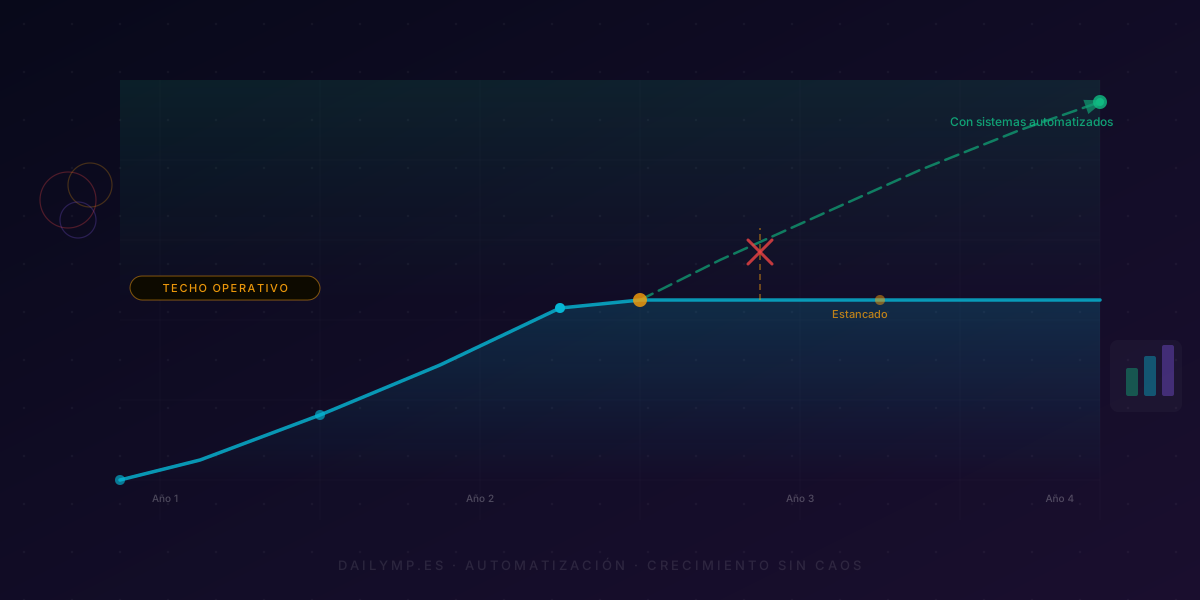
There's a number of active clients your business can handle before everything gets complicated. Before deadlines start slipping, the team starts complaining about the workload, mistakes increase, and you end up back in the middle of daily operations solving things you should be able to delegate.
That number isn't written anywhere. But it exists. And your business has already found it.
Companies that have grown and watched that growth turn into chaos know this well: more clients to manage, more coordination, more things to monitor, more points where something could go wrong. They learned the lesson the expensive way: growing without systems isn't growing — it's multiplying your problems.
The result is that the instinct now is to pump the brakes before reaching that point. Not taking that large project. Not running the campaign that would bring more volume. Not hiring a salesperson because you don't know if you could handle what they'd bring in.
The logic makes sense. But the cost of that brake is enormous, and almost nobody calculates it.
What Not Growing Actually Costs You
The cost of growing with a system that can't handle it is visible. You feel it: the chaos, the stress, the mistakes, the exhausted team.
The cost of not growing is invisible. It doesn't show up on any invoice. There's no alert to warn you. It just means the year ends with the same revenue as the year before, the same structure, the same people doing the same things.
And there's a feeling many business owners recognize: the business works, but it's not moving forward. Revenue stabilizes at a number that's comfortable but hasn't changed in three years. The growth from the early days has stalled. Not because the market changed. But because the business hit its operational ceiling and stopped pushing.
That ceiling has a concrete price. Every month without growing is a month where the business that could exist doesn't. And that gap accumulated over three years of stagnation far exceeds what it would cost to fix the system.
What You Lose While Waiting for the "Right Moment"
Think about the last big project you passed on. The client with more volume than usual. The campaign you would have launched if you'd had the infrastructure.
How much was that contract worth? And the one before?
Now multiply that by the months you've been making the same decision. The opportunity cost isn't abstract. These are real contracts that went to another company that did have the system to handle them.
It's not that your competition is better. It's that their operations can handle more. And that difference — invisible from the outside — is what determines who grows and who stagnates.
What Separates Companies That Actually Scale
It's not the market. It's not luck. It's not hiring more or better people.
What separates companies that keep growing from those that stagnate is concrete: they have systems that don't break when more clients come in.
These aren't complicated systems. They're processes that run on their own: the proposal that gets generated and sent at the right moment, the follow-up that happens without anyone having to remember it, the new client onboarding that doesn't depend on someone having time to manage it, the team coordination that doesn't require you to be at the center of every decision.
When those processes run themselves, bringing in three new clients doesn't mean multiplying the workload. It means multiplying revenue with the same structure you already have.
The ceiling rises. Not because you hired more people — but because what used to take two people several hours now happens automatically in minutes.
The Moment Something Changes
The difference isn't noticeable on the day you automate the first process. It shows up three months later.
It shows up when someone proposes a large project and instead of your instinct saying "we can't handle this right now," your first thought is "what do we need to do this well?"
It shows up when you come back from holiday and the business kept running: clients were attended to, processes moved forward, nobody called you with emergencies. Not because your team is perfect — but because there are systems that work whether or not you're there.
It shows up when your sales team starts pushing without you having to hold them back. Because for the first time in a while, you have the capacity to handle what they bring.
At DAILYMP we help SMBs raise that ceiling: we identify which processes are limiting your growth capacity and build the systems that make them run on their own. No complicated technology. No platform migrations. Just automations connected to the tools you already use.
Real Results
What business owners tell us most, three months after implementing these systems, isn't how many hours they've saved.
It's that they've stopped being afraid to grow.
Companies that had been stuck at the same revenue level for two or three years — with the same feeling that more clients meant more chaos — start closing contracts they would have previously turned down. The change wasn't in selling better. It was in being able to deliver what they were already capable of selling.
If This Sounds Familiar
If there are opportunities you've passed on in the last few months because you sensed you couldn't manage them, that's not business prudence.
It's a signal that your system has a limit your market no longer has.
And that limit isn't a lack of people. It's a lack of processes that run on their own.
It has a solution. And in most cases, it can be built in less than a month.
Let's talk about how much your business can grow with the right system →