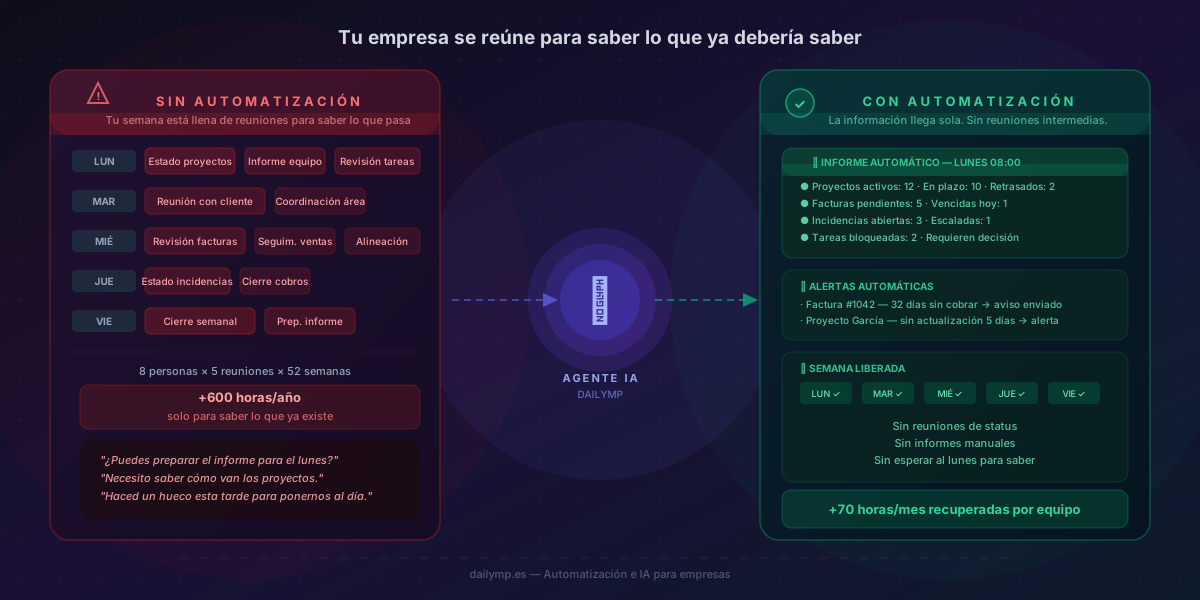
Your Business Meets to Learn What It Should Already Know
It's 9 AM on Tuesday. You've been in a status meeting for forty minutes. Someone is sharing a spreadsheet, walking through last week's projects row by row.
You're there because otherwise you wouldn't know what's happening. They're there because otherwise you wouldn't know. No decision has been made yet. The meeting ends. There's another one on Thursday.
What you just read isn't a complaint about meetings. It's a diagnosis: every time you need to meet just to learn what should already be visible, you have a systems problem, not a scheduling problem.
The Type of Meeting That Shouldn't Exist
Not all meetings are the problem. The ones where difficult decisions get made, conflicts get resolved, visions get aligned — those have real value.
The problem is the other kind. The ones that exist only to update the status of something that has already happened:
- The Monday meeting to see how projects are going
- The Tuesday meeting for each team to report on last week
- The Friday meeting to "close the week" and review pending tasks
- The client meeting where they tell you the same thing you already sent in writing
Those meetings don't create any new value. They're the cost of not having a system that shows that information without anyone needing to report it out loud.
And that cost is enormous — even though almost nobody has actually calculated it.
What One Status Meeting Hour Really Costs
Count the number of people in your weekly status meeting. Multiply by the duration. Multiply by the weeks in a year.
A business with 8 people holding a one-hour weekly status meeting is consuming 8 hours of work per week. 32 hours a month. Nearly 400 hours a year. Just to transmit information that already exists somewhere.
And that doesn't count prep time: the time someone spends before each meeting gathering what they're about to present. For a one-hour meeting, that's usually 30 to 90 minutes of preparation.
The real cost of that weekly status meeting in an 8-person company can exceed 600 hours per year. In people-hours at average salaries, that's more than €10,000 a year. Paid out in meetings to learn things that should already be available.
Why These Meetings Exist — and Why Nobody Cancels Them
The reason is simple: there's no other way to find out what's happening.
If you want to know where the Garcia client project stands, you have to ask Sarah. If you want to know how many invoices are outstanding, you have to ask someone for the report. If you want to know whether the team is overloaded, you have to hold a meeting and ask.
The meeting isn't the problem. It's the consequence of not having visibility. And as long as you don't have automatic visibility into what's happening in your business, the meeting is the only alternative.
Nobody cancels them because, without them, you'd be even more in the dark.
What You Need So They're No Longer Necessary
The right question isn't "how do I eliminate these meetings." It's "how do I get information to be available without someone having to report it."
The answer has three parts:
Data has to flow automatically. When a project advances, the system the team uses needs to record it. When an invoice gets paid, the accounting software needs to know. When a client replies, the CRM needs to update. Without anyone doing anything extra.
Information has to consolidate itself. It's not enough for data to exist somewhere. Something needs to cross-reference it, summarize it, and present it usefully. The weekly report that someone currently builds over two hours needs to generate itself, with current data, without human involvement.
Alerts need to arrive without being requested. When something is wrong — a project falling behind, a client not responding, an invoice 30 days overdue — someone needs to find out without needing a meeting to discover it.
This is exactly what we implement with AI integration in your current tools: connecting what your business already uses so information flows automatically to whoever needs it, without status meetings in between.
A Concrete Example
A 15-person services company had a status meeting every Monday morning. It ran 60 to 90 minutes. All department leads attended.
The content was always the same: each lead reported what had happened with their projects the previous week, any incidents, and what was pending. The director took notes. Final review of urgent items.
We implemented a system where every Monday at 8:00 AM, before anyone arrived at the office, the director received an automatic report with the status of all active projects, open incidents, outstanding invoices, and tasks marked as blocked. In five minutes, they could see everything the ninety-minute meeting was trying to cover.
The meeting became monthly. The ninety-minute Mondays disappeared. The team recovered more than 70 hours per month between everyone.
And something else: decisions that previously depended on the meeting — because it was the only time the information was available — could now be made when they needed to be made. Immediately. Without waiting for Thursday.
For You, Who Have Meetings This Week
Your company's status meetings won't disappear on their own. But there's a way to know whether they're necessary or just a symptom:
Ask yourself: if someone in my business knew in real time what was happening with every project, every client, every outstanding invoice — would this meeting still be necessary?
If the answer is no, you have a visibility problem. And that problem has a solution.
With the AI automation agents for SMEs we implement, your business information stops living in people's heads and conversations and becomes available wherever and whenever you need it.
No meetings to learn it. No time lost reporting it. Just the information, when you need it.
If you have meetings this week that could be an automatic report instead, let's spend 30 minutes together and I'll tell you exactly which process to change first in your business.