You Don't Know Your Real Profit Per Project. Fix That.
You finished the project. The client approved it. You sent the invoice. They paid.
Did you make money? How much, exactly?
If your honest answer is "I think so" or "I'm not entirely sure," keep reading. Because that uncertainty is probably costing you money every single month — and you don't even see it.
Most service businesses share the same blind spot: they know what they invoice, but they don't know what each project actually costs them. That gap — between what comes in and what really went out — is the margin nobody is tracking.
You Set Prices Without Knowing If They Work
How does your company set prices?
In most SMEs it's some mix of: "what the competition charges," "what feels reasonable," "what this client seems willing to pay," and "what we charged for something similar last year."
None of those answers is your real cost.
Your real cost includes the hours nobody logged: the meeting that ran two hours over, the last-minute revisions the client requested, the senior person who jumped in to solve something outside the original scope. It includes the tools used specifically for that project. It includes the coordination and management time that nobody bills but somebody pays.
When that calculation doesn't exist, pricing is a bet. Sometimes you win. Sometimes you don't. The problem is you don't know which one it is until you've been doing it for months.
Some businesses have been pricing below their actual costs for years. Not because of poor management — but because nobody ever connected the data that already existed to run that calculation.
You Have Clients Who Are Costing You Money Without Knowing It
Think about your most demanding client right now.
The one who calls twice a week to ask for updates. The one who requests changes after the project was signed off. The one with bi-weekly check-ins that always turn into mini-renegotiations. The one who always has "one more thing" at the end of every email.
Do you know how many actual hours their account has consumed this year?
If you don't have that number — if nobody in your company can tell you exactly how much time that client has cost versus what they've paid — then you don't know if they're a good client or one of your worst.
The most common trap is confusing "biggest invoice" with "most profitable."
A client who pays €20,000 a year but consumes 600 hours of your team is a completely different margin than one who pays €8,000 in well-scoped projects that close in 40 hours. The first one looks better in your sales report. The second one probably is better in your actual profitability. But without data, you can't know.
And the real cost isn't just the time — it's what that time isn't doing. Every hour spent on a low-margin client is an hour not going to work that actually pays off.
Without Data, Every Decision Is a Guess
Which types of projects should your company specialize in? Which client profiles have the best margins? Should you raise prices on any service? Is there work you should stop taking on altogether?
Without profitability data by project, you can't answer any of these questions confidently. You can only guess.
The result is a business that grows — in revenue, in clients, in headcount — but doesn't know if it's growing healthily or accumulating projects that don't close well. And that uncertainty has real consequences: wrong pricing decisions, poorly allocated resources, and teams working hard on work that doesn't pay.
The data to fix this already exists in your business. It's in the hours logged in your project management tool, in the invoices in your accounting system, in your tool costs. The problem is that nobody has connected it so it becomes visible.
What Changes When You See Your Margins in Real Time
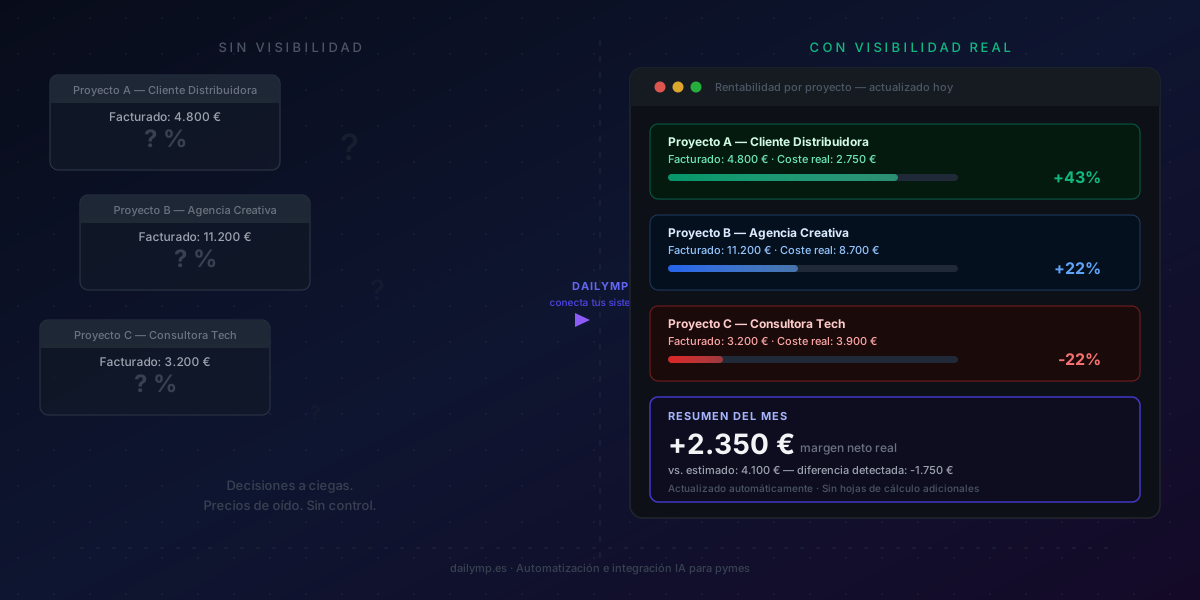
Imagine opening a dashboard this morning and seeing, for every active project:
- What you've invoiced so far
- What it's actually costed you (hours × cost per role + tools + subcontracting)
- The current margin and how it's trending
And for every client:
- Their average profitability over time
- Which projects went well and which didn't
- A clear signal when a project is drifting below the expected margin
That's not magic. It's information that already exists in your systems — just scattered, disconnected, unread.
With that level of visibility, you go from managing by gut feeling to managing by data. You can raise prices on services you've been undervaluing. You can identify your most profitable client profiles and align your outreach toward them. You can catch in real time when a project is going sideways — before it's too late to do anything about it.
At DAILYMP we connect the tools you already use — your project management system, your time tracking tool, your invoicing software — so that calculation happens automatically, without anyone building a spreadsheet by hand every month. In under two weeks, you have real profitability visibility running on your actual data, at the level of detail you need.
Real Results
Companies that start seeing their real project profitability consistently find three things:
One or two projects that were clearly below cost. Not because the team did poor work — but because pricing was set without data and actual hours exceeded estimates without anyone seeing it until the project closed.
A client consuming disproportionately more resources than they appear to. Once you see it in numbers, the conversation about price or scope becomes much easier. It's not intuition — it's a figure.
The ability to raise prices with a solid foundation. When you know your real margin on a type of project is 18% and your sector works at 35%, you have internal grounds to adjust. Before having that data, the pricing conversation was always uncomfortable and imprecise.
One Concrete Question Before You Go
How much did you actually make on your last closed project?
Not what you invoiced. What was left after accounting for everything it cost.
If you can't answer that in under a minute, this is the moment to change it.
Tell me how you track costs now and I'll show you what can be visible in 30 days →