Your AI agent pipeline fails silently. Here's why.
You deployed the pipeline three days ago. Everything shows green in the logs. This morning a client calls: 47 records have incorrect data.
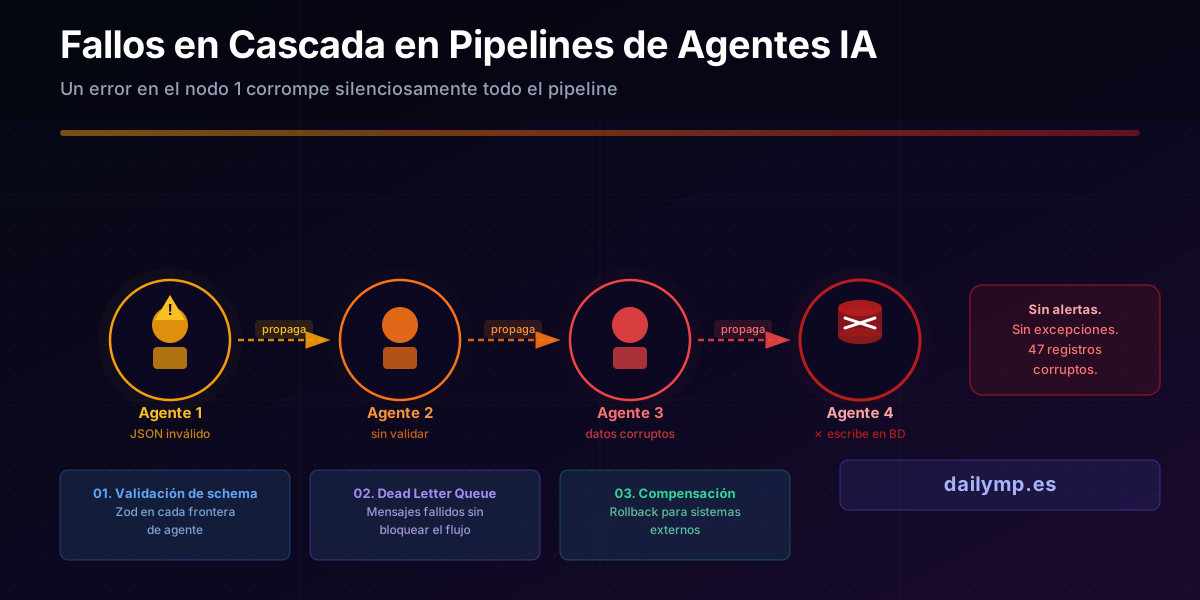
You check the logs again. No exceptions. No timeouts. No visible errors. Agent 1 passed a JSON with an empty field to Agent 2. Agent 2 processed it as-is. Agent 3 did too. And Agent 4 wrote that corrupted JSON to the database, confident it was doing exactly what it was supposed to.
This is a cascading failure in an AI agent pipeline. And it's the hardest type of error to catch in production because it never throws an exception — it just propagates bad data in silence.
Why agent pipelines fail differently than monoliths
In a traditional monolithic system, an error is local. A function throws, the stack trace tells you exactly where and why. The damage is contained.
In a multi-agent pipeline, the architecture fundamentally changes the nature of failure. Each agent is an independent process that trusts the output of the previous one. If Agent 1 returns something structurally valid but semantically wrong — a JSON with the right field but an empty value — Agent 2 has no way to know. It processes what it receives. Same for Agent 3. Agent 4 writes to the database.
Result: a small error in node 1 becomes data corruption in node 4, with no alerts firing anywhere.
This gets especially serious when agents have write access to external systems: databases, third-party APIs, email systems, CRMs. A single bad input can generate dozens of incorrect records before anyone notices — usually because a client calls.
Pattern 1: Schema validation at every agent boundary
The first defensive pattern is treating every agent-to-agent transition as an external system boundary. Just as we validate inputs at a REST API before processing them, we need to validate what enters each agent.
import { z } from "zod";

const CustomerSchema = z.object({
  id: z.string().uuid(),
  email: z.string().email(),
  plan: z.enum(["free", "pro", "enterprise"]),
  metadata: z.record(z.string()).optional(),
});

type Customer = z.infer<typeof CustomerSchema>;

async function agent2EnrichCustomer(raw: unknown): Promise<EnrichedCustomer> {
  // Validate BEFORE processing — never trust the previous agent
  const customer = CustomerSchema.parse(raw);

  // If parse() throws, the error is caught here, not 2 nodes downstream
  return await enrichFromCRM(customer);
}
With Zod (or any schema validation library), if Agent 1 returns an empty field where a UUID is expected, the error throws exactly at the transition point, with a stack trace pointing directly to the problem — not 3 nodes later when the damage is already done.
This seems obvious. It's absent in most pipelines we audit. The justification is always the same: "the previous agent already validates that." No. Each agent must assume its input could be corrupted.
Pattern 2: Dead letter queue for failed messages
Validation catches errors at transition points, but what do you do with the failed message? If you simply throw and halt the pipeline, messages queued behind also get blocked.
The correct pattern is a dead letter queue (DLQ): a separate queue where messages that couldn't be processed go, without blocking the main flow.
type PipelineMessage = {
  id: string;
  payload: unknown;
  attempts: number;
  lastError?: string;
};

async function processWithDLQ(
  message: PipelineMessage,
  processor: (payload: unknown) => Promise<void>,
  dlqWriter: (msg: PipelineMessage, err: Error) => Promise<void>
): Promise<void> {
  try {
    await processor(message.payload);
  } catch (error) {
    const err = error instanceof Error ? error : new Error(String(error));

    if (message.attempts >= 3) {
      // After 3 attempts, park in DLQ for manual review
      await dlqWriter({ ...message, lastError: err.message }, err);
    } else {
      // Retry with exponential backoff
      await scheduleRetry({ ...message, attempts: message.attempts + 1 });
    }
  }
}
With this pattern, problematic messages don't block the pipeline — they're parked in the DLQ for review. The team can inspect what failed, correct the message, and reintroduce it manually if needed.
If you're using Supabase as your database in an AI integration project, a agent_dlq table with fields payload, error, created_at and resolved_at gives you a complete record of all failures without additional infrastructure.
Pattern 3: Compensation for irreversible actions
The two patterns above prevent error propagation. But what about what already executed before the failure was detected?
In classic database transactions, you can rollback. In agent pipelines that interact with external systems — sending emails, calling third-party APIs, modifying CRMs — there's no rollback. The email already went out. The order was already created in the vendor's system.
The solution is the compensation pattern: instead of undoing, execute explicit opposite actions for each step that completed before the failure.
type PipelineStep = {
  execute: () => Promise<void>;
  compensate: () => Promise<void>; // opposite action if a later step fails
};

async function executePipelineWithCompensation(
  steps: PipelineStep[]
): Promise<void> {
  const executed: PipelineStep[] = [];

  try {
    for (const step of steps) {
      await step.execute();
      executed.push(step);
    }
  } catch (error) {
    // Run compensations in reverse order
    for (const completedStep of [...executed].reverse()) {
      await completedStep.compensate().catch(console.error);
    }
    throw error;
  }
}
This pattern isn't hard to understand, but it's expensive to add to an existing system. Every pipeline step needs its compensation defined from the initial design. Added as an afterthought, it's almost always incomplete — exactly when cascading failures cause the most damage because external systems already hold incorrect state.
What it costs to retrofit resilience into a live system
These three patterns are easy to understand. They're difficult to add to a pipeline that's already processing real messages.
Retrofitting schema validation into an existing pipeline without breaking inter-agent contracts takes 2-4 weeks of specialized work. Adding a DLQ with retry logic and the operational dashboards to manage it: another 2 weeks. The compensation pattern, depending on how many external systems the pipeline touches, can extend to a full month.
At DAILYMP, we design AI agent pipelines with these patterns from day one — not as hardening work added later, but as part of the base architecture. The reason is straightforward: building it right from the start costs 5 times less than remediating it after a client calls and the data is already corrupted.
If you have an agent pipeline in production and you don't know exactly how it behaves when a node fails, that's the right question to ask before you scale it.
Silent failure is the most expensive kind
An error that throws an exception is easy to fix. An error that silently processes incorrect data for 72 hours costs client trust and weeks of corrective work.
AI agent pipelines don't behave like traditional systems. Inter-node validation contracts, failed message queues, and compensation patterns aren't optimizations — they're the difference between a system that scales and one that fails in production without warning.