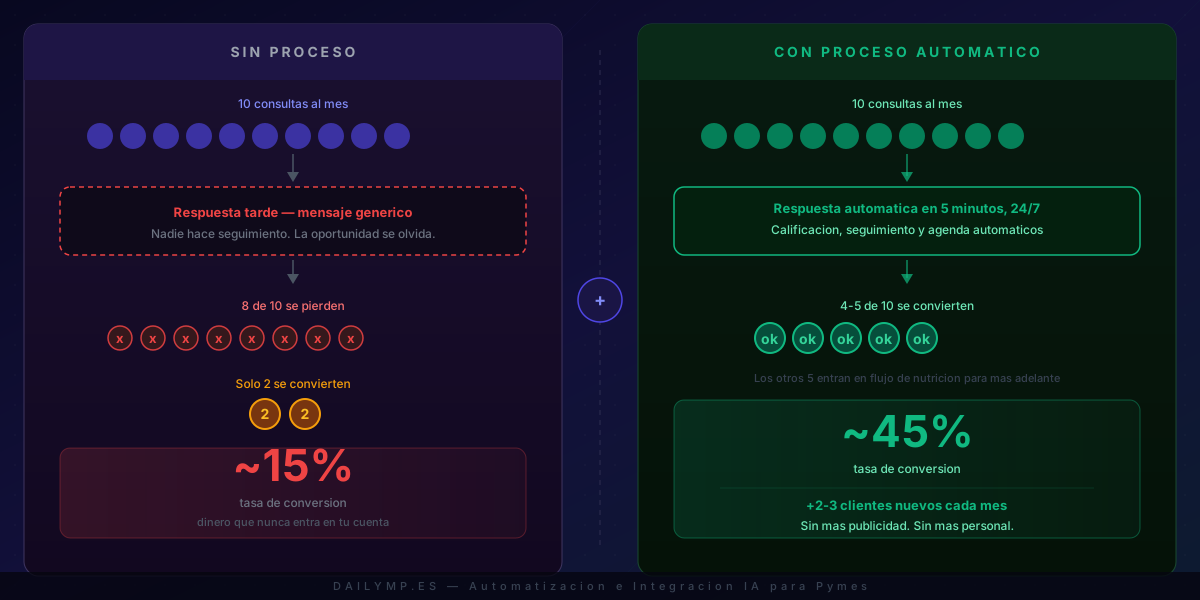
You Get Inquiries. Few Become Clients.
Last Monday someone visited your website. They read what you do, liked what they saw, and sent you a message asking whether you could help with a project.
What happened next?
If your business is like most, here's the likely answer: the message landed in a shared inbox nobody monitors urgently. Someone spotted it hours later and replied with "Thanks for reaching out, we'll be in touch soon." Then moved on to the next task.
The prospect waited. Got the same generic reply from two other companies that same day. By Wednesday, they had a call booked with the one that responded well and fast.
You'll never know they chose you first.
The window you don't see closing
There's a B2B sales statistic that's been consistent for decades: responding within the first 60 minutes multiplies the chances of converting an inquiry by seven. At two hours, the probability drops significantly. By 24 hours, many prospects have already decided — just not with you.
This isn't about impatient customers. It's about how decisions are made when someone is actively evaluating options: the first business to respond with something genuinely useful gains a serious advantage. And once that window closes, it doesn't reopen.
In your business — how long does it take between someone submitting your contact form and receiving a real, useful response? And what does that response actually say?
If the honest answers are "it depends on who's free" and "the standard welcome message," that's why conversion stays low.
What happens without a process — step by step
The pattern repeats across most businesses with 10 to 50 people:
The inquiry arrives. It lands in the general inbox, the website form, the WhatsApp account. Someone sees it when they can, which usually means after some time has passed.
A generic reply goes out. "Thanks for your interest, we'll follow up shortly." No questions to understand what they actually need. No information that helps them decide. No clear next step.
The prospect doesn't know what to expect. When will they hear back? Tomorrow? Next week? In that uncertainty, they start looking at alternatives.
Nobody follows up. Three days later, if the prospect hasn't responded, nothing reminds anyone to reach back out. The opportunity sits in an inbox until it quietly disappears.
At the end of the month, nobody knows how many inquiries came in or how many were lost. No record. No tracking. Just a vague feeling that "things have been a bit slow lately."
That's not a process. That's the absence of one.
The math nobody does
Pick a number. How many inquiries do you get per month?
Say ten, for round numbers.
Without a response-and-follow-up system, conversion from inquiry to client typically sits between 10% and 20%. With a well-designed automated process — fast response, qualification, structured follow-up — that rate usually climbs to 35%–50%.
If your average service is worth €2,000 and you receive ten inquiries a month, the difference between converting 15% and 40% is €5,000 more per month. €60,000 a year. Without extra marketing spend. Without hiring anyone new. Just by having a process where there wasn't one before.
You didn't lose that money all at once. You lost it inquiry by inquiry, over months or years. That's why it never registered as a loss.
Why the process never gets built
The reason most businesses don't solve this isn't lack of desire. It's timing.
The moments when you receive the most inquiries are exactly the moments when the team is most occupied. When business is good, there's no time to build a better system for handling it. When business slows, the problem feels less urgent because there's less volume.
The result: the process never gets built. Something more urgent always comes first.
So every week, inquiries arrive and get handled however they get handled — depending on who's available, how much time they have, and how they happen to feel that day.
Systems built on goodwill break when you need them most. Precisely when inquiry volume spikes — after a campaign, entering a peak season, when the business starts to grow — is when the informal approach falls apart.
What changes with an automated process
Imagine that when someone submits your contact form, this happens within the next five minutes, with no manual effort from your team:
The prospect receives a response that isn't generic. It's adapted to what they asked, with two or three specific questions to understand their situation, and a clear next step: book a call, access relevant information, or see exactly how you could work together.
You receive a notification with a summary of the inquiry and how interested they appear to be. No need for anyone to read and manually process the message.
If the prospect doesn't respond within 48 hours, they get a follow-up message. Different from the first. Useful, not pushy. It reopens the conversation without pressure.
If they're interested but "not right now," they enter a nurturing flow that keeps your business present over weeks or months — without anyone needing to remember to check in.
Human involvement comes when it actually matters: when the prospect is ready to talk, with full context on what they need and where they are in the decision process.
This is exactly what we build at DAILYMP through our AI capture and sales automation agents: a system that turns every inquiry into a managed opportunity, regardless of who happens to be available at that moment.
Real results
Businesses that implement an automated response and follow-up process see two changes within the first month:
Response time drops from hours to minutes. Not because the team works faster — because the system responds the moment an inquiry arrives, any time of day.
Conversion rates rise by 20–35% compared to the previous baseline. Not by magic. Because now every inquiry receives the same well-designed process, instead of depending on whoever's available that day.
And there's a third effect: the team arrives at each conversation with more context. They know what the prospect asked, what they replied, where they are in the decision process. Conversations go straight to the point.
The concrete question for today
Do you have a record of the inquiries that came in over the last three months?
Do you know how many became clients — and how many didn't?
And of those that didn't convert, how many received at least one follow-up message?
If you don't have precise answers, you have a process that runs on inertia. And inertia-based processes break when context changes — more work, someone out sick, twenty inquiries in one week.
The solution isn't hiring someone to respond to inquiries. It's building a system that responds well, every time, without depending on who's free.
With the integration of your current channels — web form, email, WhatsApp — that system can be running in under two weeks.