Your Business Works 9 to 6. Your Competitors Work 24/7.
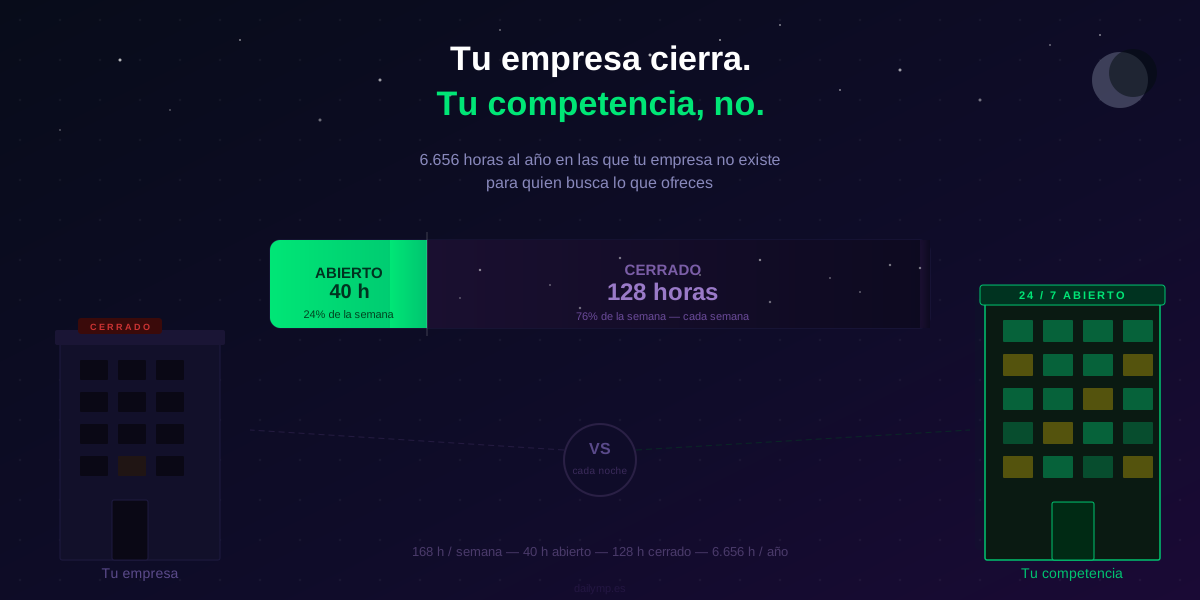
This week, your business will be open 40 hours. And closed 128.
Not a criticism — a mathematical reality. There are 168 hours in a week. Eight hours a day, five days, is 40. The remaining 128 hours, your business simply doesn't exist for anyone searching for what you offer.
Over a year, that's more than 6,600 hours closed. 277 full days during which, if someone looks up your service, compares options, or has a question, there's nobody on the other end.
And here's the real problem: those 128 hours aren't empty. They're full of people searching for providers, comparing prices, making decisions. The market doesn't stop when you do.
What Happens During the Hours You Don't See
I'm not just talking about someone sending a message at 10 PM and having to wait until morning. That's a response-time problem.
I'm talking about something different: the silent research phase that happens before that message ever gets sent.
The person who asks for a quote on Monday morning didn't find you on Monday morning. They found you Sunday afternoon. They compared your website to three other providers Sunday night. Read reviews. Checked pricing. And arrived Monday having already made a preliminary decision about who they want to talk to.
That decision was made when you weren't there. What did your business do to influence that moment?
If the answer is "the static website and nothing else," your business loses ground every weekend, every evening, every night — against competitors who do have something active when you're closed.
Your Competitors Aren't Working More Hours. They Have a System.
I don't mean a large company with night shifts and an on-call team. I mean a business your size — or smaller — that has an active system running when you're not.
When someone lands on their website on a Tuesday at 10 PM with a question, something responds. Not a human: a system ready to provide useful information, collect the contact, and leave the case documented for a person to pick up in the morning with full context.
When someone searches for their service on a Saturday and makes an enquiry, that interest gets logged, they receive a response within minutes, and it sits on a list someone reviews Monday.
They're not working more hours than you. They've systematised what you leave to chance.
And the visible result of that difference: when you arrive Monday morning, they already know who's interested. You start from scratch.
Calculate What Being Closed Is Costing You
Do the maths with your own numbers:
- How many enquiries do you receive per month? (forms, emails, WhatsApp messages, calls)
- What percentage do you estimate arrive outside business hours? In professional services and B2B, it's typically 30–60%.
- What's your average client value?
If you receive 20 enquiries per month and 40% arrive outside hours, that's 8 enquiries per month finding your business closed. If your average ticket is £2,000 and you convert 30% of the enquiries you handle well, you're passing up the chance to close two or three clients every single month.
Not because your service is inferior. Not because your pricing is wrong. Because there was nobody on the other side when that potential client was making their decision.
The Cost That Never Shows Up in Any Report
What makes this problem especially invisible is that you can't see it. You don't get a notification saying "three people asked questions last night and no one responded." Those people simply never become your clients. And you have no way of knowing how many there are each month.
The clients you lose this way don't complain. They don't leave a negative review. They just go somewhere else, and you never know they existed.
What It Means to Have a System Working When You're Not
I'm not suggesting you hire someone to work nights. I'm suggesting something different: a system that does three specific things when you're unavailable.
Receives and logs. Any enquiry that arrives outside hours gets documented with all the relevant information.
Responds with something useful. Not a "thanks, we'll be in touch" that says nothing. A response with real information about your service that creates the feeling that your business is there and someone will handle the case.
Leaves the work ready for morning. When you arrive at 9 AM, there are no unprocessed messages. There's a summary of who contacted you, what they need, and what the next step is. You start the day with opportunities, not an inbox to clear.
This is what we build at DAILYMP with automation agents: systems that cover availability gaps without you hiring anyone or changing how your team works during normal hours.
The integration with your existing tools — your email, your website, your business WhatsApp — means it works from day one without friction.
The Question That Deserves an Honest Answer
How many hours a week is your business active for someone searching for you?
If the answer is 40, there are 128 hours every week where your automated competitor has an advantage over you. Not because they're better. Not because they're cheaper. Because they're there and you're not.
You don't need to solve everything at once. But it does make sense to know exactly what that gap costs you — in real money, with your actual numbers, every month.
Tell me how many hours your business is closed and we'll work it out together →
In 30 minutes we'll look at when your enquiries actually arrive, what's happening outside hours in your specific case, and whether it makes sense to build something to cover that gap. No obligation, no technology pitch — just your business numbers on the table.