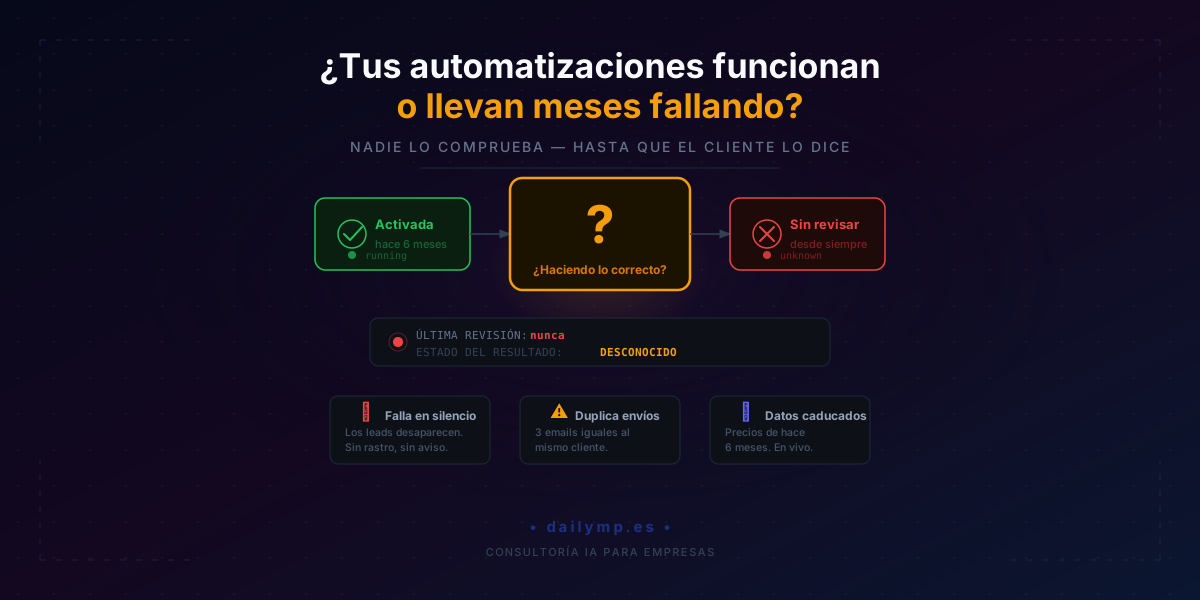
Your Automations Are Running. Are They Actually Working?
Think about the last automated process you activated in your business. Maybe it's the bot that responds to website inquiries. The flow that sends a welcome email to each new client. The system that generates the weekly report and sends it to your team. The follow-up sequence that reaches out to quotes that haven't responded.
When did you last check that process is still working correctly?
Not that it's still "running." That it's still doing what it's supposed to do — with the right data, without repeating things it shouldn't, without missing things it should.
If the answer is "when I first set it up," there's a problem you may not have calculated yet.
The Automation Nobody Watches Works Alone... Until It Doesn't
An automation doesn't break with a bang. There's no alert. No message saying "I've stopped working." Most of the time it stays active, keeps executing, keeps appearing to run fine.
What changes is the output. And if nobody checks the output, the problem can run for weeks or months without anyone noticing.
There are three ways an automation fails without warning:
It fails silently. A field in your lead capture form changed. The bot keeps running, but the data it receives no longer matches what it expects. Leads keep hitting the form, but none reach your CRM. Eleven weeks later, you're wondering why lead volume has dropped. The answer has been waiting for you.
It fails by duplicating. Something in the scheduling or logic causes the same process to run more than once. The client receives three identical emails in two minutes. The supplier gets the same order twice. Your team gets the same report four times before Monday. Not a critical error in itself — but the damage to trust and perception is real.
It fails with stale data. The automation keeps running, but it's been sending outdated prices, terms that no longer apply, or information from a previous version of your catalog. The client receives an offer you can't honor. The automation worked. The problem is what it did.
Calculate What It's Already Cost You Without Knowing
Here's the exercise nobody wants to do — but should do at least once.
Pick an automation you have running. Now ask yourself: if it had been failing for the past two months, how would you have found out?
If the answer is "when a client told me" or "when I checked it manually," you have a system without oversight. And without oversight, there's no way to know if it's failing right now.
In lead capture, a broken bot running for ten weeks could mean dozens of inquiries that never reached you. Not to a competitor — just gone. No trace. No complaint. Just a lead number that seems low and that nobody connects to the automation.
In client communication, a process that duplicates messages or sends incorrect data creates an impression that doesn't show up in metrics — but does show up in the decision to buy from you again or not.
In internal processes, a weekly report that's been calculating wrong or an approval flow that got stuck means someone on your team made decisions with incorrect information. And that has a cost that doesn't appear in any dashboard either.
Add those up. For most SMEs that already have some level of automation, the cost of running processes without oversight far exceeds the cost of building them correctly from the start.
The Mistake Almost Every Business Makes When Automating
Setting up the automation feels like the job. What comes after — verifying it's doing what it should, reviewing results, making sure it stays accurate when things change — doesn't get planned as part of the process.
It's the equivalent of hiring someone new, explaining what to do on day one, and not speaking to them again for six months.
No business would do that with an employee. But most do it with their automations.
An automation without oversight isn't a system that works on its own. It's a system that might be failing on its own.
What Changes When You Have Real Supervision
The difference between an automation that runs and one that works well isn't in the code. It's in whether someone — or something — is checking the output.
A well-built system doesn't just execute the task. It logs what it did, alerts when something goes wrong, and has periodic review points where someone confirms the result is correct.
That means you find out about problems before your client does. You have a record of what the automation did and can audit it. When something changes in your business — a form, a price, an internal process — someone updates the automation so it stays accurate.
If you have automated processes running in your business and you don't know with certainty whether they're producing the right results right now, the first step is an audit of what you have. Our AI integration for business service starts exactly there: reviewing what already exists before building anything new.
And if what you need is a system that monitors its own processes and alerts you when something fails, AI agents for SMEs are the piece that turns an automation into a process with real supervision.
Tell me what automations you have running and we'll check if they're working →