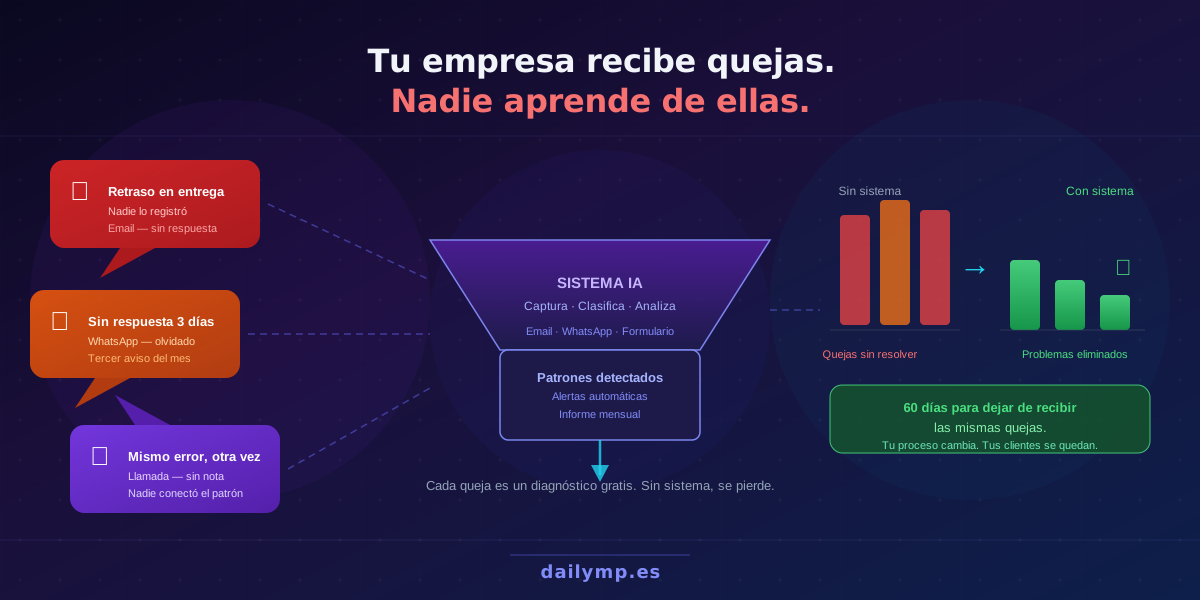
Your Business Gets Complaints. Nobody Learns From Them.
Yesterday, one of your clients left frustrated. Maybe they emailed. Maybe they sent a WhatsApp message. Maybe they just stopped replying.
Someone handled it. Calmed them down. Or tried to.
What nobody did: write it down anywhere. Classify it. Analyze it. Connect it to the complaint that arrived three months ago for the exact same reason.
The Invisible Problem With Complaints That Have No System
The complaints your business receives aren't isolated incidents. They're data. They're the most honest diagnosis you can get about what's actually breaking in your operation.
But without a system to capture, classify, and group them, that diagnosis disappears into the noise.
Here's what typically happens:
- A complaint arrives by email to one team member. They handle it as best they can. No record.
- Another comes via WhatsApp to the salesperson. Resolved. Forgotten.
- A third arrives by phone. Someone makes a mental note. The note vanishes.
- A month later, another client complains about the same thing. Nobody connects the dots.
Your business is receiving the same warning from different clients, at different times — and nobody is listening to it as a pattern.
What Repeats Without Anyone Noticing
Some businesses lose clients for the same three reasons for years. They don't know it because no one has connected the dots.
Delivery delays. Information that doesn't arrive on time. Misunderstandings about quotes. The contact person who takes too long to respond.
These are real problems with real solutions. But you can only solve them when you see them as recurring patterns — not one-off incidents.
Without a system, every complaint is treated as if it's the first time it's happened. Because for whoever handles it that day, it is the first time. They don't have access to the history. They don't know it happened before.
The Concrete Cost of Not Seeing It
Put numbers to it. If your business loses two clients per year over problems that had already sent warnings before leaving — with an average ticket of €2,000 — that's €4,000 a year walking out the door because you had no system to connect the signals.
If the ticket is higher, the cost is higher. If the clients leaving are your largest ones, the cost is disproportionate.
And that's without counting what can't be measured: reputation, referrals that never happen, clients who never complained and simply left without saying a word.
What Changes When Complaints Have a System
It doesn't have to be complicated. It doesn't require cutting-edge technology. It requires that when a complaint arrives — through any channel — it ends up somewhere it can be seen alongside all the others.
That someone — or something — classifies it. That if it's unresolved after three days, an alert fires. That at month-end there's a report showing which problems repeated.
That's it.
With that information, you can do something you currently can't: prioritize what to fix first based on what's actually damaging your client relationships.
A business with this running doesn't fix problems blindly. It fixes them in order of impact. And when it solves one, that type of complaint stops coming in.
The AI automation agents we implement at DAILYMP can centralize complaints coming in via email, WhatsApp, web forms, or phone — transcribing voice notes, categorizing messages, assigning follow-ups — without your team having to do anything extra.
The Moment It Becomes Clear
There's a moment when all of this becomes obvious. It usually happens when you review the history with a client who's threatening to leave, and you realize they've been sending signals for six months that nobody collected.
That conversation is the most uncomfortable one to have. Because you can't promise it won't happen again if you don't know why it happened.
And you don't know why it happened when the history is scattered across emails from three different people, WhatsApp messages on four phones, and mental notes nobody remembers.
Integrating AI with your customer service tools turns that scattered chaos into a single view. Complete history for each client, the problems they had, how they were resolved, and how long they took.
When that difficult conversation comes, you have answers. And when a new client asks how you work, you can tell them you have a process. Because you do.
One Question Before August Arrives
Do you know which complaint repeats most often in your business?
If you need more than ten seconds to answer, you don't know. And if you don't know, you can't fix it.
In August, teams go on holiday. Complaints don't. Clients don't either. If you don't have a system managing them while your team rests, you'll come back in September with the same problems you had in July — plus a month's delay on top.
In 30 minutes, I can tell you which part of your client service process can be automated, and which recurring problems you probably have without realizing it.