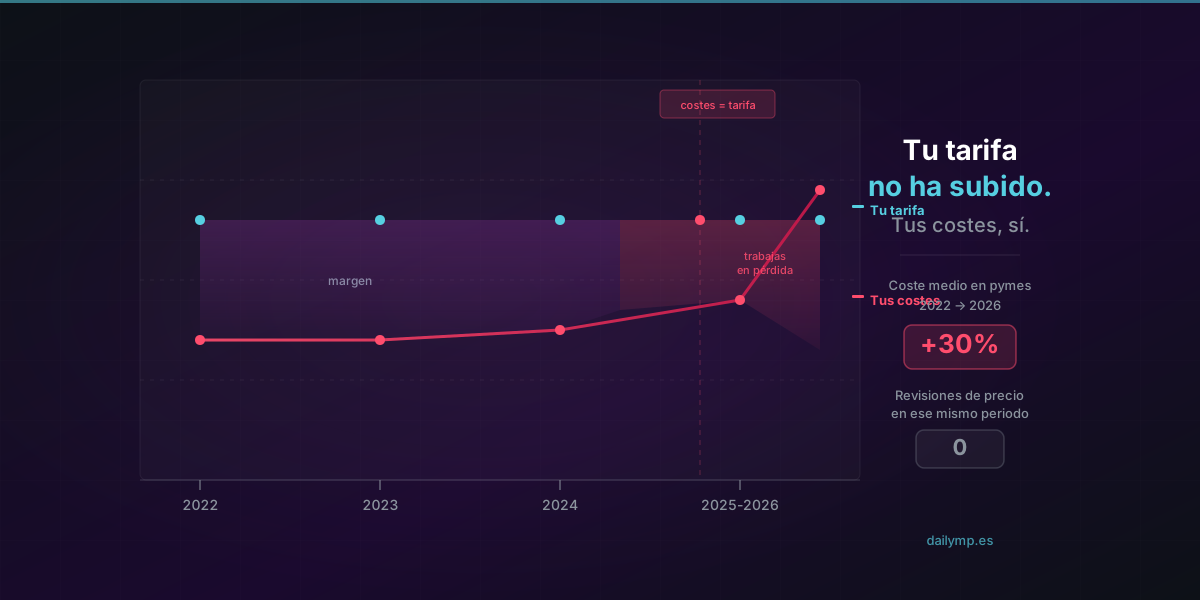
Your Prices Haven't Moved in Years. Your Costs Have.
You've been sending the same invoices for years. The number at the bottom hasn't changed. And that, whether you realize it or not, is a decision — to let inflation, rising tool costs, salaries, and overhead quietly eat your margin without anyone sounding the alarm.
Nobody sounds the alarm because you have no system in place to do it. And that's how many businesses reach the end of the year working just as hard as always, billing just as much as always, and earning noticeably less than before.
What Has Changed Since You Set Your Price
Over the last two to three years, the cost of running a business has risen steadily. Not all at once, not with a warning. Quietly, line by line.
Salaries have gone up. Minimum wages have increased and the talent market has tightened. If you have people on your team, you're paying more for them than you were three years ago.
Tools have gone up. Every subscription you rely on — CRM, design, project management, storage, communication — has increased between 20% and 40% since 2022. You've probably accepted each price-hike notice without doing the math.
Energy and services have gone up. Fixed costs have climbed if you run any kind of physical space.
Subcontractors have gone up. If you rely on external providers to deliver your services, they've revised their rates too. You haven't.
The result: a project that cost you €800 to deliver in 2022 now costs €1,100. But you're still charging €1,500, same as before. Your margin has dropped from €700 to €400. You haven't noticed because the invoice number looks the same. Only what's left after has changed.
The Calculation Nobody Does
Here's the real problem: most small businesses don't have a clear cost per project or per service. They know how much they bill. They don't know how much they earn on each individual thing they sell.
Do you know how many real hours your team spends on a typical project? What does that hour actually cost when you factor in salaries, taxes, tools, management overhead, and coordination time? Is there a service you're delivering below cost without knowing it?
If you don't have those answers, you're not making a pricing decision. You're letting time make it for you.
And time has decided you should work more for less.
Why You're Not Raising Prices (And Why That Fear Has No Basis)
The most common objection is always the same: "if I raise prices, I'll lose clients."
The data says otherwise. When you raise prices in a thoughtful, communicated way, the percentage of clients who leave is far smaller than you expect. And those who stay are, in general, the ones who are the best fit for what you offer.
What does happen when you don't raise prices: you end up selecting clients by price, not by quality. You attract whoever is looking for the cheapest option — the client who demands the most and leaves the least margin. And you can never invest in doing things better because there's no room.
The other argument is "I don't know what to charge." That's a real problem. But it doesn't get solved by staying still. It gets solved by calculating your actual cost and adding the margin you need for the business to work.
How to Start Without an Accounting Degree
You don't need a complex cost-accounting system. You need three basic things:
First, know what a real hour of work costs you. Not just gross salary. Include employer contributions, prorated tools, internal meeting time, management, and overhead. That number is typically 40% to 70% higher than it looks.
Second, track actual hours per project. Not estimated. Actual. Simple tools do this automatically, and AI integrations can connect that data to your invoicing system so you see in real time whether a project is profitable or not.
Third, review your rates once a year. That's it. One annual check where you look at current costs, real margins by service, and market pricing. What isn't reviewed doesn't get adjusted.
If you want to automate that monitoring — so the system alerts you when a project is consuming more hours than budgeted, or when a service margin drops below the threshold you've set — that's exactly what we build with AI automation agents connected to your business data.
The Money You're Leaving on the Table
Imagine you offer five services. One of them — one you've sold well, one with solid demand — turns out to cost more to deliver today than you charge for it. You've sold it ten times this year. Each time, you've lost money without knowing it.
That's not an edge case. It's what happens when prices don't keep up with costs.
The good news: it's fixable. Not overnight, not traumatically. With an honest review, a gradual adjustment, and — if you want — systems that alert you before the problem compounds.
The Decision Nobody Makes Until It Hurts
Reviewing your prices isn't a conversation anyone enjoys having. But the alternative — never reviewing them — has an exact cost, even if it doesn't show up on any line of your invoice.
If it's been more than a year since you last looked at what you charge, this week is a good time to start. And if you want to understand your actual margins before making any decision, I can help you build the picture.