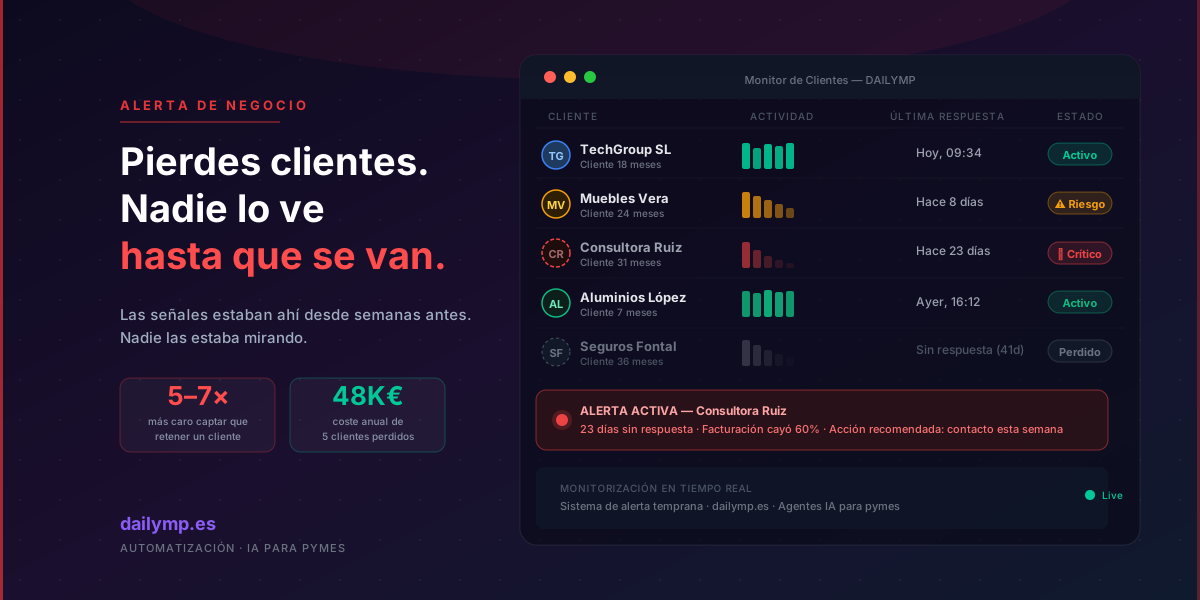
You're Losing Clients. Nobody Notices Until They're Gone.
You have sixty active clients. This month, three of them are going to leave.
They won't tell you. There'll be no cancellation email, no explanation, no final conversation. They'll simply stop responding. Or their project requests will get smaller. Or the next renewal just won't come.
And by the time you notice, they'll have already signed with someone else.
The silent client departure is the most expensive
There are two kinds of clients you lose. Those who leave with noise: they complain, they request meetings, they give you one last chance. Those ones hurt, but at least you see them coming.
And then there are those who leave in silence. No drama, no conversation, no obvious signals. One day they're simply gone.
These are the most expensive. Because by the time you realize something was wrong, the relationship was already damaged. They'd already looked at alternatives. They'd already made the decision mentally weeks before you received any signal.
The business didn't know. No alert went off. Nobody checked the patterns. The client just disappeared.
What your business isn't measuring
When a client is about to leave, they leave signals. Always.
- They take longer to reply to your emails than they did six months ago
- Their orders or project requests are getting smaller
- The usual contact has changed: the director no longer writes to you, now it's an assistant
- Meetings get postponed more and more
- When you do speak, the tone is colder or more clipped
- They've stopped engaging with anything you send them
None of these signals, in isolation, is conclusive. Together, they're a map of a client who's in the process of leaving.
The problem is that in most businesses, nobody is looking at that map. Not because they don't care — but because nobody has the time or the system to cross-reference that information.
What it's costing your business not to see it
Put a concrete number on it. Say the average ticket for an active client is €800/month. You have sixty clients. You lose five per year without catching it early — that's a typical figure for service-based SMBs.
Those five clients represent €4,000/month leaving the business. €48,000/year.
Then add the cost of acquiring replacement clients. Acquiring a new client costs five to seven times more than retaining an existing one. If you redirect that budget toward recovering at-risk clients before they leave, you completely change the equation.
A client on the verge of leaving who receives a personal, well-timed outreach — a proactive call, a solution to a problem they mentioned three months ago, a renewal proposal with something added — has a high probability of staying.
But that outreach only happens if someone knows it needs to happen. And that someone, in most businesses, doesn't exist because there's no system to alert them.
How it works when there's a system that detects it
An AI automation agent connected to your tools can monitor each client's engagement patterns in real time:
- Contact frequency: if a client who used to write every week has been silent for three weeks, there's an alert.
- Business volume: if their orders have been trending down for two months against their historical average, there's an alert.
- Response rates: if three of your recent emails took over 48 hours to get a reply when they used to respond the same day, there's an alert.
- Incident history: if a problem occurred two months ago with no confirmed resolution on record, there's a follow-up flag.
These alerts don't arrive when it's already too late. They arrive when there's still time to act.
The person responsible for that account gets a clear notification: "This client shows signs of reduced engagement. Recommended action: proactive contact this week."
They don't need to check a spreadsheet. They don't need to remember when the last touch was. The system is already doing that for them.
What changes in practice
Businesses that implement this kind of AI-powered client monitoring see results in two concrete metrics:
Reduction in silent churn: clients who used to leave quietly now receive contact before the relationship cools. Not all of them stay, but a meaningful portion do.
Better client perception: when a client feels that the business is paying attention proactively, without them having to ask for it, their perception of the service improves. That translates into renewals, referrals, and contracts that last longer.
This isn't magic. It's having the right data at the right moment, in the hands of someone who can actually do something with it.
The question to ask yourself
How many clients have you lost in the last year who never told you exactly why they were leaving?
Probably more than you think.
The money from those lost clients is gone. But the money at risk over the next twelve months — the clients who are right now showing warning signals that nobody has seen — can still be saved.
If you want to know which of your clients are at risk right now, and how to set up a system that warns you before it's too late, I can explain exactly how it works in 30 minutes.