A2A + MCP: The Protocols Redefining AI Agents in 2026
Most AI agents are brilliant but isolated. They handle a specific task, then stop. They can't pass context to another agent, can't delegate work, and can't coordinate with other systems unless a human steps in to bridge the gap.
That gap is expensive. Every handoff between agents — or between an agent and a human — is a point of friction, delay, and manual effort.
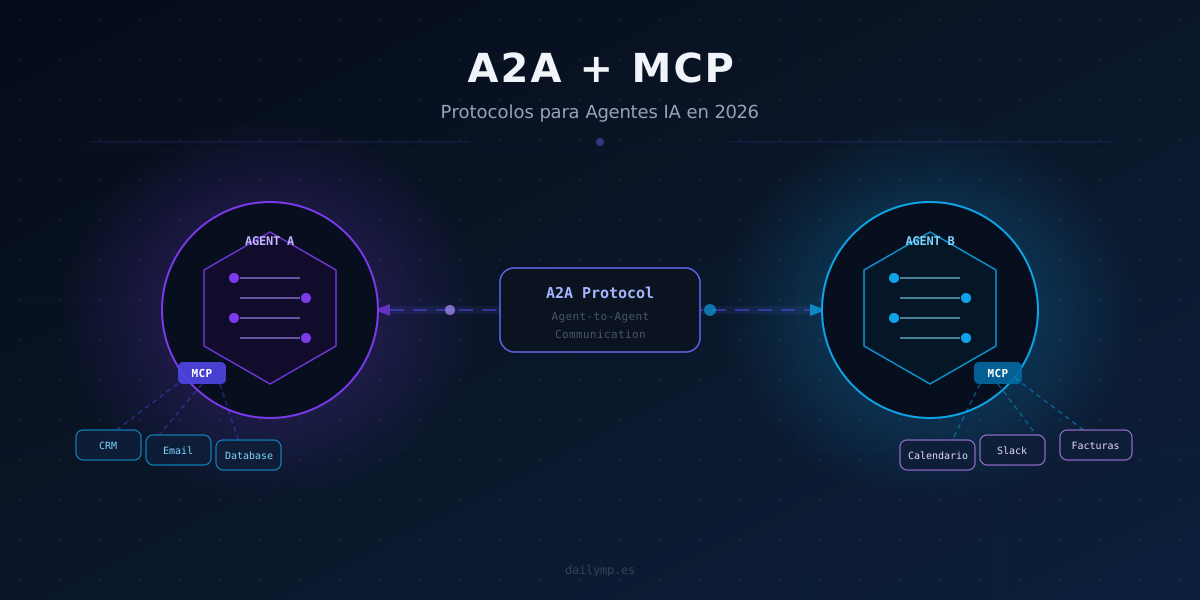
Two open protocols are closing that gap: MCP (Model Context Protocol) by Anthropic and A2A (Agent-to-Agent Protocol) by Google. Together, they form the invisible infrastructure making real business automation possible in 2026.
What MCP and A2A each solve
They're complementary, not competing. Each tackles a different layer of the problem.
MCP: connecting agents to your tools
MCP is the protocol that gives an AI agent secure, structured access to your external systems. Without MCP, an LLM is smart but blind — it can't read your database, send emails, or query your CRM. With MCP, each tool exposes a standard interface the agent understands.
An MCP server defines what resources are available (files, databases, APIs) and what actions the agent can take. The model connects to the server, retrieves real business context, and acts on it. Think of it as giving a new hire controlled access to the systems they need — no more, no less.
We published a full MCP implementation guide if you want to go deeper on the technical side.
A2A: agents that delegate to each other
A2A is the protocol that lets one AI agent communicate with and delegate tasks to another AI agent. Announced by Google in April 2025 and progressively adopted across the ecosystem, A2A defines how two agents — from different companies, models, or platforms — can:
- Discover each other's capabilities via a public "Agent Card"
- Send tasks with structured context
- Receive partial responses and real-time status updates
- Coordinate complex workflows without a human orchestrator in between
The key difference from a simple API call: A2A is designed for autonomous systems. Agents negotiate, delegate, and collaborate the way specialized teammates would — without needing to be told every step.
How A2A + MCP create the complete automation stack
The two protocols fit together naturally:
- MCP connects each agent to tools and data → the what it can do layer
- A2A connects agents to each other → the how they coordinate layer
A concrete example to make it tangible:
Scenario: A B2B services company wants to automate lead qualification and client onboarding.
Without A2A + MCP: A sales rep receives a form submission, manually copies it into the CRM, drafts a welcome email, creates a Drive folder, and adds tasks to the project tracker. Two to three hours of admin per lead.
With A2A + MCP:
[Agent 1: Qualifier]    ← MCP → CRM, LinkedIn API, deal history
       ↓ A2A (if lead score ≥ 7)
[Agent 2: Onboarding]   ← MCP → Gmail, Drive, Notion, Calendar
       ↓ A2A (if contract signed)
[Agent 3: Operations]   ← MCP → Slack, Jira, internal systems
Each agent has its own tools via MCP and delegates to the next agent via A2A. The full pipeline runs automatically. The team only touches the edge cases.
Getting started: three concrete steps
You don't need to build this from scratch. The current ecosystem gives you the building blocks.
Step 1: build the MCP server
Using Python, Anthropic's official library reduces MCP server creation to a few dozen lines. Here's a real example exposing CRM data to an agent:
from mcp.server import Server
import mcp.types as types

server = Server("company-tools")

@server.list_tools()
async def handle_list_tools() -> list[types.Tool]:
    return [
        types.Tool(
            name="get_crm_contact",
            description="Retrieves contact data from the CRM by email address",
            inputSchema={
                "type": "object",
                "properties": {"email": {"type": "string"}},
                "required": ["email"]
            }
        )
    ]

@server.call_tool()
async def handle_call_tool(name: str, arguments: dict):
    if name == "get_crm_contact":
        data = fetch_from_crm(arguments["email"])  # your actual CRM logic
        return [types.TextContent(type="text", text=str(data))]
The model never touches your database directly — it only gets what the MCP server decides to return. That's the security model baked into the protocol.
Step 2: publish an Agent Card for A2A
Every agent participating in an A2A workflow publishes an Agent Card — a JSON document describing its capabilities so other agents can discover and call it:
{
  "name": "Lead Qualification Agent",
  "description": "Analyzes and scores inbound leads from web forms",
  "url": "https://my-company.com/agents/qualifier",
  "capabilities": {
    "streaming": true,
    "pushNotifications": true
  },
  "skills": [
    {
      "id": "qualify_lead",
      "name": "Qualify Lead",
      "description": "Scores a lead 1-10 with reasoning and CRM data enrichment"
    }
  ]
}
This standard means any compatible agent can discover what to ask your Qualifier Agent without custom bilateral integrations.
Step 3: orchestrate with n8n or LangGraph
With agents defined, an orchestration layer ties the flow together:
- n8n: ideal for visual workflows where A2A agents are HTTP nodes triggered by webhooks
- LangGraph: ideal for stateful flows with complex reasoning loops and advanced error handling
In AI integration projects with real clients, the n8n + MCP + A2A combination is the fastest to implement and maintain for teams without dedicated ML engineers.
The measurable business impact
When both protocols run together in a real business, the results show up fast:
| Process | Without A2A + MCP | With A2A + MCP |
|---|---|---|
| Lead qualification | 45 min manual | 3 min automated |
| Client onboarding | 2 days admin | 4 hours with review |
| Weekly reporting | 3h of data gathering | Automatic generation |
| Tier-1 support | 8 h/day of team time | 1 h human review |
The shift isn't just speed. Agents with A2A + MCP run 24/7 without supervision, routing edge cases to the right specialized agent automatically. The human team moves from executing tasks to reviewing outcomes.
Why 2026 is the year multi-agent systems go mainstream
Until 2025, deploying a multi-agent system required an ML engineering team, weeks of custom development, and costly infrastructure. MCP and A2A change the equation:
- Open standard: any compatible agent can talk to any other, regardless of vendor
- Growing ecosystem: thousands of MCP servers already available for common tools (Notion, Salesforce, GitHub, Google Workspace...)
- More capable models: Claude Opus 4.6, GPT-4o, and Gemini 2.0 are designed to operate stably in multi-tool environments
- Accessible cost: pay-per-use pricing makes viable for SMEs what only large enterprises could afford before
The barrier has dropped so far that the question is no longer "can we implement AI agents?" — it's "which process do we automate first?"
Wrapping up
MCP and A2A aren't abstract technology trends. They're the infrastructure that separates "AI chatbots" from automation systems that actually work on their own. MCP gives agents access to your tools; A2A gives them the ability to coordinate with each other.
Companies that implement this stack in 2026 will have a real operational edge: processes that scale without headcount growth, specialized agents that collaborate without friction, and human teams that focus on work that genuinely needs human judgment.
If you want to implement A2A and MCP in your company or have specific processes you want to automate with AI agents, let's talk: