From 0 to 3,000 LinkedIn Followers with an AI Plan
For months I was writing LinkedIn posts about LangGraph, RAG pipelines, and vector embeddings. The result: zero leads, zero messages, and the uncomfortable feeling of talking to an empty room.
The problem wasn't the technology. The problem was me: I was communicating what I found fascinating, not what my potential clients needed to hear.
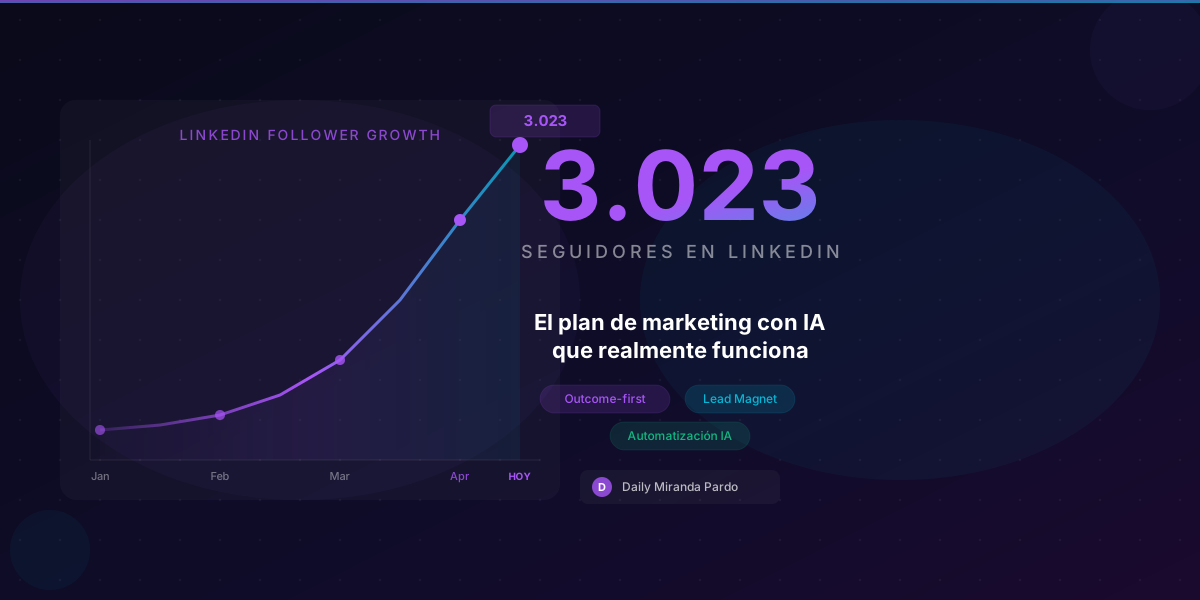
Here is what I changed in April 2026, and how I reached 3,023 followers with only two published posts.
The mistake I was making: tech-first instead of outcome-first
My old posts sounded like this: "I built a RAG pipeline with LangGraph and ChromaDB to reduce inference latency in multi-agent environments."
Who hires someone based on that? Nobody. Because nobody outside the technical world understands what that means or what problem it solves in their company.
The shift was radical: I stopped talking about stacks and started talking about real problems.
Before: "I build AI agents with LangChain and RAG pipelines."
Now: "I help companies automate the processes that consume the most time — using AI that works on its own while your team focuses on what actually matters."
The difference? The second sentence speaks directly to the operations manager who has been battling manual data entry for three years. That person cares. The first sentence loses them in the first three words.
The shift: lead with the outcome, always
The outcome-first method is straightforward: always start with the concrete result your client will get, not with how you achieve it.
I applied this across three layers:
- Website headline: from "AI and LLM Consultant" to "I automate the processes that drain the most time from your business"
- LinkedIn bio: from a list of technologies to "I help teams spend less time on repetitive tasks and more time on work that matters"
- Posts: a new structure built around the reader's problem, not my expertise
The effect is immediate. Potential clients recognize their own problem in your words and feel like you are talking directly to them. That recognition is what starts a conversation.
The post framework I used: PAIN → AMPLIFY → SOLUTION → PROOF → CTA
I drafted five posts in a single afternoon using this framework:
-
PAIN — Name the exact problem your ideal client is experiencing. No softening.
"Your team copies data between systems by hand. Every single day." -
AMPLIFY — Expand the consequence. What happens if it stays unsolved?
"That is 40 minutes per person per day. For a team of five, that is over 800 hours a year spent on zero-value tasks." -
SOLUTION — Present your approach in a concrete, credible way.
"An AI agent connected to your existing systems can eliminate that process entirely in under two weeks." -
PROOF — A real case, a real number, a real demonstration.
"I did this for a logistics SME. They went from 3 hours of manual work per day to 12 minutes of review." -
CTA — One specific action, zero friction.
"Want to see if this applies to your situation? Send me a direct message."
The first two posts I published with this structure generated more engagement in 48 hours than all my technical posts combined over the previous six months.
The lead magnet: capture emails before they leave
One thing I learned quickly: most people who visit your profile are not ready to hire you that day. You need a way to stay in touch.
I created a downloadable PDF: "Automation Map: The 5 Processes Stealing the Most Time From Your Business (and How AI Solves Them)".
The concept is simple: deliver real value in a format that can be consumed in ten minutes, in exchange for an email address. No inflated promises, no padding.
I embedded it directly on the homepage with a form connected to Resend, storing leads in Supabase. From day one, subscribers started arriving from LinkedIn.
Why does it work? Because it lowers the barrier to entry. Hiring a consultant is a big decision. Downloading a free PDF is not. And once you have someone's email, you can build the relationship at a natural pace.
The result after a few days: 3,023 followers and real leads
With two published posts and the lead magnet active, the numbers started moving:
- 3,023 LinkedIn followers (starting from near-zero activity)
- First direct messages from people interested in automation and AI agents
- Lead magnet subscribers arriving organically from the posts
- Open conversations with potential clients in week one
This is not the result of years of effort. It is the result of changing the message and staying consistent for days, not months.
What comes next: automating distribution with AI
The logical next step is using AI to scale what is already working. I currently have in progress:
- An agent that adapts each LinkedIn post to Twitter/X, Telegram, and the blog
- An n8n workflow that schedules publications automatically at the optimal time
- A tracking system that detects which topics generate the most conversations and proposes new ideas
If you want to understand how this type of automation works, take a look at the AI Agent for SEO and Social Media service or the AI Agents and Automation page.
If you are thinking about applying any of this to your own business, or want help designing your AI marketing strategy, reach out directly on WhatsApp. We can spend 30 minutes seeing whether it makes sense to work together.