While You Do It Manually, Your Competition Has Already Automated
Three weeks ago, a client contacted a company in your industry. They asked for a quote. They didn't get a response until the next day.
By then, they had already signed with someone else.
The other company had the exact same service. The same price. But they responded in 7 minutes. At 9 PM. Without anyone in the office.
That wasn't your client to lose. Not yet. But if someone in your industry has already automated their responses, their follow-ups and their sales process — and you haven't — it's only a matter of time.
The Race Has Already Started, and Someone Has a Head Start
Every working day, companies in your same sector are using automated systems to do what your employees still do by hand:
- Sending quotes in seconds with the client's data already integrated
- Answering enquiries via email, web or WhatsApp without anyone having to be available
- Following up automatically with leads who didn't convert the first time
- Logging orders and notifying the team without copying anything manually
- Generating weekly reports with data updated to the minute
None of these tasks are complex. They're repetitive. And that's exactly the problem: what's exhausting for a person is trivial for an automated system.
Your competitor who already has this running isn't smarter than you. They simply acted sooner. And every week that passes, that advantage compounds.
The Client Who Didn't Wait
There's one number almost no business tracks: the actual time it takes to respond to a new potential client from their first contact.
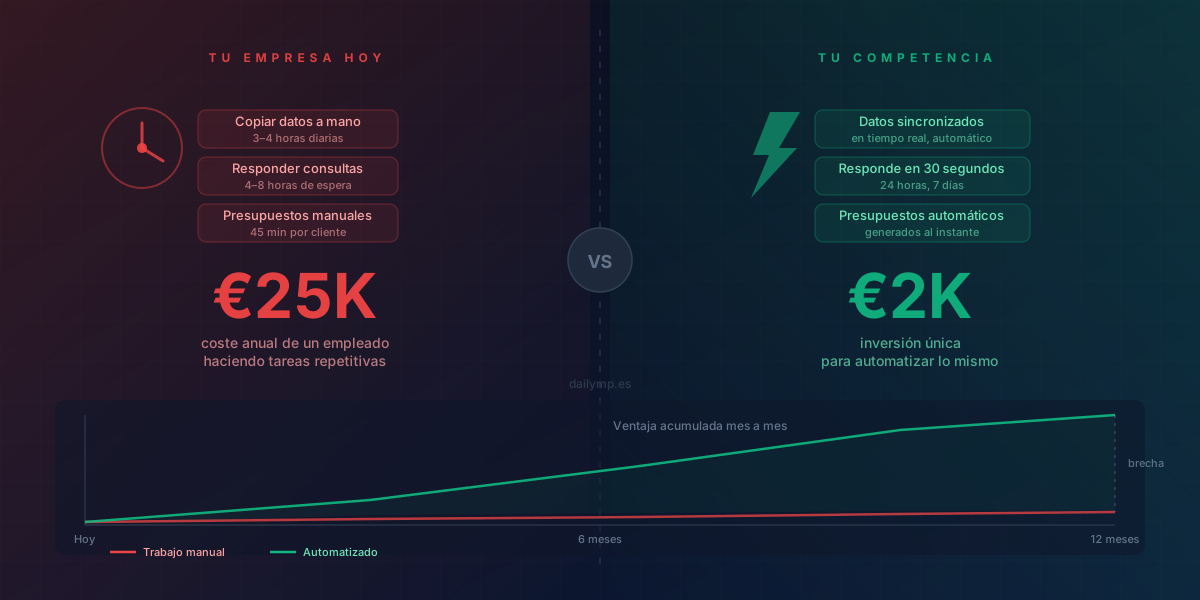
The data is brutal: a prospective client who doesn't receive a response within the first 5 minutes has an 80% lower chance of converting. After an hour, the probability drops to almost zero.
But if your team is already busy when that enquiry comes in, how long does it actually take?
One hour. Four hours. Sometimes until the next morning — if it arrives at 5 PM on a Friday.
Nobody's to blame. It's just that the same people who need to respond to that enquiry are also managing today's orders, preparing this week's report and dealing with whatever comes up during the day.
An automated system responds in 30 seconds. Any time of day. Without anyone needing to be on call.
And while you're thinking "we'll get back to them tomorrow", your competition already has that client inside their sales process.
Your Competitor With Half the Team Produces Twice as Much
This is the question I get most from business owners who come to talk to me: "How can that company in my sector be growing so fast with so few people?"
The answer in most cases is the same: they don't have more human capacity. They have more automation.
Every repetitive task they automate frees up time for work that actually generates value. Every enquiry that gets answered automatically is a client served without consuming resources. Every quote generated automatically is an opportunity that doesn't slip away while the team is busy with something else.
The result: they produce more without hiring more people. And they do it systematically, without errors, without bad days and without holidays.
Meanwhile, you're adding more hours to the people you already have, trying to keep pace. And the pace still isn't enough.
Hiring More People Doesn't Scale — The Calculation Nobody Does
When a business runs out of capacity, the natural reaction is to hire. It seems logical.
But here's the calculation that's rarely done before signing that contract:
An administrative employee costs between £22,000 and £30,000 per year between salary, taxes and training. They need time to learn. They take holidays. They can make mistakes. And they can only do one thing at a time.
Automating the processes that role covers costs between £1,500 and £5,000 once. It runs 24 hours a day, without errors and with no significant monthly cost.
Most projects I work on achieve positive return on investment in under four months.
I'm not saying you shouldn't hire people. I'm saying that if your next hire is someone who will copy data, send follow-up emails or generate reports — it's worth running the numbers first.
Every Week You Wait Is a Week You Hand Over
This is what almost everyone tells me the first time we talk: "Yes, we've been thinking about it. But now isn't the right time."
I understand. There are always more urgent things. There's always a reason to postpone.
The problem is that your competition isn't waiting for the perfect moment.
Every week without automating a process is a week where another company in your sector builds more advantage. Weeks become months. Months become a gap that costs far more to close than it would have to avoid.
Automation isn't the future. It's what companies like yours are implementing right now. Not next season. Not when the market settles. Now.
And the good news is that you don't have to start with everything at once. With just one automated process — the one that consumes the most time or loses you the most clients — you'll already feel the difference.
Real Results
Results we consistently see in the businesses we work with:
- Client response time reduced from hours to under 2 minutes for routine enquiries
- Between 8 and 15 hours per week recovered per team from tasks previously done manually
- Zero errors in registration, follow-up and document generation processes
- Positive return on investment within 4 months in the majority of projects
Businesses like the ones I work with at DAILYMP — between 10 and 50 people, doing well but wanting to grow without hiring more staff — are the ones who notice the change fastest. Because the bottleneck wasn't the team. It was the process.
What We Do at DAILYMP
At DAILYMP we don't sell software or platforms. We analyse your business, identify the processes that consume the most time or lose you the most clients, and build the system that solves it — with agents that run on their own from day one.
AI integration into your current processes doesn't require you to understand how it works under the hood. It requires you to be clear about which problem you want to solve first.
And if your team wants to learn how to get the most from these tools on their own, we also offer practical AI training focused on real results, not theory.
The Question You Need to Ask Yourself Today
How many clients have you lost this week because you were slow to respond?
How many hours has your team spent on tasks that tomorrow will be exactly the same?
What is your competition doing while you read this?
You don't need to have all the answers to start. You just need 30 minutes to tell me where the bottlenecks are in your business — and I'll tell you whether they have a solution, how to approach it and what results you can realistically expect.
No commitment. No jargon. An honest conversation about your business.