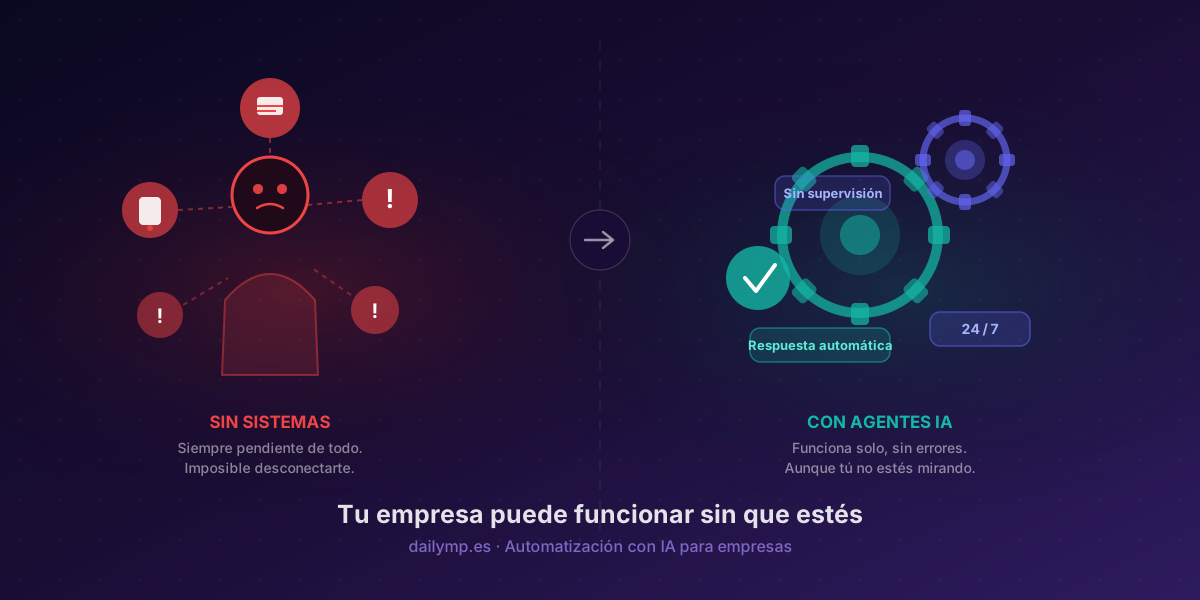
Why You Can't Disconnect From Your Business
The last time you went on holiday, you checked your phone every thirty minutes.
Not because you wanted to. But because if you didn't look, no one would. There was a client waiting for a reply. An issue only you knew how to handle. A decision that couldn't wait until Monday.
When was the last time you truly switched off? A full day without opening your work email, without answering a client's message, without fixing something that "only you can sort out"?
For most business owners and SMB managers, the honest answer is: a long time ago. Or never.
That's not dedication. It's a symptom. And it has a name.
Your Business Doesn't Have Systems — It Has You
When a company depends on one specific person watching in order to function, it doesn't have a system. It has a person acting as the system.
You're the one who knows how to deal with that difficult client. You're the one who remembers the negotiation history. You're the one who knows what to do when the usual process breaks. You're the one who approves, reviews, decides and resolves.
The business works because you're there. And that means when you're not — or when you can't be — the business suffers.
This isn't a people problem. It's a design problem.
A business that truly scales doesn't depend on someone watching at all times. It has processes that act on their own in routine situations. It has automations that collect, process and respond without anyone supervising them. Complex problems are solved by people. Repetitive processes are handled by systems.
The difference between a business that scales and one that burns out its owner isn't working more hours. It's that one has those systems and the other doesn't.
What It Costs Your Business (Beyond Your Own Rest)
The most obvious cost is personal. There's no need to argue it: the inability to disconnect takes a toll on health, relationships and energy that every business owner knows well.
But there's a business cost that rarely gets calculated.
Response speed. When you're the bottleneck for decisions, your business moves at the pace of your availability. Every response that depends on you arrives later. Every approval that passes through you halts a process while it waits. In markets where speed matters, that delay has a direct cost in lost clients.
Growth capacity. A business that depends on its owner to function cannot grow faster than that owner can handle. Every new client adds more load to the same person. At some point, the limit isn't market demand. It's you.
Operational risk. What happens if one day you simply can't be there? A week of sick leave, a family emergency, a health issue. If the business runs because you're watching, the day you can't watch, everything slows down. Or stops.
Why This Happens More in SMBs Than Large Companies
Large companies have written processes, operational manuals, systems that log every interaction, and automations that act without anyone having to remember. Not because they're smarter — but because at some point they had to stop depending on specific individuals in order to scale.
In small businesses, that moment rarely comes. Growth happens through personal effort. What works is what you make work. The "system" is you — or the trusted team who knows how things actually run under the hood.
Nobody planned it this way. It just happened.
And what can change it isn't hiring more people. It's building the processes you run yourself and automating them so they happen on their own.
What Changes When Your Business Has Automated Systems
Imagine that when a client writes on WhatsApp outside working hours, they receive a relevant reply in seconds and their enquiry is automatically logged without anyone having to step in. The process happened. Without you watching.
Imagine that when an order comes in, the whole chain — team notification, client confirmation, system update — runs by itself. Without anyone triggering it manually.
Imagine that on Monday morning you receive a summary of everything that happened over the weekend: enquiries received, issues resolved, projects updated. Not because someone prepared it. Because the system generated it on its own.
That's exactly what we implement at DAILYMP through AI automation agents: systems that do for your business what today depended on someone — usually you — being on call. With AI integration into your current operation, the processes that today depend on people start working on their own, with the right data, at the right moment.
You don't change all your tools. You don't retrain the whole team. You identify the points where time is leaking and automate what can be automated — leaving people for the work that genuinely requires human judgement.
Real Results
The businesses we work with at DAILYMP arrive with a very specific symptom: the person in charge is overwhelmed, and growth is blocked because everything goes through the same people.
What we implement doesn't transform a business overnight. But within weeks — not months — processes that previously depended on someone being on call start happening on their own. The team recovers time. The person in charge starts receiving summaries instead of interruptions. The business starts operating as a system rather than as a collection of people doing things.
The goal isn't to remove people from the process. It's to free people for work that genuinely requires human judgement — and automate the rest.
The Question Worth Asking
How many hours last week did you spend on things that could have happened automatically?
Think about it specifically: you answered emails with the same standard information you always give, supervised routine tasks that always turn out the same way, approved things the process could have approved on its own, made decisions a system could have handled for you.
Those hours aren't productive work. They're the visible cost of not having systems. And that cost gets paid every single week, whether anyone counts it or not.
In 30 minutes we'll review together which parts of your operation could run autonomously, what impact that would have on your week and what the first concrete step would be.