Late Proposals Don't Win Deals
Your prospect needs exactly what you offer. They have budget. They have urgency. And, like any responsible business person, they send the same request to three different providers.
The first replies in two hours with a clear, personalised proposal. The second replies the next day asking clarifying questions. You reply on day three with a thorough, error-free proposal.
The client already signed with the first one.
You never found out.
The invisible sale nobody tracks
When a client decides to buy, their active decision window typically lasts between 24 and 72 hours. During that time they're comparing options, talking to multiple providers, and forming their opinion.
After that window, the decision is effectively made — even if they haven't communicated it yet. They might still be open to changing their mind if there's a significant difference, but the momentum already belongs to whoever arrived first.
The problem isn't your proposal. It's how long it takes to send it.
And that time, in most businesses, isn't what the sales team would choose. It's what the manual process allows.
The CRM doesn't record it as "lost due to slow response." The client simply stops replying. The team closes the lead as "didn't advance" without understanding quite why.
Why a quote takes days to leave the building
Nobody wants to work slowly. But generating a proposal in a business that runs on manual processes involves more steps than you'd think.
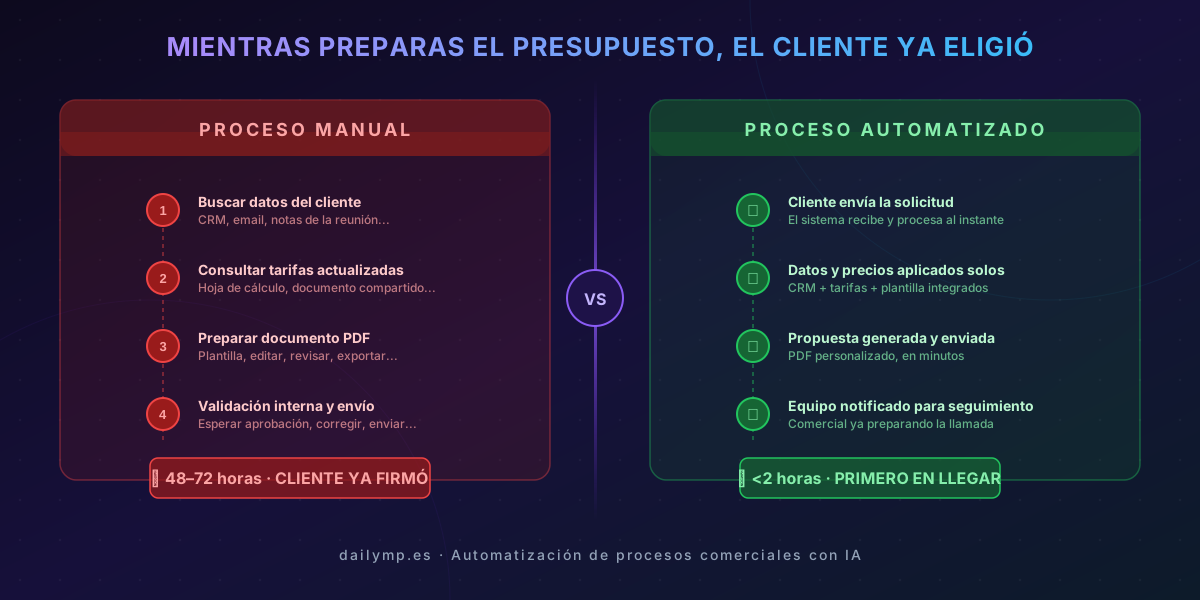
First, someone has to gather the client's information — which might be in the CRM, in an email thread, in notes from the initial meeting, or spread across all three.
Second, they need to calculate the price. That means checking the current rate card — which might live in a spreadsheet, a shared document, or in the head of whoever manages pricing.
Third, prepare the document. Open the template, update the client details, make sure no references to the previous client slipped through, add the right services at the right price, export to PDF.
Fourth, in many businesses, the proposal goes to internal approval before it's sent. Wait for someone to review it. Receive feedback. Make corrections.
Fifth, send it to the client with a personalised message that doesn't look like a generic copy-paste.
Each step requires someone to actively do it. And those people have other urgent things on their plate. The proposal moves down the team's queue until someone finds a gap.
Result: the client receives your proposal two or three days after asking for it. The competitor's arrived 48 hours ago.
The number nobody calculates
Say your business generates between 5 and 10 proposals per month. In your current process, you take between 48 and 72 hours on average to send each one.
If 1 in 4 clients who requests a quote chooses a competitor simply because of response speed — a conservative estimate in markets where price and proposal quality are similar — you're losing 1 to 2 opportunities per month without it appearing anywhere as "lost sales."
With an average deal value of €2,000 per project, that's €2,000–€4,000 per month in opportunities that evaporated before your proposal arrived.
Per year: €24,000–€48,000 that never came in — and that nobody identified as a process problem. Just "leads that didn't advance."
The most insidious part of this cost is that it triggers no alarm. The team handled it. The proposal went out. Everything was correct. It just arrived late.
What changes when the process runs itself
When quote generation is automated, this is what happens:
The client submits a request → the system automatically pulls their information from the CRM, applies current pricing, generates the document with the correct data, and sends it with a personalised message.
All within minutes. Without anyone having to remember to do it. Without errors from copying data between tools. Without waiting for a team member to find a slot.
The sales team can spend that time preparing the follow-up call — where deals are actually won or lost — instead of preparing the PDF.
And the proposal arrives while the client is still in their active decision window.
You don't need to be the cheapest option. You don't need the most elaborate proposal. You need to arrive on time.
How we do it at DAILYMP
At DAILYMP we build the complete commercial workflow: from the moment a client request comes in to the moment they receive the proposal, including automatic document generation and internal team notification.
It doesn't change how your team works. It doesn't require them to learn new tools. What changes is that response time drops from days to hours — and in many cases, to minutes.
Integrating AI into your commercial processes isn't a months-long project and doesn't require replacing the software you already use. In most cases, the tools you have are perfectly valid. They just need to be connected and the manual steps automated.
Real results
Businesses we work with have reduced proposal sending time from 3–4 days to under 2 hours. The most immediate result wasn't just improved close rates — it was that the sales team stopped spending half their time on administrative work and returned to what actually closes deals: conversations with clients.
The most common reaction after the first few weeks: "I can't believe we used to take that long for something this straightforward."
The question worth money
How long does it take your business to send a proposal after a client requests one?
If the answer is more than 24 hours, sales are being lost before they even arrive. Not because your proposal is worse. Because the process that generates it can't keep up with the speed at which your clients make decisions.
In 30 minutes we'll analyse where the bottleneck is in your commercial process and what can be automated so that proposals go out on their own — with the right data, at the moment the client needs them.
No commitment. No technical jargon. An honest conversation about your business.