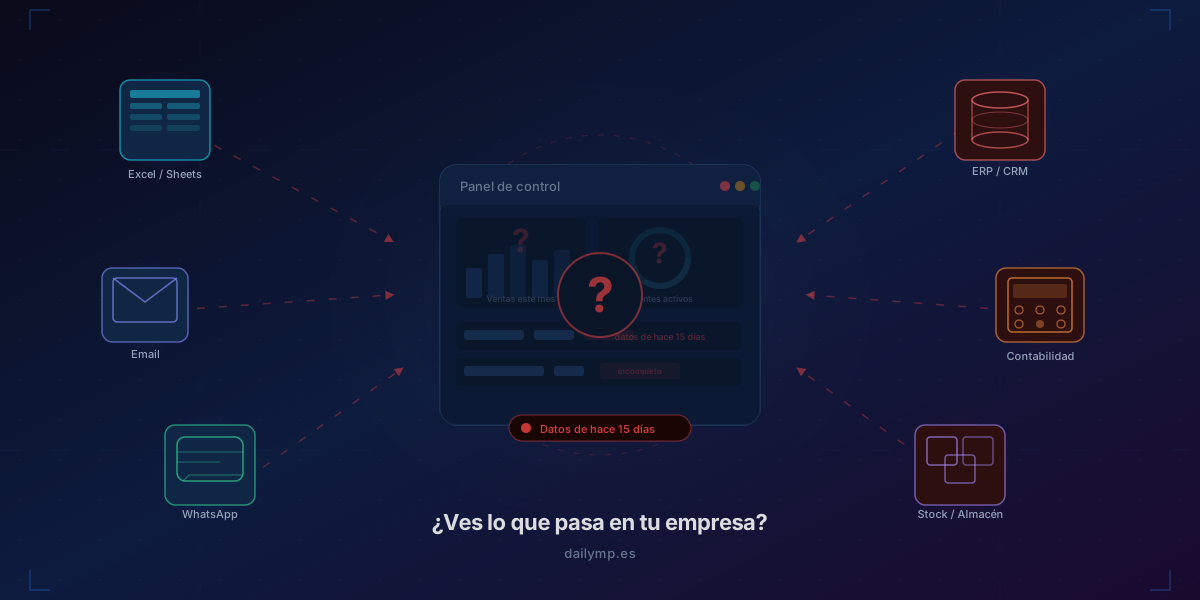
You're Running Your Business Blind
You've been feeling for weeks that something doesn't add up. Sales should be going better. You have the nagging sense that some clients are pulling back. So you ask for the numbers. Someone promises you a report by Monday. Monday comes, the report arrives — and the data is two weeks old.
What exactly are you supposed to do with information about what happened fifteen days ago?
This is the silent problem plaguing most small and mid-sized businesses: it's not that they lack information. It's that the information they have arrives late, incomplete, or scattered across five different places. And making decisions under those conditions is, essentially, flying blind.
The Report That Always Arrives Too Late
Somewhere in your company, every week, someone spends three to four hours gathering data. They open the sales spreadsheet. They check emails for support issues. They log into the accounting software. They call someone to ask about stock levels. Then they put it all together in a document and send it to you.
By the time that report lands in your inbox, the data is ten to fifteen days old. And the world didn't pause in the meantime.
Did last week's campaign perform well? You still don't know for certain. Is that client who's been quiet for three weeks about to leave? There's nothing alerting you. Is that product you thought was selling well actually losing margin? Finding out means looking in yet another system, cross-referencing another spreadsheet, asking another person.
This isn't a problem with your team. It's a design problem. The business isn't built to give you visibility. It's built so that someone, manually, constructs that visibility for you every week. And that has an enormous cost — in time and in decisions made too late.
Your Data Lives in Six Places and Nobody Sees All of It
Quick exercise. Tell me where you'd find this information in your business right now:
- How much did you bill last week?
- How many active clients do you have at this moment?
- Which product or service has had the most issues this month?
- What was the average response time on your last ten quotes?
- Which clients haven't bought from you in over 30 days?
If answering any of those questions requires opening more than one system, asking someone, or waiting for something to be prepared — you have exactly the problem I'm describing.
Your business information lives in a spreadsheet here, in the email inbox there, in the WhatsApp history, in the accounting software, in the ERP, in someone's system. And the real knowledge — the kind that actually explains why something is working or not — lives inside the heads of two or three key people. Who might be on holiday. Or who might not be around tomorrow.
Nobody has the complete picture. And when nobody sees it, everyone works from their own fragment of reality. The sales team doesn't know what's happening in operations. The purchasing manager doesn't see what's happening with clients. And you, who should have the full view, depend on someone preparing it for you.
AI system integration solves exactly this: connecting all those points in one place, without anyone having to do it manually.
Important Decisions Are Being Made on Gut Feel
"Should we launch this campaign?" "I think last month went well, so yeah, let's do it."
"Do we renew with that supplier?" "Not sure — ask Sarah, she handles that account."
"Should we hire someone?" "Honestly, I don't have the numbers in front of me right now."
This happens in every company. Not because teams are poor performers, but because the data isn't available when it's actually needed. And without data, decisions get made by instinct, habit, or whatever someone half-remembers.
Instinct has value. But instinct plus real data is far more powerful. And instinct alone, when your competitors are already making decisions backed by real-time information, simply isn't enough.
I'm not talking about large enterprises with data analytics departments. I'm talking about businesses your size that already use AI agents that consolidate information automatically and surface it every morning — without anyone having to prepare anything. Without waiting for Monday's report.
What Changes When You Connect Everything
I'm not talking about building a massive system or hiring a team of analysts. I'm talking about something much more concrete.
Imagine that every morning, before the day starts, you have in one place:
- How much was sold yesterday and how the month is tracking against target
- Which clients have had open issues for more than 48 hours
- Which products are declining week-over-week
- An automatic alert if an important client has gone quiet for too long
Not because someone prepared it. But because the systems you already have — email, ERP, invoicing software, CRM — are connected, and an agent reads that information, processes it, and presents it to you clearly.
That's what we do at DAILYMP with system integration: connect what already exists so information flows automatically, arrives when you need it, and lets you act in real time — not in retrospect.
The result isn't just "better reports." The result is that you start actually seeing what's happening in your business. And when you can see what's happening, you can act before small problems become big ones.
What You Can Do Today
If any of these scenarios rang true, the first step isn't to hire anyone. It's to make a quick map of where your key business information actually lives right now.
How many different places? How long does it take someone to pull it together? How often is the data you receive already a week or more old by the time you see it?
Once you have that map, the solution becomes obvious. And it's usually simpler and more affordable than it looks.
If you want to run through that exercise with me in 30 minutes, I'll help you identify exactly what can be automated in your specific case and what the real impact would be on your day-to-day.
You don't need to be technical or know anything about AI. You just need to recognise that making decisions without current data is too costly to keep doing.