Before You Hire Someone New, Read This First
You've been telling yourself the same thing for weeks: there's too much work. Someone needs to handle all of this. And the most logical solution in the world is to hire someone.
Before you post that job listing, there's one number worth putting on the table.
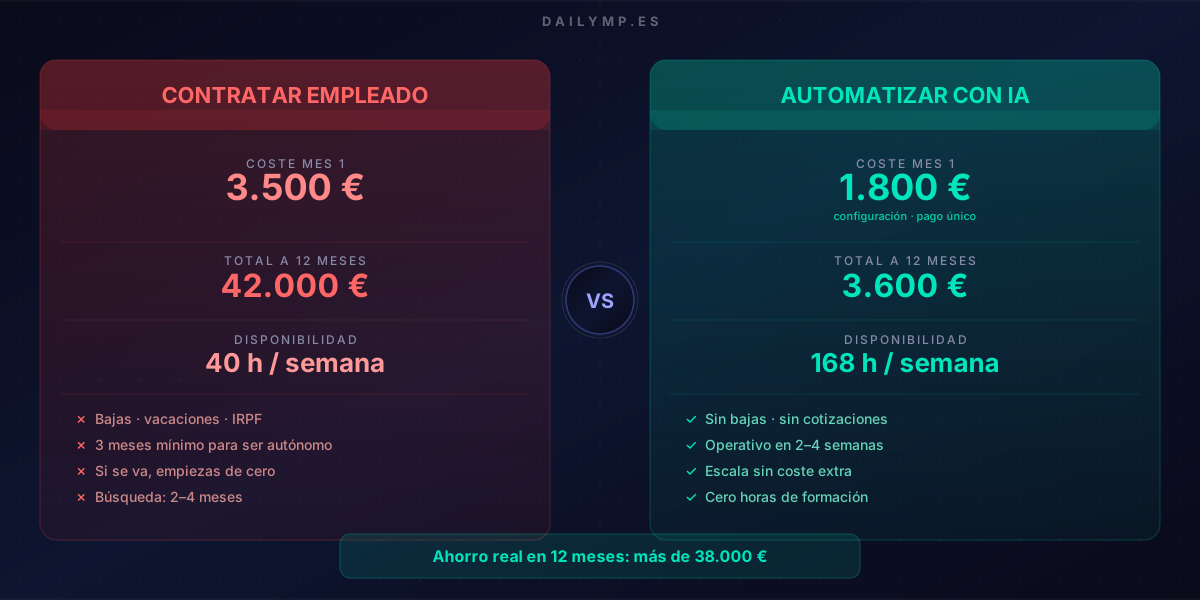
Hiring a person for administrative or coordination tasks at a small business costs, with all costs included, between €3,000 and €3,500 per month. Automating those same tasks costs between €1,500 and €2,500 one time, plus around €100–150 per month in maintenance.
By month twelve, the automated system will have cost around €3,500 in total. The hired person will have cost €42,000.
This isn't magic. It's just a calculation almost nobody runs before signing the contract.
What Hiring Someone Actually Costs
When people think about the cost of hiring, they usually think about the gross salary. But the real cost is something else.
A coordinator, admin, or experienced assistant profile costs in Spain between €1,800 and €2,200 gross per month. On top of that you add the employer's Social Security contribution — an additional 30–35%. That puts you at €2,400–3,000 per month before touching anything else.
Then come the invisible costs:
Time to find the right person. Finding the right fit takes two to four months. That time costs management hours, interviews, screening candidates, and often the cost of a recruitment platform.
The learning curve. For the first three months, the new hire works below full capacity while learning how your business works. Someone on the team spends hours training them — hours they're no longer dedicating to their own work.
The day they leave. People leave. For a better offer, a life change, whatever reason. When that happens, the full cost of searching, hiring, and training starts again from scratch.
In the end, the real cost of hiring isn't the salary. It's the salary plus social security, plus selection time, plus training, plus turnover risk. When you add it all up, the number looks very different from what appears on the payslip.
The Core Problem: You're Paying a Person to Do System Work
Here's the point nobody says out loud.
When a business hires because "there's too much work," most of that extra work is predictable and repetitive. Answering inquiry emails. Following up on proposals that haven't received a response. Updating the CRM. Generating the weekly sales report. Posting on social media when there's time.
These tasks share something in common: they don't require human judgment. They're always the same, they always follow the same steps, and the expected outcome doesn't change from one day to the next.
When you hire a person to do them, you're paying €2,400–3,000 per month for someone to do what an automated system would do for €100–150 per month.
Nobody is to blame. It's simply that the business grew and the natural reflex is to hire. But that reflex carries an enormous cost paid month after month for years.
The Real Comparison in Numbers
Here's what each option costs over twelve months:
| Hire | Automate | |
|---|---|---|
| Month 1 | ~€3,500 | ~€1,800 (setup) |
| Month 3 | ~€10,500 cumulative | ~€2,100 cumulative |
| Month 12 | ~€42,000 cumulative | ~€3,500 cumulative |
| Availability | 40h/week | 168h/week |
| Sick days & holidays | Yes | No |
| Learning curve | 3 months minimum | None |
| Scales without extra cost | No | Yes |
| If they "leave," you lose | All their knowledge | Nothing |
The automated system doesn't take holidays. It doesn't call in sick. It doesn't need three months to learn. And if you need it to handle more work, it scales without additional cost.
This is exactly what we build at DAILYMP with AI automation agents: systems that handle your business's repetitive tasks continuously, without errors, without anyone having to supervise them. If you want to understand what would fit your case, our AI integration page explains how we connect this to the tools you already use.
So, When Should You Actually Hire?
For what only humans can do.
Automation has a very clear limit: it works when tasks are predictable. When there's variation, complex context, human relationships to manage, or decisions that require judgment, there's no replacing a person.
The model that works in the companies I partner with is this: the automated system handles 70–80% of mechanical tasks. The hired person — if you hire — dedicates their time to the 20–30% that requires real judgment: managing clients with complex situations, building relationships, making decisions that have nuance.
That person performs far better. They work on what actually makes sense to do by hand. And the cost of having them is genuinely justified.
What to Do Before Posting the Job
Before opening the selection process, it's worth running this twenty-minute exercise:
Write down everything that person would do. Every task, without filtering. The welcome email to a new client, following up on the proposal that's been sitting unanswered for a week, the Monday report, the inventory update, the social media post.
Mark which ones are repetitive. The ones that are always the same, with the same steps, the same expected result.
Calculate what percentage of the total workload they represent. If more than 50% of the tasks are mechanical and predictable, automating first makes more sense than hiring. The person you hire afterward will bring much more value because they'll focus on what can't be automated.
If fewer than 50% are repetitive, hiring may be the right path — but even then, automating the mechanical part means that person delivers more value from their very first month.
Real Results
The businesses I work with at DAILYMP typically arrive with the same situation: the team is overloaded, work is piling up, and the conclusion is that someone needs to be hired. We go through the exercise together — listing the tasks, marking the repetitive ones, and calculating the real cost of each option.
In most cases, between 60% and 80% of the tasks driving the hiring decision can be automated within three to four weeks. The first-year savings typically range between €30,000 and €38,000.
The change teams describe most often: "I'm finally doing the work they hired me for, not the work nobody wanted to do."
Before You Sign That Contract
If you're at that point — you have candidates, you have the role defined, you know someone needs to handle all of this — it's worth spending 30 minutes reviewing which part of that work a system can handle before a person does.
In that conversation you don't need to understand anything about AI or automation. You just need to know which tasks you want off your plate. I'll tell you whether they have a solution, how long it takes, and what the cost looks like compared to hiring.
No commitment. No technical jargon. Just the numbers on the table.