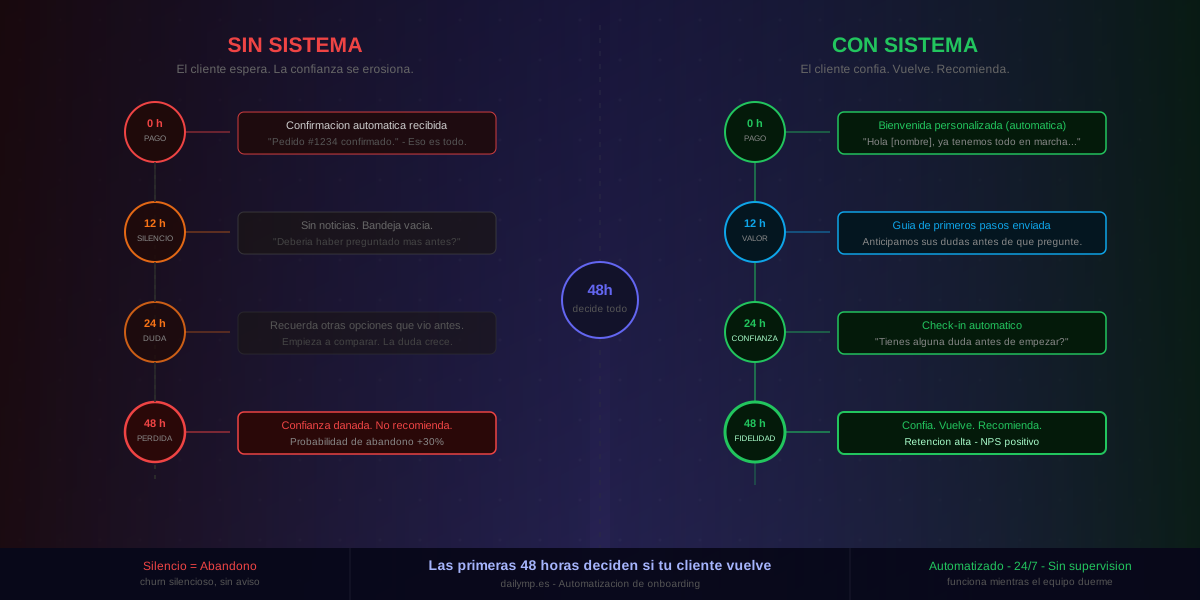
What Happens to Your Client in the First 48 Hours
The moment someone pays you is the most important in the entire business relationship.
Not when they find you. Not when they read your proposal. Not when they decide to hire you. The moment they pay.
Because right after paying, the human brain enters a very particular state: it needs to confirm it made the right decision. And what happens in the next 48 hours will shape how that client remembers you, whether they buy again, and whether they refer you to others.
Most small businesses, during those 48 critical hours, do almost nothing.
What Your Client Feels When You're Not Watching
Imagine you just hired a service for the first time. You pay. The charge appears in your bank account. And then... silence.
The confirmation email arrives — if it arrives — with an order number and a PDF. Nothing else. You don't know exactly what's going to happen. You don't know when they'll contact you. You don't know if you need to do anything on your end. You only know that you paid.
In that uncertainty, the brain starts working. Did I make the right decision? Why haven't they said anything else? Should I have looked at that other company?
This isn't weakness on the client's part. It's basic psychology: after committing to something important, human beings need signals that validate that decision. If they don't receive them, they create their own. And the ones they create by default are negative.
Silence isn't experienced as efficiency. It's experienced as abandonment.
What Happens Hour by Hour in Those First 48
This is what happens with a typical client who receives no positive signal after paying:
Hours 0–2: The client checks email expecting something more than the technical confirmation. Nothing arrives. Minimal concern, but it's there.
Hours 4–8: Still no news. They start wondering if they should have asked more questions before paying.
Hours 12–24: The day's work takes over. But when checking email, still nothing. They mentally reconstruct the comparison with other options they considered.
Hours 24–36: The question that was already floating in their mind takes more space: "Did I do the right thing?"
Hours 36–48: If by then there's been no sign of life beyond the initial confirmation, that client has already taken a psychological position. They may move forward, but with less confidence. And that reduced confidence has consequences: less likely to recommend you, more likely to question every delivery, easier to lose after a while.
All of this happens in silence. The client says nothing to you. They simply keep accumulating uncertainty.
What Should Happen in Those 48 Hours
This isn't marketing theory. It's what businesses with high retention rates and many referrals actually do: they have a system that acts at the right moment, without anyone having to remember it.
Within the first hour: A confirmation that isn't technical. Not "Order #12345 received." Something like: "Hi [name], we've received your payment and everything is underway. Here are the next steps: [clear list]. If you have any questions, we're here." Brief. Personal. Clear.
Within the first 24 hours: A real welcome follow-up. Not to sell more, but to deliver value: a resource, information, a preemptive answer to common doubts. A small gesture that says "we were thinking of you before you even asked."
At 48 hours: A short question. "Do you have any questions about the next steps?" An open door that gives the opportunity to resolve any uncertainty before it becomes a problem.
None of these three things requires someone to remember them or write them by hand. An automated system can execute them at the exact moment, with the client's name, the right context, your company's tone.
That's exactly what we build at DAILYMP with automated process agents: flows that work on their own, at the right moment, so the client feels attended to even when no one on the team is paying attention to it at that instant.
The Real Impact on Your Business
Client retention has a direct impact on profitability that many people underestimate.
Acquiring a new client costs, depending on the industry, between 5 and 25 times more than keeping an existing one. If your annual retention rate is 70%, you're losing 30% of clients who already found you, already trusted you, and already paid. And you have to replace them with new acquisitions that cost much more.
The first experience of a new client is the most determining factor in whether they come back.
Not the price. Not the product itself. The experience of those first hours.
And that experience is built in the first 48 hours, when they're still in "did I make the right decision?" mode. If in that moment you give them clear signals that yes, you're there, they have support, and everything is going as planned, the question disappears. And in its place comes trust.
Trust is what makes them recommend you. Trust is what makes them buy again without comparing prices. Trust is what turns a client who paid once into a client who brings you other clients.
Your Tools Already Have the Information — They Just Need to Connect
You most likely already have the pieces to build this system. Your email platform. Your CRM or whatever tool you use to register new clients. Your invoicing system.
The problem isn't that you lack information: it's that those tools aren't connected to act automatically when a new client arrives.
When someone pays, someone on the team has to notice, go to the CRM, add the contact, prepare the welcome email, and send it. If that person is busy, if it's Friday at 6pm, if there's an urgent client at that moment... the email doesn't go out.
With a proper integration of those tools, the process happens automatically. Payment detected → welcome sequence activated → first contact sent → 24-hour reminder → 48-hour check-in → CRM updated. Without anyone supervising it. Without depending on someone being available.
Real Results
Companies I work with that implement an automatic onboarding flow consistently observe two changes:
Fewer "how's it going?" questions in the first days. Clients know what's happening because the system keeps them informed. They don't have to ask because nobody told them anything.
More referrals in the first three months. The impression formed in the first 48 hours is what gets shared. If that impression is "they took care of me perfectly from the very first moment," that's what the client tells their network.
The change isn't radical. It's quiet. But it shows in the numbers after a few months.
If you have clients who paid you and you didn't hear from them again until work actually started, that silence of yours has a cost you're probably not measuring.
In 30 minutes I can help you design an automatic welcome flow that works with the tools you already have. Without buying anything new. Without technical complexity.