Your Client Asks for a Project Update. You Don't Know.
Your phone rings. It's a client. "Hey, how's the project going? Are we still on schedule?"
And the first thing that crosses your mind is: I need to check with Mark. Or Sarah. Or both — let's see who knows.
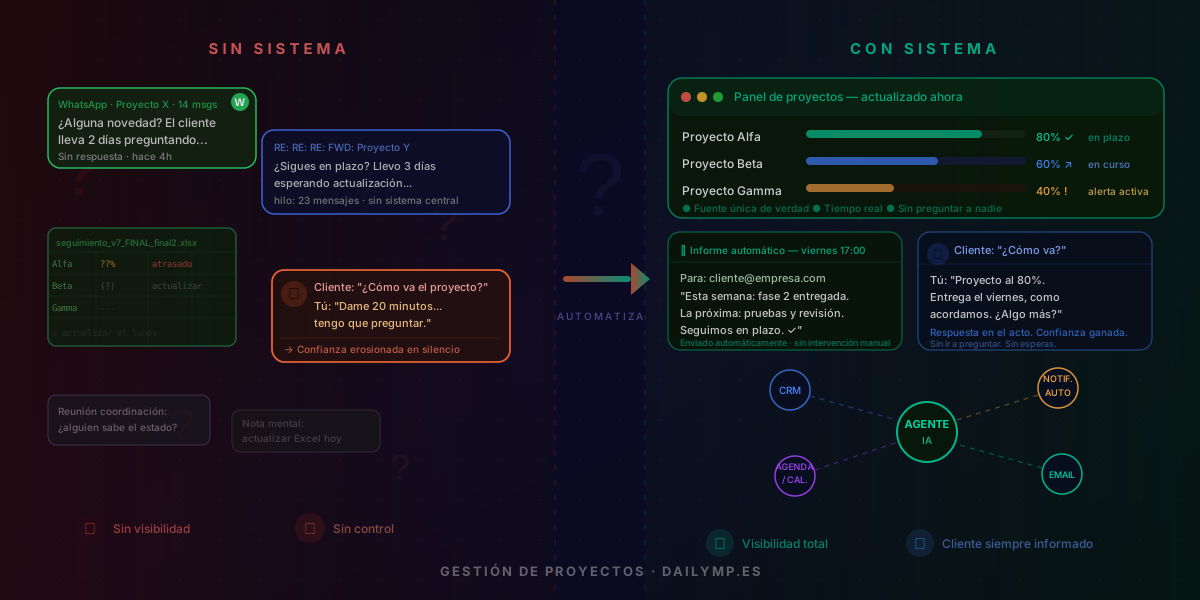
"Give me twenty minutes and I'll get back to you," you say.
Those words say more about how your business runs than any sales presentation you've ever given. And what they say isn't good.
Why project management in SMEs is always scattered
In most 10-to-50-person companies, projects are managed the same way: a WhatsApp group per project, an email thread with the client, a spreadsheet that someone updates when they remember, and coordination meetings where notes get taken that nobody reads.
It's not a lack of effort or intention. It's that as the company grew, nobody stopped to design a proper project tracking system. One tool got stacked on top of another until today the project information lives in six different places — and none of them has everything.
The result: whoever "manages" the projects isn't a tool — it's you, or someone on your team, acting as a human bridge between WhatsApp, email, spreadsheets, and hallway conversations. Answering "how's the project going?" requires gathering, cross-referencing, and summarizing. That takes time. And while you do it, the client is waiting.
There's no single place to look and know in two seconds where each project stands, what's pending, and whether anything is running behind.
What "give me twenty minutes" tells your client
For you, it's a routine step. For your client, it's information — about you.
When you say "let me verify and I'll call you back," the client processes that as: "the person I'm talking to doesn't control what's happening in their own company." They don't think it in those exact terms, but they feel it. And that feeling compounds with every similar interaction.
The first time, nothing happens. The second time, maybe still nothing. But if every time your client wants a project update they have to call, wait, and receive an answer that took twenty minutes to produce, over time they start asking questions they'll never ask you directly:
Are they really on top of this? Is anyone in charge? Should I look elsewhere for the next project?
And there's something worse: clients who've lost confidence don't always announce it. They show it. They start following up on the project themselves. They reach out directly to individual team members. They ask for updates every two days. They become the project manager of their own work — something that shouldn't be their job, and that strains the relationship.
When a client starts actively managing their own project at your company, they've already decided something about you. They just haven't told you yet.
The project tracking your business should have
Here's the real change a proper system introduces: instead of the client calling and you having to ask around, the client already knows — because the system told them before they needed to know.
This is how it works when project management is automated:
Every Friday at 5pm, the client receives a brief summary: what was completed this week, what's coming next week, whether there's anything they need to action. Not a twenty-page report. Three lines and a clear status. Automatic. Nobody prepares it manually.
If something changes — a delay, a dependency, an unexpected issue — the system detects the change and notifies the client with context before they notice it themselves. "Phase 2 delivery is shifting three days due to X. Here's the updated schedule." No last-minute surprises.
When the client calls, there's an immediate answer because there's a single source of truth. Whoever picks up the phone can open the dashboard, see real-time status, and answer on the spot. No "give me twenty minutes." No "I need to check with someone."
This is exactly what we build at DAILYMP with AI process automation agents: systems that connect the tools you already use, centralize project information, and generate follow-up communications automatically. Without changing your entire workflow. Without your team learning everything from scratch.
Why "more organization" doesn't solve this
When this problem is identified, the typical response is to add more discipline: "from now on, everyone updates the spreadsheet daily, and the project manager does a weekly manual report."
It works for two weeks. Then the team has real work to do, the manual report gets delayed, the spreadsheet goes stale, and everything reverts to how it was before. It always happens — because discipline doesn't scale under pressure.
Systems do scale. And a well-built system doesn't depend on someone remembering to do something. It runs on its own, with real data from the tools you already have, at the right moment.
What gets automated isn't just team time — it's the perception your client builds of you week after week.
To understand how to connect this with your existing processes, the AI integration page walks through the full process.
Real results
Companies that implement an automated project tracking system consistently describe two changes:
Clients stop calling to ask for updates. Not because the project is going better or worse, but because they already have the information before they need it. Proactive communication eliminates the client's anxiety and reduces interruptions to your team.
The team recovers coordination time. When you don't have to prepare manual reports or be available for verbal updates, that time goes back to actual productive work.
The comment that comes up most often one month after implementing: "Our clients tell us they've never worked with anyone this organized." The irony is that before automating, that same company was living exactly the chaos we described above.
The next time your client calls asking how the project is going, you have two options: go ask Mark, or have the answer ready before they call.
The second option exists. It doesn't require rebuilding your entire company. Just connecting what you already have.