Your Best Employee Is Leaving. Blame the Spreadsheet.
It's Monday morning.
Sarah has been with your company for three years. She stood out from everyone else in her interview: real experience, her own ideas, a genuine ability to solve problems. You hired her to build things. Important things. New things.
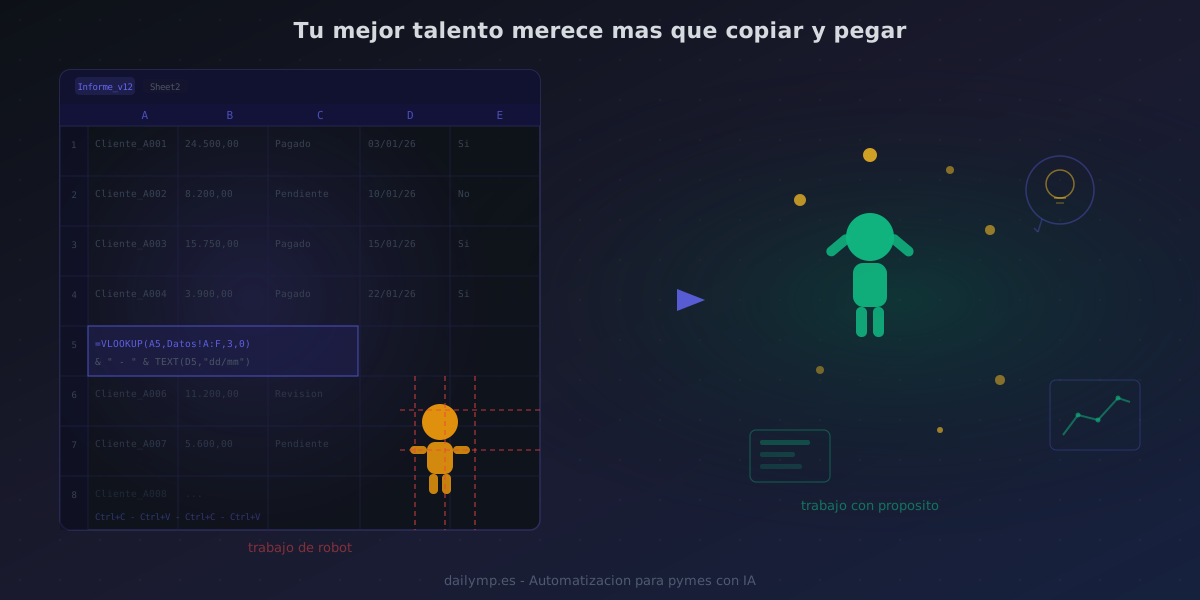
This morning, like every Monday, she opened the same spreadsheet. She exports data from the sales system, cleans it up, pastes it into the report template, checks the numbers add up and sends it by email. An hour and a quarter. Every week. Since she joined.
She's not unhappy with the team. Not with the salary either. She's unhappy with her work.
And you haven't noticed in months.
You're paying her to think. You have her copying.
This is the hardest thing to admit. When Sarah joined, the repetitive tasks were secondary. Over time, they accumulated. Nobody took them off her plate because it worked — she was reliable, fast, never complained. The result today is that someone earning between €2,000 and €3,000 a month spends between 30% and 50% of her time on work that doesn't need her intelligence. Work that doesn't need her judgment. Work that isn't helping her grow.
The economic cost is obvious if you do the maths: between €600 and €1,500 a month in expensive talent doing cheap work. But that's not the real cost.
The real cost is that Sarah is already looking at job listings.
She hasn't said a word. She's checking LinkedIn at lunch. And if something comes up that lets her get back to doing what she's good at, she'll leave.
The risk that doesn't show up in any report
Talented people share one thing in common: they can't go long without feeling like they're growing. They can last months, even a year or two, if there's an interesting project on the horizon. But when that horizon fills up with manual exports, repetitive emails and maintaining systems nobody wants to touch, the countdown starts.
And when Sarah leaves, she doesn't leave alone.
She takes with her the knowledge of how your company actually works: the unwritten shortcuts, the known errors, the undocumented processes that only she knew existed. She takes three years of context that lives nowhere in any manual. And she takes the energy the team needed to run well.
Replacing her takes two to four months of searching. Another three months of onboarding before someone new performs at the same level. In the meantime, someone else on the team carries her tasks — or nobody does. And the Monday report keeps being the Monday report.
The irony is that the work draining her motivation can be automated this week.
What can run automatically without changing any of your current tools
This is what changes everything.
The export Sarah does every Monday, the data cleaning, the report generated and sent by email — a system can do all of that automatically. Without her disappearing. Without changing the tools you already use. Without hiring anyone new.
These are the most common cases in the teams we work with:
Data sync between tools. The CRM data that needs to go into the spreadsheet, the order status that needs updating in three different places, the contact form information that needs copying into the internal record. All of that can be connected so it flows on its own.
Periodic report generation. The Monday report, the monthly sales summary, the pipeline status update. The system generates them with current data, in the right format, and sends them to whoever needs them. Without anyone preparing them.
Routine maintenance and alerts. Checking that everything's working, detecting issues, notifying when something changes. Tasks that eat up technical profiles' time without adding anything a well-configured automatic alert couldn't handle.
Predictable communication handling. Responses to the same recurring questions, follow-ups on unanswered quotes, appointment confirmations. When the message is always the same, nobody needs to write it each time.
Document classification and filing. Invoices, contracts, client documentation. Naming, moving, registering. A well-built system does it in seconds for every document that arrives.
The question isn't whether this can be automated. It already can. The question is how long you've been paying expensive talent to do machine work.
Real results
The teams that work with us at DAILYMP with automation agents tend to say the same thing after a month: "Sarah is Sarah again".
Not metaphorically. Literally. When someone stops doing mechanical work, they get their headspace back for thinking. They propose ideas. They solve problems. They bring the judgment you hired them for.
The change isn't just efficiency. It's the company recovering talent it already had and was wasting. And the person, for the first time in months, shows up on Monday actually wanting to be there.
If you want to see how this connects to the systems you already use, we can cover it in a 30-minute no-commitment call.
Before it's too late
Talent doesn't give notice when it's about to leave. One day there's a conversation, an offer, a moment of clarity — and within a month you have a gap in the team you didn't see coming.
The manual work trapping your best person can be automated. Without them having to learn anything new, without changing your systems, without any disruption to the team.
You just need to know what to automate first — and do it properly.