The Warning Signs Are in Your Data. Nobody Reads Them.
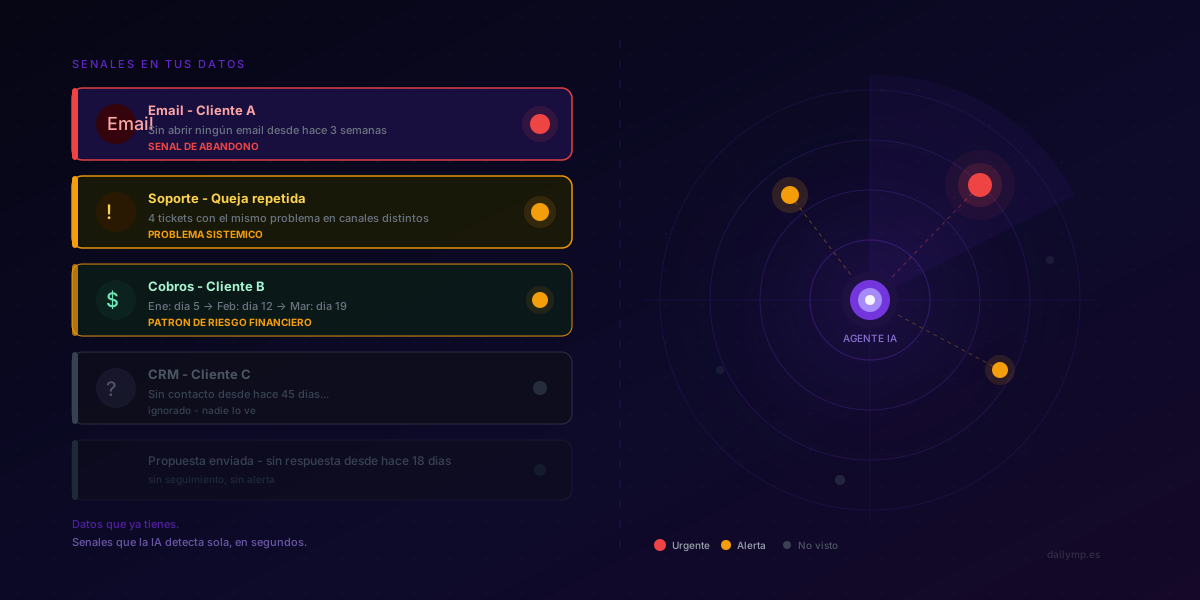
One of your clients hasn't opened a single one of your emails in three weeks.
The same complaint has appeared in your support inbox four times this month. Different words each time, same underlying problem.
A payment that arrived on the 5th in January came on the 12th in February. On the 19th in March.
None of those three things has triggered any alert in your business. Not because they're unimportant — they're very much so — but because catching them would require reading every email, reviewing every ticket, and cross-referencing payment dates with each client's history. That takes hours. There are more urgent things to do. And so, week after week, the signals pile up without anyone processing them.
Until the client leaves. Until the support issue explodes. Until the payment doesn't arrive.
Your data already knew it was coming. Nobody was reading it.
The signals that exist, that nobody sees
Your business generates information constantly. Every email opened or ignored. Every support ticket received. Every invoice paid on time or late. Every WhatsApp message left unread for three days. Every proposal sent that never got a reply.
All that information exists. It's stored somewhere: the CRM, the billing system, the support inbox, the WhatsApp history, the email archive.
The problem isn't that you don't have data. The problem is that that data is too much to process manually and too valuable to ignore. It's there, generating signals, and nobody has the time or the tools to read them.
In a business with 10 to 50 people, this shows up as concrete situations you probably recognize:
- A key client has gone quiet for weeks, and nobody notices until the contract renewal comes up
- An issue is affecting multiple clients, but since each complaint arrives through a different channel, nobody connects the dots
- One of your services has a higher complaint rate than the rest, but that data is buried in hundreds of emails
- Three clients whose payment patterns have been gradually worsening — a clear signal of financial stress heading your way
All of this is in your data. And nobody on your team can process it manually because their time is already full with the urgent work of each day.
The cost of not reading what you already have
This isn't abstract. It has a direct, calculable economic cost.
When you lose a client you could have retained, you lose the value of future projects with them. When a recurring support issue isn't detected in time, it escalates into a crisis that consumes hours of your team. When a client with payment problems isn't caught early, the invoice arrives late — or doesn't arrive at all.
The key point is that these problems are predictable. They're not bad luck. They're repeating patterns, signals that appear before the problem explodes, information that already exists in your system — and that, if someone processed it at the right moment, would give you time to act.
The problem is that "someone processes it" can't be a full-time person dedicated to reading emails and cross-referencing data. There's too much data and it changes too fast.
What an AI does that no person can
An AI agent integrated into your systems doesn't replace your team. It does something your team physically can't: read everything, always, without getting tired.
While your team works on the day's projects, the agent is quietly reading, analyzing patterns, and detecting anomalies. When it finds something relevant, it acts or alerts — depending on how you've configured it.
Here's what it can do with the data you already have right now:
Detect clients at risk of leaving. If a client who used to open 90% of your emails hasn't opened one in three weeks, that's a signal. If that same client hasn't responded to a proposal sent ten days ago, that reinforces it. An agent detects that pattern automatically and alerts the account manager to act before it's too late.
Identify recurring support problems. Three separate tickets, sent by three different clients, describing the same issue in different words. No person is going to cross-reference those tickets manually. An agent will. And it can alert you to a systemic problem affecting multiple clients, well before it escalates.
Monitor your clients' payment behavior. If a client's payment history shows a gradual trend toward paying later and later, that's data predicting financial trouble with enough lead time to have a proactive conversation — instead of chasing unpaid invoices.
Flag upsell and cross-sell opportunities. A client who has repeatedly bought service A and is now in a situation that fits service B perfectly. The agent spots the moment and can notify the sales team, or trigger personalized outreach directly.
None of this requires building a new system from scratch. The data already exists. What changes is that something now reads it systematically and acts on it.
What separates businesses that act before things go wrong
There are two types of business facing the same data.
The first kind learns about problems after they've already happened: the client left, the ticket escalated to a formal complaint, the payment didn't arrive. Then they react.
The second kind acts first. Not because they have more information — they have exactly the same data. But because they have something that reads it and turns it into actionable alerts at the moment when there's still time to intervene.
That difference isn't created by a data analytics department. It's created by a well-configured AI agent system that runs quietly in the background while the team does their work.
The result isn't just "catching problems sooner." It's that the team stops fighting fires because something sees them before they ignite. That frees up time, reduces stress, and improves client relationships — clients feel like someone is always on top of things, even if they don't know how.
The first step that's worth more than it looks
If you recognized your business in any of these scenarios, the starting point isn't buying anything. It's a ten-minute exercise: identifying which three signals from your business nobody is reading right now.
Are there clients who've gone quiet that nobody has noticed? Problems repeating in support that nobody has cross-referenced? Payment patterns that deserve attention before it's too late?
When that's clear, the solution becomes much more concrete — and faster to implement — than it seems.
If you want to work through that exercise together, in 30 minutes we identify which of your existing data has the most untapped value and what impact acting on it would have.
You don't need to understand how AI works under the hood. You just need to know that the data your business already generates every day is worth far more than what you're currently getting from it.