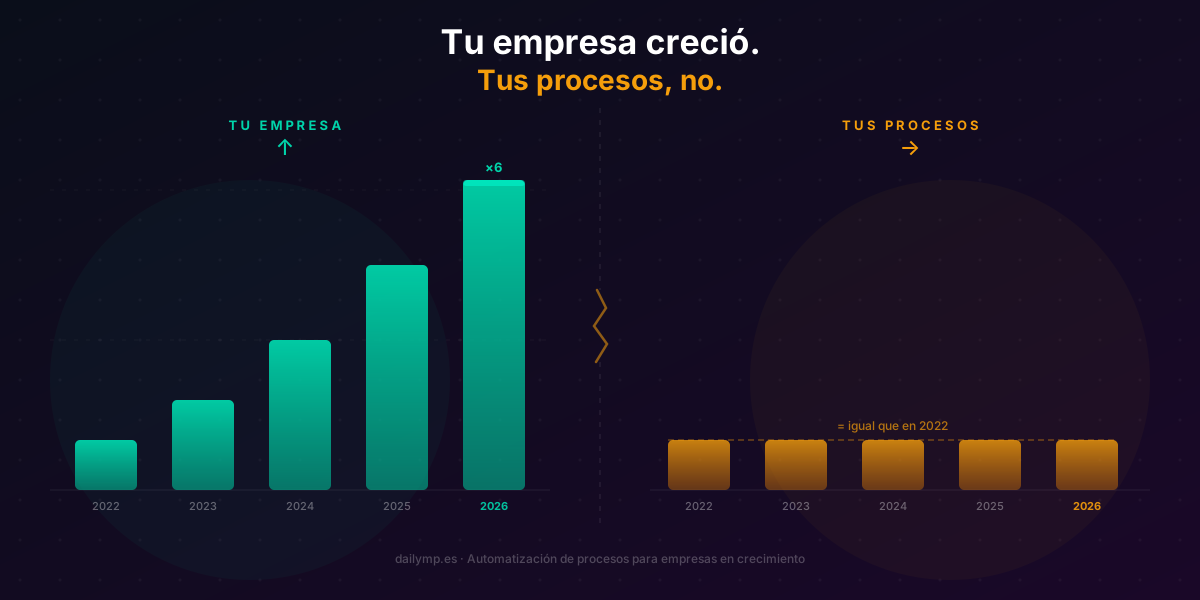
Your Business Grew. Your Processes Didn't.
There was a time when your business ran smoothly. Not perfectly, but smoothly. You were three or four people. Everyone knew everything. When a problem came up, you'd huddle for ten minutes and move on. A client would call and whoever answered could handle 90% of situations on the spot.
That was a while ago.
Now you're twelve. Or fifteen. And it works... mostly. But something's off. Mistakes are more frequent. Meetings run longer and resolve less. When someone goes on holiday, their whole area grinds to a halt. Clients are starting to notice inconsistencies that didn't used to exist.
It's not that the team is worse. It's that the systems you're working with were built for four people. Automating processes in a growing business isn't a nice-to-have — it's what separates companies that scale well from those that get stuck in their own success.
The symptoms that appear when your team grows but your systems don't
There's one very clear sign that your processes haven't kept pace with your business: the same task produces different results depending on who does it.
A client calls and gets an answer. Two weeks later they call again, speak to someone else, and the answer is slightly different. Not dramatically different — just enough for the client to sense that something isn't quite right.
That's not the only symptom. Here are the most common ones:
- To know how a project is going, you have to ask someone. There's no place where that information is visible without a person in the loop.
- New employees take weeks to understand how the business actually works. They learn by asking, not by reading any documentation — because that documentation doesn't exist.
- When someone is off sick, a task doesn't get done. Or you absorb it yourself. Or someone else improvises, not really knowing how it should be handled.
- Work conversations are scattered across four different channels and when you need a specific piece of information, you search everywhere and find it nowhere.
- The mistake that happened last month happens again this month, because nobody documented why it occurred or what needs to change to prevent it.
This isn't bad luck. It's not disorganisation. It's what happens naturally when a business grows without its systems growing alongside it.
Why this is costing you more than you realise
Here's the problem: the cost of operational chaos doesn't appear on any invoice. There's no line in your accounts that says "losses due to missing processes: £3,200 this month".
But it's happening.
It's in the clients who don't come back. Not because your service is bad, but because they had two slightly different experiences and the feeling is that "this company doesn't always do things the same way." That perception is enough for them to choose someone else next time.
It's in the time your team wastes. Every time someone has to ask how to do something that should be documented, that question costs two people time: the one asking and the one answering. Multiply that by every day, every new hire.
It's in the mistakes that repeat. If a process runs on memory with no fixed reference point, the error isn't learned from — it repeats. Next month it happens again, and the month after.
It's in your dependence on specific individuals. If certain tasks can only be done by one person, that person can't get sick or go on holiday without something breaking. And if they leave the company, they take half the operational knowledge with them.
The cost isn't dramatic at any single moment. It's cumulative. And it grows at exactly the same rate as your team.
What automating processes actually means for a growing business
At this point, many business owners close the article thinking: "that's for companies with an IT department and a consulting budget."
It isn't.
Automating processes in a growing business — ten to thirty people — means very concrete things:
- The client who submits a contact form gets the same well-written response at 2pm and at 9pm, without anyone managing it manually.
- When a sale closes, the data flows automatically to the systems that need it, without anyone copying anything by hand.
- Follow-up tasks happen on their own: the reminder goes out, the update is sent, the report is generated.
- There's one place where the status of every project is visible to whoever needs it, without having to ask the person managing it.
None of this requires replacing the tools you already use. It requires connecting them and adding the automation layer that turns your current processes into processes that run consistently on their own — regardless of who is or isn't in the office that day.
If you're not sure where to start, our AI integration service for businesses does exactly that analysis: identifying which processes have the highest impact when automated first and how to connect them with what you already have.
The three questions that show you what to automate first
You don't need to transform everything at once. In fact, trying to do so is the surest way to transform nothing.
These are the three questions I always ask when starting with a new business:
1. What task is repeated more than three times a week in exactly the same way? If the answer is "none", you're not looking closely enough. Every business has tasks that get done the same way, over and over. Those are the first ones to automate.
2. What task gets dropped or forgotten when things are busy? The tasks that disappear under pressure are the most dangerous: they're visible to the client and the first ones to damage trust.
3. What information has to pass from hand to hand for something to happen? Every time someone has to copy data from one system to another, there's a failure point and a delay point.
With those three answers, you have the map of what to automate first. And in most businesses, addressing those three points changes the operational rhythm immediately — without large investment or months of implementation.
At DAILYMP we've built systems like this for businesses of 8 to 40 people. The pattern is always the same: a few weeks of implementation, impact that's visible in the first month.
Real results
The businesses we work with to systematise their operational processes move from "everything depends on someone" to "the system manages it, people oversee it".
Onboarding time for new employees drops from weeks to days. Inconsistency errors disappear because the process is always the same, regardless of who executes it. And the owner can actually disconnect without the operation stalling.
What we hear most often after a month of working together: "I didn't realise it could be fixed this quickly."
Your business is no longer small. Its systems still are.
You've done the hard part: you've grown the team. You've won clients. You've scaled.
What you haven't done yet is let the systems that hold that business up grow at the same pace. And that gap is what generates the noise you're noticing: repeated mistakes, inconsistencies, dependence on specific people, the feeling that the more you grow, the more chaotic things get.
Fixing it doesn't require a total transformation or stopping operations. It requires starting with the process that hurts most and building from there.