Your Business Data Is Lying to You
Three People. Three Different Answers. The Same Client.
A client calls. They want to know if their project is still on track.
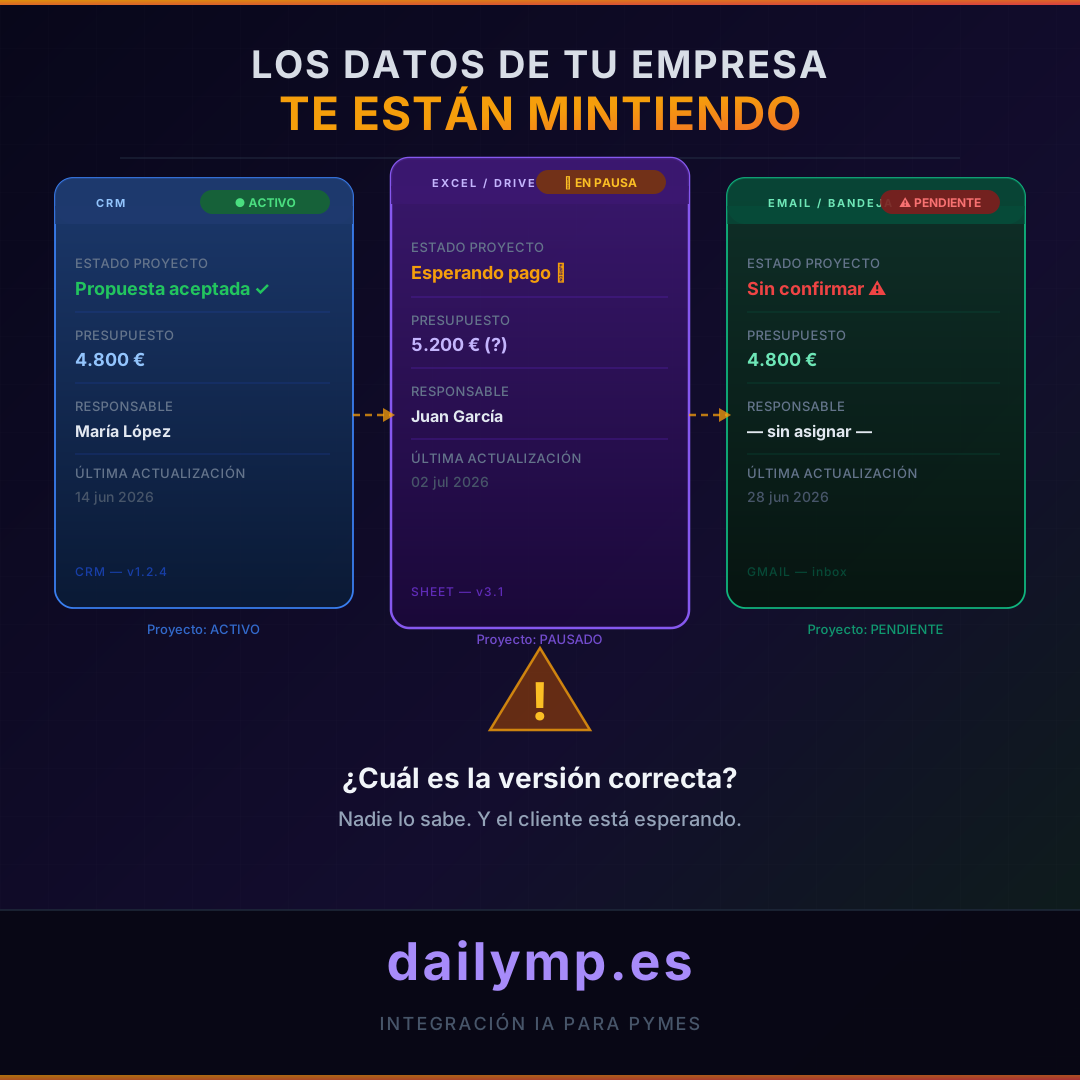
Your sales rep checks the CRM: "Yes, there's an accepted proposal from last month." Your project manager opens the spreadsheet: "It's on hold. Waiting for payment confirmation." Your accountant searches through email: "We sent an invoice two weeks ago. Still no reply."
What's the actual situation? Nobody knows for certain. And the client — who just wanted a simple answer — now has three contradictory versions of their own project.
This isn't a communication problem. It's a data problem.
The Hidden Cost of Deciding on Wrong Information
When your business data lives in separate places and nobody syncs it, every decision carries a built-in margin of error. It doesn't show up on any report, but it's there.
Here are concrete examples that happen in real SMEs every week:
- You send two different quotes to the same client because one salesperson didn't see that a colleague had already sent one.
- You undercharge because someone updated the price in the spreadsheet but not in the CRM used to generate the invoice.
- You assign resources to a paused project because the team didn't know the client had asked to wait a month.
- You lose a client because nobody logged that they had a problem in March, nobody followed up, and by June they had already moved on to a competitor.
Add those mistakes up over a year. The number tends to be unpleasantly surprising.
Why This Happens — and Why It's Not Your Team's Fault
Businesses don't start with fragmented data. Data fragments on its own over time, naturally.
At first there's one person who knows everything. Then two. Each one uses whatever tool works best for them: one uses email, another a personal spreadsheet, another WhatsApp. Nobody syncs anything because "we just talk to each other."
When the team grows or the workload increases, that informal coordination breaks down. Every tool has its own version of the truth. And none of them is complete.
The tools aren't the problem. The problem is that they're not connected to each other. Someone has to go into each one and update the same information multiple times. Nobody does that consistently. And that's where the mistakes nobody sees coming begin.
What a Business With Clean Data Actually Looks Like
Having your data in order doesn't mean using just one tool. It means that when something changes in one place, it changes everywhere.
Client confirms the project → CRM status updates → project team sees it → invoice is generated automatically → follow-up is scheduled.
Without anyone copying and pasting anything. Without anyone having to "remember to update the spreadsheet."
This is achieved in two ways:
1. Integrating your existing systems so they talk to each other: CRM, billing, project management, email. A change in one reflects in all. You don't have to replace the tools you already use — just connect them. That's how we approach AI systems integration.
2. Putting an AI agent as a unified layer: it receives information from any channel, logs it in the right place, and updates the status of everything that depends on that data. That's how the automation agents we build for SMEs work: they don't replace your tools, they orchestrate them.
The result is one: when someone asks about a client, there's one answer. And it's the right one.
What You Gain Goes Beyond Time Savings
When your data stops contradicting itself, concrete things happen in the business:
- Meetings get shorter because nobody wastes time reconciling different versions of the same information or asking "who has the right version?"
- Billing errors disappear because the price and project status are always the same across all systems.
- Customer service improves because anyone on the team can answer without having to ask someone else first.
- Decisions improve because they're based on real data, not on what someone remembers seeing somewhere last week.
It's not magic. It's having a system that works.
Does Everyone in Your Business Have the Same Version?
If the answer is "not always," or "depends who you ask," the problem is already there. You're just not measuring it yet.
The good news: you don't have to replace every tool you use. Most of the time, it's enough to connect them and automate the sync.
If you want to know which systems you have disconnected and how much that's costing you, I can walk you through it in 30 minutes at no cost.
Message me on WhatsApp and we'll figure it out together.