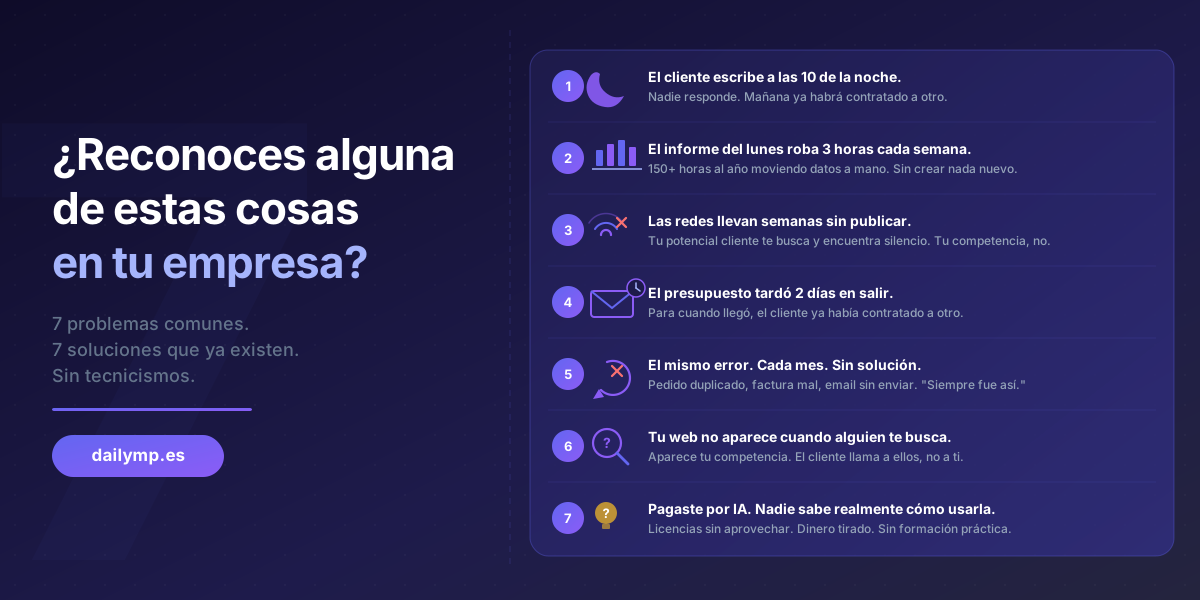
7 Business Problems That Already Have a Solution
It's nine in the evening. You're ending the day with more pending tasks than you had this morning.
Not because you didn't work hard enough. It's because your business has processes that demand more than they should — from you, from your team, and from your time. And the worst part isn't that it happens. It's that everyone treats it as completely normal.
At DAILYMP we work with businesses of 10 to 50 people. There are seven situations we see repeating in nearly all of them. Not as occasional exceptions, but as part of daily life. And all seven have a solution. None of them require you to understand technology.
Do you recognize any of yours?
1. The client who writes at 10 PM and nobody answers
A potential client visits your website on a Tuesday night, has a specific question, sends a message. Next morning someone sees it. By midday they reply.
By then, they've already contacted another company.
This isn't exaggeration: responding within the first 30 minutes multiplies by 7 the chances of converting that inquiry. After 24 hours, the opportunity has nearly vanished. The problem isn't your team's dedication — it's that no human can be available at any hour for any incoming inquiry.
At DAILYMP we set up agents that respond, qualify, and schedule appointments automatically, even when your team is unavailable. Explore our AI agents and automation service.
2. The Monday report that steals 3 hours every week
Every Monday, someone on your team opens several programs, copies data, pastes it into a spreadsheet, checks the totals add up, and sends it by email. Always the same. Always by hand.
That's 3 hours not spent analyzing the data. Just preparing it.
Over a year, that's over 150 hours dedicated to moving information from one place to another — without creating anything new, without adding insight, without anything changing. That time exists. It has a cost. And it doesn't produce anything that an automatic process couldn't do without anyone touching it.
At DAILYMP we connect your tools so data flows automatically and reports generate without anyone touching them. More about AI integration for your business.
3. The social media you "update when you can"
You have a presence on LinkedIn or Instagram. But between one project and the next, weeks go by without anything new published. You know it. The intention is there. The time isn't.
The problem is what a potential client sees when they look you up: silence.
Silence on social media isn't neutral. It signals either that there's no activity, or that nobody in your business has time to show it. Your competitor who posts regularly doesn't have more time than you — they have a system that works while they focus on other things.
At DAILYMP we create and schedule content tailored to your business automatically, without you writing a single line. Discover the AI agent for social media.
4. The proposal that took 2 days to send (the client already hired someone else)
A request comes in. You need to find client data, review current prices, write the proposal, format it, and send it. Two hours of work and a couple of days before it goes out.
By the time it arrives, the client has received other proposals. And in many cases, already made a decision.
Speed in the sales process isn't a secondary detail — it's a direct competitive advantage. The first well-presented, fast proposal has a significantly higher probability of winning. Not because it's better. Because it arrived first.
At DAILYMP we automate the commercial process so the time from inquiry to proposal is minutes, not days. More about AI-powered sales automation.
5. The error that repeats every month because "that's how it works here"
There's a process in your business that fails regularly at the same point. A duplicate order. An incorrect invoice. A confirmation email that never arrives. Everyone on the team knows about it. Nobody has fixed it.
It's not that nobody wants to fix it. It's that nobody has time to stop and redesign the process.
The problem with leaving a systematic error unresolved isn't just the error itself — it's the cost that accumulates every time: correction time, client incidents, lost credibility. A bug that slips through one month, multiplied by twelve, is a real problem.
At DAILYMP we audit and automate processes so recurring errors stop occurring before they reach the client. Learn about Bug Shield, our AI-powered QA service.
6. The website that doesn't show up when someone searches for you
Someone in your area searches for exactly what you offer. Three businesses show up. You're not one of them.
Your website exists. It's up to date. It has accurate information. But if it isn't optimized for the right searches, it's invisible to that potential client.
For many service businesses, search engines are already the main channel through which new clients arrive. Not showing up there isn't a minor issue to fix someday — it's business walking through your competitor's door while yours stays closed.
At DAILYMP we design and position websites so you appear when your client searches for you. More about web design and SEO for businesses.
7. Your team has AI tools that nobody really knows how to use
The business paid for Copilot, ChatGPT, or other AI tool licenses. The team uses them occasionally, without clear criteria, without measurable results. Each person uses them for different things. Or barely uses them at all.
Having the tool without knowing exactly what to do with it in your specific business isn't leveraging AI. It's paying for something expensive with no return.
The difference between a business that saves real time with AI and one that pays for licenses without results isn't the tool. It's whether the team knows what to do with it, when, and for which specific task in their daily work.
At DAILYMP we train teams in practical AI use for their specific business: what to use, when, and how to measure the result. Explore our AI training for businesses.
Real results
We're not asking you to trust our word. Here are real results from businesses we've worked with: from 0 to 2,620 people seeing their business on LinkedIn in 3 months, proposals that used to take 2 days now going out in 20 minutes, teams that recovered 10 weekly hours from repetitive work.
The starting point isn't understanding technology. It's recognizing that something in your business could work better — and deciding to change it.
Did you recognize yourself in any of these situations?
If reading this list made you think "that happens to us" for even one point, you already have enough information to act.
The question isn't whether you need to improve these processes. The question is how much longer you're going to wait while they keep costing you money, hours, and clients.
I can help you identify which of these situations has the most impact on your business and what can be resolved first. No commitment, no jargon, in a 30-minute call.