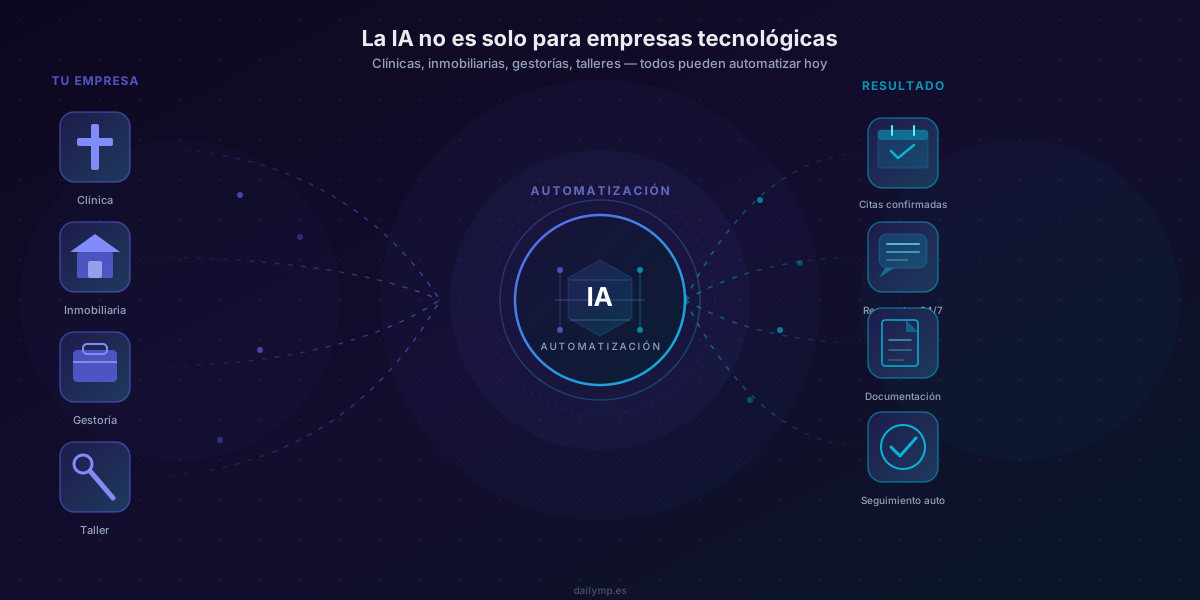
Your Business Doesn't Have to Be a Tech Company to Automate
There's an idea that stops many businesses before they even start: "AI is for tech companies, not for us".
It's understandable. When you read about artificial intelligence, you see startups, digital platforms, companies with entire engineering teams. You don't see neighbourhood clinics, family-run accounting firms, or auto repair shops. And if you don't see it, you assume it's not for you.
But that's exactly the mistake: confusing the industry with the processes. AI doesn't automate tech companies. It automates tasks. And repetitive tasks — responding to messages, confirming appointments, sending reminders, following up with clients, generating documents — exist in every business, regardless of sector.
What I want to do in this article is simple: show you four types of business that have nothing to do with technology, and what they're already doing with automation today.
The Clinic That Stopped Calling Its Patients
A physiotherapy clinic with five practitioners. For years, the receptionist spent one and a half to two hours a day confirming appointments: calling patients one by one, waiting for them to answer, updating the schedule if someone cancelled, and reassigning the slot.
It's not complicated work. But it has to get done — because no-shows cost real money: an empty 45-minute slot is a patient who wasn't seen and revenue that didn't come in.
With an automation agent, the process now works like this: 24 hours before the appointment, the system sends an automatic WhatsApp message to the patient. The patient confirms with a "yes" or cancels. If they cancel, the system updates the schedule and notifies the team. If there's no response within two hours, the system places an automatic call.
The receptionist no longer calls anyone. She reviews the exceptions — the cases that genuinely need a human — and uses that time for other things.
Result: fewer no-shows, less time on the phone, the same well-managed schedule.
The Real Estate Agency That Never Sleeps (But Its Agents Do)
A potential client visits a property website on Saturday afternoon and fills in a contact form asking about a flat. Monday morning, someone from the team sees it, replies, and schedules a viewing for Tuesday.
By then, the client has already spoken to two other agencies that replied within the hour.
In real estate, speed of response is everything. The first one in has the advantage. And getting there first at 8pm on a Saturday is impossible when it depends on someone checking their inbox.
An AI agent connected to the contact form responds in seconds: it greets the client, asks what kind of property they're looking for, sends the most relevant listings, and books a viewing directly into the available agent's calendar. All without anyone managing it manually.
The human agent arrives Monday to find the appointment already booked.
Result: 24/7 response speed, more viewings closed, less time answering basic enquiries.
The Accounting Firm That Stopped Chasing Documents
If you've worked with an accounting firm — or you run one — you know this problem: clients need to submit their documents before a deadline, and chasing them consumes a disproportionate amount of the team's time.
Emails are sent. Calls are made. The email gets sent again. The client says they'll send it soon. They don't. The deadline creeps closer. Another, more urgent reminder goes out. Week after week, for every client, for every due date.
With an automated reminder flow, the process runs on its own: the system knows which documents each client needs and when the deadline is. It sends the first reminder a month out. Another two weeks before. A final one three days prior. If the client still hasn't submitted anything, the system alerts the account manager to step in.
The account manager no longer needs to track the status of twenty clients in their head or spend time chasing anyone. The system does that for them.
Result: fewer missed deadlines, fewer follow-up calls, team focused on work that actually creates value.
The Auto Shop That Stopped Losing Quotes
A car repair shop receives twenty enquiries a week via WhatsApp and email. Each one requires calculating a quote, writing it up, sending it, and then following up to see whether the client accepts.
Some of those enquiries get lost along the way. The shop was busy, the mechanic didn't have time to reply, the client waited two days and went somewhere else.
An agent connected to the shop's contact channels can reply to the initial enquiry, ask for the vehicle details and the nature of the problem, generate an estimated quote based on the shop's rates, and send it to the client within minutes. If the client accepts, it books the appointment. If there's no reply within 48 hours, the system follows up automatically.
Result: more quotes sent, faster, with less load on the team.
What These Four Businesses Have in Common
A clinic, a real estate agency, an accounting firm, a car repair shop. Completely different sectors. None of them are tech companies. None of them have a development team. None of them needed anyone to write a single line of code.
What they have in common is that they identified tasks that were always done the same way, with the same steps, and delegated them to a system instead of a person.
That's automation in its most practical form: it's not artificial intelligence in the science-fiction sense. It's taking a process that someone on your team does repeatedly in exactly the same way, and making it happen on its own.
The most common tasks that can be automated in any sector are:
- Confirmations and reminders (appointments, deliveries, deadlines, pending payments)
- Responses to repetitive enquiries (FAQs, availability, rough pricing)
- Lead and quote follow-up (without anyone having to remember to do it)
- Document requests and management (without chasing anyone by phone)
- Report and summary generation (without copying data between programmes by hand)
If your business has any of these tasks being done manually and repeatedly, you already have your starting point.
Where to Start If You've Never Automated Anything
You don't need to overhaul your entire operation overnight or understand how the technology works under the hood. The first step is much simpler: identify the task that takes the most time in your team and is always done exactly the same way.
That task — whatever your sector — is the perfect candidate for your first automation. And it's rarely a huge project or a disproportionate investment. It's a concrete change that frees up real hours from the first month.
If you'd like to explore which processes in your business could be automated and what it would change in your operation, let's talk. A free 30-minute consultation, no jargon, no commitment.
You can see how I work on AI integration for businesses and on AI agents and automation.