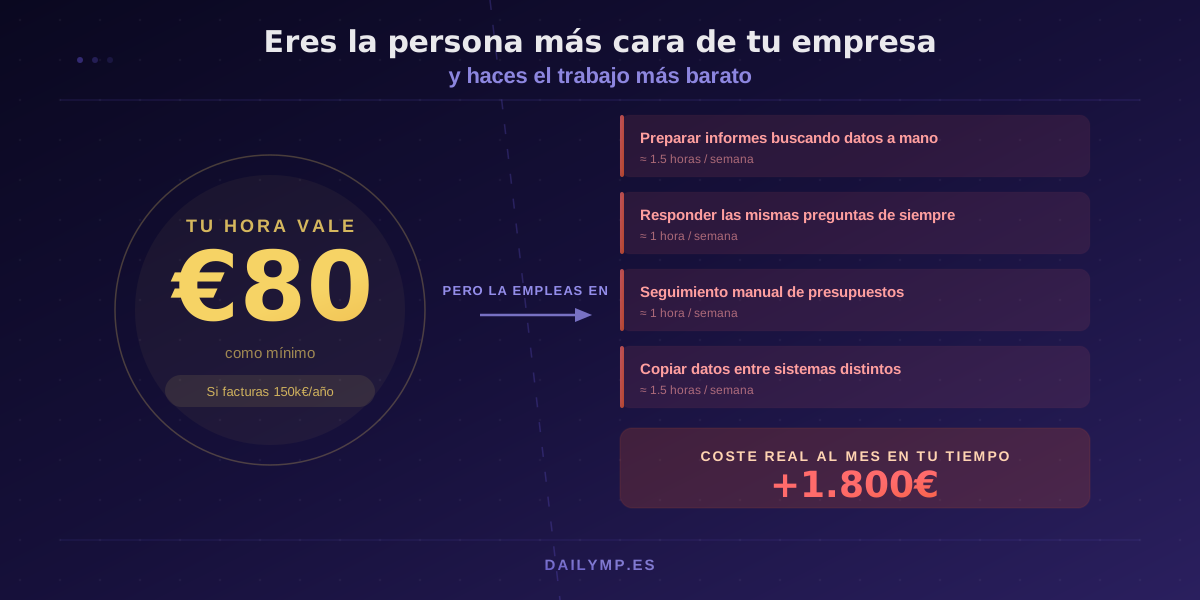
The Priciest Person in Your Company Does the Cheapest Work
Tuesday, 9:30 AM. Twelve unread emails, a weekly report nobody has started yet, and two suppliers waiting on confirmation. Your phone rings. Another urgent thing.
By 2:00 PM you've been working for four hours and you still haven't done what you actually needed to do.
This isn't a discipline problem. It's a role problem. You're the most expensive person in your company doing the cheapest work. And the bigger the business grows, the wider that gap gets.
The Calculation Nobody Wants to Make
There's a simple sum most business owners avoid. Too uncomfortable.
If your company bills between €100,000 and €200,000 a year and you put in 40–45 hours a week, your hour is worth between €55 and €100 in real terms. More if your margins are strong, more if you have a team that multiplies your output.
Now think about what you did yesterday.
Did you pull together a report by hunting data from different places? Did you answer questions you've already answered twenty times? Did you chase up a supplier that someone else — or a system — could have handled? Did you manually update data that should update itself?
Those tasks, outsourced, cost €10–€20 per hour. You're doing them at €80 per hour. The gap between those two numbers, every single week, is money your business loses without it ever showing up on a P&L.
5 Owner Tasks You Could Automate This Week
I work with small businesses of 5 to 40 people. And there are five tasks that show up in almost all of them — always consuming the time of the most valuable people in the business.
1. The Weekly Report Nobody Wants to Prepare
Every week, someone in management spends one to two hours pulling data from different sources — sales, new clients, tasks, incidents — and formatting it into a spreadsheet or PDF for the team.
The result: a document the team glances at for five minutes and files away.
A system connected to your existing tools generates that report automatically: up-to-date data, whatever format you need, sent to whoever needs to receive it. Without anyone touching it.
2. The Questions That Are Always the Same
"How much does it cost?" "How long does it take?" "Do you have availability next month?" "What do I need to get started?"
If your business receives these questions by WhatsApp, email, or contact form, someone — often you — answers them one by one, every week, always the same answers.
An AI agent connected to your website or WhatsApp answers these questions instantly, 24 hours a day, and only escalates the cases that actually need your judgment. That's exactly what we build through our AI integration service.
3. The Follow-Up on Proposals You Sent
You send a quote. Four days go by. No reply. Do you follow up? Probably not — you have ten more urgent things sitting on top of it.
Meanwhile, your competitor already sent a message. They have the meeting booked.
Automated follow-up detects every unanswered proposal and sends the right message to the client at the right moment. You only appear when there's a real decision to make.
4. Coordinating with Suppliers and Collaborators
Emails to confirm dates. Messages asking for updates. Replies to "how's that thing going?" that add nothing unless they come with the actual answer.
Most of this coordination is routine. It doesn't need your judgment. It needs something — or someone — to manage it consistently without forgetting.
5. Copying Data from One System to Another
Your CRM is on one side. The spreadsheet is on another. The invoicing system somewhere else. When something changes in one, someone has to update the others.
That someone is usually you. Or a team member who could be doing something that actually matters.
Integrations between systems eliminate this work entirely. Data flows on its own. Nobody copies anything anywhere.
What Changes When You Automate These Tasks
The first reaction I hear from business owners is: "Sure, but my company is different." I get it. You've been doing things this way for years. It seems like there's no other option.
There is. And it doesn't require understanding technology, hiring anyone new, or changing how your whole team works.
When these tasks stop depending on people — especially on you — three concrete things happen:
You get real time back. Not "a little more time." I mean 20 to 30 hours a month that return to you for doing the things only you can do: making decisions, building relationships, thinking about the business.
Processes become consistent. The report arrives every week on the same day. Follow-ups go out on the same schedule. Questions get answered the same way every time. Quality stops depending on whether someone had a good day.
Your business runs outside your working hours. Enquiries that arrive at 10 PM get a response. Follow-ups due on Saturday go out anyway. The business keeps moving even when you're not in front of it.
Real Results
At DAILYMP we work with business owners who have been managing these tasks manually for years. Not because they enjoy it. But because they never found a way to get rid of them without tech jargon and without the solution costing more than the problem.
The process always starts the same way: a 30-minute session where we map out together which tasks in your business make the most sense to automate first. No commitment, no technical jargon, just a clear diagnosis and a real cost.
Most business owners identify three to five automatable tasks in that first conversation. And the cost of automating them is usually less than the value of a single week of the time they're currently losing.
What Is Waiting Costing You?
Do the maths yourself. Estimate how many hours per week you spend on manual tasks that could run by themselves. Multiply by your real hourly cost. Multiply by four weeks.
That number — whether it's €600, €1,500 or €2,400 — is what it costs your business every month to not automate your manual tasks. Not in some theoretical scenario. In your actual business, right now.
Talk to Daily and map out what to automate first →
The 30-minute consultation is free. The cost of not booking it, you already know.