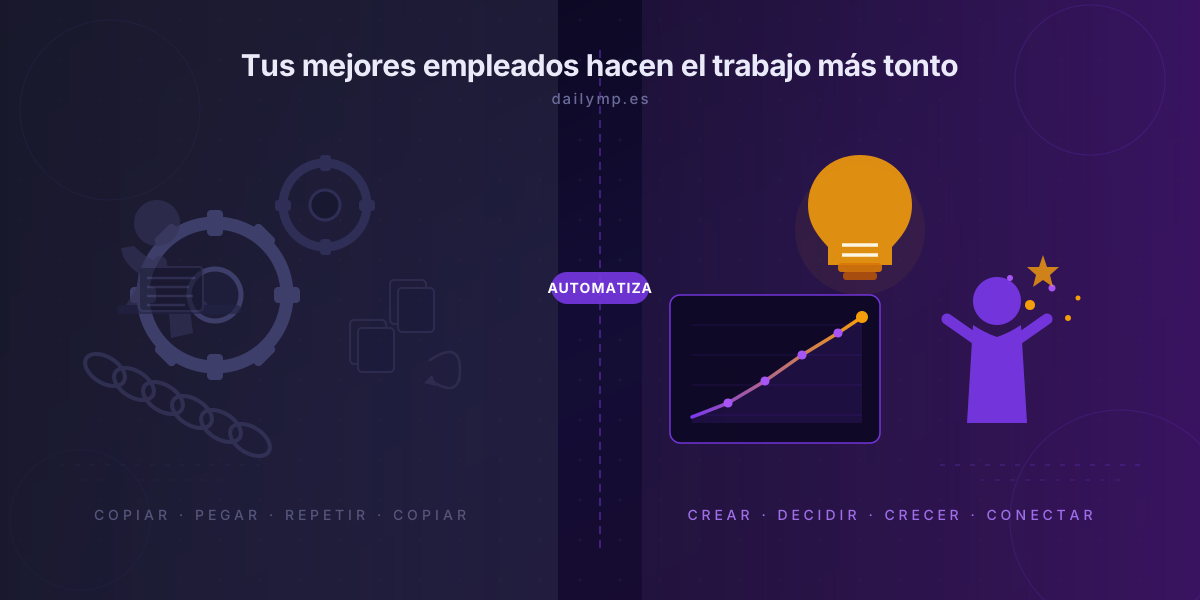
Your Best People Are Doing Your Worst Work
Maria has been with your company for four years. When you hired her, she won you over in the interview by talking about clients — how she reads people, how she senses what a customer needs before they say it. You chose her for exactly that.
This morning she's been updating the CRM for ninety minutes. Field by field. Copying dates. Pasting notes. Making sure every status label is current.
Ninety minutes. No thinking. No connecting with anyone. No application of anything that makes her actually good at her job.
That's not Maria's fault. It's a design flaw in how your business operates.
The talent you hired and the work you give them
Think for a moment about the people on your team. Why did you hire them?
One, for his analytical mind. Another, because she handles difficult clients without losing composure. A third, because he brings a business perspective most people his age haven't developed yet. The fourth, because she solves complex problems with a calm that your whole team looks to in a crisis.
Now think about what percentage of their day actually requires those abilities.
The analysis that never happens because they have to compile the data report by hand first. The client relationship that gets pushed because a system record needs updating. The business insight that waits while someone moves leads from a web form into a spreadsheet, then into the CRM, one by one, carefully.
You have the most capable people in your company doing the work that requires the least capability.
This doesn't make you a careless business owner. It's what happens when processes grow organically toward complexity — at some point someone had to do it manually because that was the only way available. And it stayed that way, unquestioned, because it works and because there are always more urgent things to deal with.
What robot work steals from your business
The most visible cost is time. But it's not the most expensive.
The most expensive thing is what doesn't happen while someone is busy with mechanical work.
The follow-up call that never happened because your account manager spent Tuesday updating system records from the previous week.
The problem nobody caught in time because the operations lead was compiling the weekly report — data from four systems, three hours of work for a document that takes ten minutes to read.
The process improvement that nobody proposed because team meetings get consumed reviewing task statuses that should live on a live dashboard.
The upsell opportunity that slipped away because nobody had time to check which active clients hadn't heard from you in months — that review also happens manually, when there's time, which is almost never.
Robot work doesn't just consume hours. It consumes the attention, energy, and judgment of people who could be using those things to grow your business. That cost doesn't appear in any report because nobody measures it — you only feel it when results don't move as fast as they should.
What happens to good people who do bad work
There's something business owners don't always see coming: talented people, when they do robot work for too long, start to disengage.
Not dramatically. They don't come in one morning and announce they're done. It happens gradually: they stop suggesting improvements because "nothing ever changes anyway." They stop bringing energy to meetings because they used it all up before the meeting started. They stop feeling like their work matters — because for months, it hasn't required anything they're actually good at.
And eventually, those people leave. To find a place where the work demands something more than copy-paste.
The cost of replacing a good employee — search, onboarding, and months before a replacement performs at the same level — typically runs three to six months of their salary. And most of those departures aren't about compensation. They're about the work stopping to feel meaningful.
Automating mechanical tasks isn't just an efficiency decision. It's a decision about what kind of company you want to be for the people who work with you.
What changes when your team stops doing robot work
It's not about working less. It's about working on what they're actually good at.
When CRM updates happen automatically after every call, your account manager has real time to reach clients who've gone quiet. When the weekly report generates itself with the right data, your operations lead arrives at the meeting having actually thought about what they want to say — not racing to finish the numbers. When internal approvals have an automatic reminder flow, nobody has to send the same email three times to get a signature.
People do what people do well: read situations, make decisions, build relationships, solve what wasn't expected.
At DAILYMP, we identify exactly which tasks on your team require execution but not judgment — and we build the system that handles them automatically. We don't replace the tools you already use. Your team doesn't learn anything new. Integrating AI into your current business processes typically takes two to four weeks.
And what we hear afterward, almost every time, is the same thing: "I can't believe we used to do this by hand."
Not because it was complicated. Because now the team has time to do what you actually hired them for.
Real results
Businesses we work with in consulting, professional services, and retail have freed between 10 and 18 hours per week of mechanical work from their teams. In most cases, the first impact wasn't in revenue — it was in how it felt to work at the company. The second impact followed: more clients reached, more opportunities identified, more problems caught before they became emergencies.
Your team is better than their current tasks show
The question worth asking today is specific: which capable person on your team is spending their best hour of the day on mechanical work?
That task — that specific one — is almost certainly automatable. Clearing it from their list isn't a big project. It's a decision that gets made in a single conversation.
If you want to know which tasks on your team could disappear from their lists this week, tell me what your business does. I can give you a concrete answer in 30 minutes.