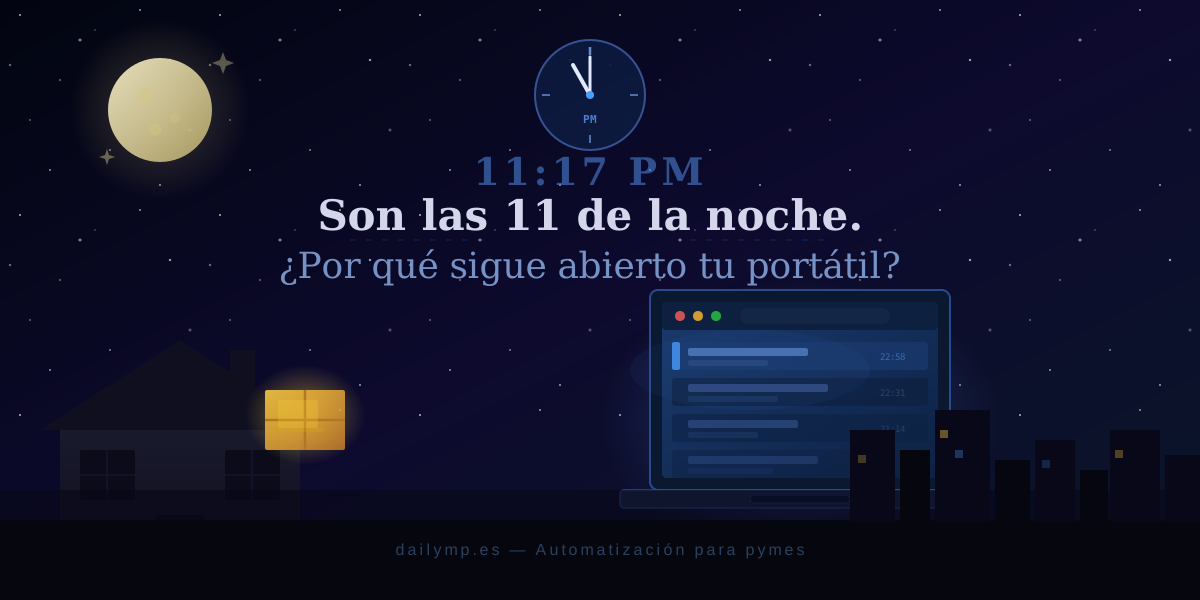
It's 11 PM and You're Still Running Your Business
It's 11:17 PM.
Your partner fell asleep an hour ago. The kids have been out for two. Even the dog found his spot on the sofa and hasn't moved.
And you still have the laptop open.
It's not a crisis. Not a real emergency. Just the usual weight of running a business at the end of the day: checking if important emails got a reply, updating something left pending, preparing what the team needs tomorrow, looking at the day's numbers in case something needs attention.
Things that "only take a minute." That together take another hour and a half.
This isn't dedication. It's a design flaw.
There's a widespread story about business owners who work late: that they're the most committed, the most responsible, the ones who truly take their business seriously.
That story is wrong. Or more precisely: it confuses the symptom with the virtue.
The business owner working at 11 PM isn't the most dedicated one. They're the one running a business that can't function without them. A business that depends on someone watching, approving, reviewing, and responding for things to happen.
That's not commitment. That's a design flaw.
A well-built business should work with less of you, not more. Repetitive processes should happen on their own. Tasks that look the same every day shouldn't depend on someone remembering to do them. Routine messages shouldn't wait for you to be available.
If your business still needs you at 11 PM, the problem isn't the hour. The problem is that your business doesn't have the systems that should be doing that work.
The five tasks keeping you up (that don't belong on your list)
Not all late nights are the same. There are real problems that require human judgment and sometimes happen at night. That's unavoidable.
But most of the time, what you have open on your laptop at 11 PM isn't a complex problem. It's routine management work that could — and should — have handled itself.
1. Checking whether important emails got a reply. You sent three proposals this week. None have responded. You're following along. Every night you open your inbox to see if there's anything. If there were a system doing that follow-up automatically and only alerting you when something moves, you wouldn't need to check. The system would do it.
2. Updating project or order status. A client asked how things are going. A team member sent an update on WhatsApp. You have to sync everything together and reply. If information flowed automatically between systems — from the team to the client, from the work to the record — there'd be nothing to update manually. It would already be done.
3. Looking at the day's numbers. How many sales? What came in? How's the month going? Nobody sends you that summary. You have to open three different programs, cross-reference the data, and build the picture yourself. If an automatic report arrived every evening at 6 PM with everything consolidated, there'd be nothing to review at night. You'd have already seen it.
4. Responding to late-arriving enquiries. Someone wrote at 7 PM. Your working day ended before that. But the client is waiting, and by tomorrow morning it'll already look like you took too long. So you respond now, at 11 PM, before going to sleep. If there were an intelligent automated response handling that initial enquiry — gathering the details needed, giving a useful first answer, and only alerting you when it actually needs your input — you wouldn't have to be awake for it.
5. Preparing what tomorrow needs. The brief for the 10 o'clock meeting. The information the supplier asked for. The document that needs to be ready before someone arrives. Things that could have been prepared automatically if the process were connected, but that depend on you remembering and preparing them before bed.
None of those five things require your judgment. None of them require your expertise. They are processes that repeat the same way, every single day, and exist on your late-night list because nobody has automated them.
The cost nobody calculates
When we calculate the cost of not automating, we almost always think in hours worked or money lost. Those calculations matter. But there's another cost that rarely appears in any spreadsheet.
The decisions you make at 11 PM are worse decisions.
Not because you're less professional. But because the human brain has a limited decision-making capacity each day. After hours of work, cortisol levels are elevated, analytical capacity is reduced, and the tendency to choose easier options — even if they're not the best ones — increases.
The proposal you review at 11 PM won't have the same quality of judgment as the one you'd review fresh at 9 AM. The email you send before going to sleep will have a different tone to the one you'd write with a rested mind. The decision you make tired is a degraded version of the one you'd make well.
And that has real consequences for your business.
There's more. Every late night takes longer to recover from than it seems. Interrupted sleep, a mind that doesn't fully switch off, the difficulty of starting the next day with energy. A business owner who sleeps badly for months isn't the same person who made the decisions that grew the business. They're an exhausted version who reacts, rather than one who leads.
And then there's what doesn't get measured: what you miss of the life happening while the laptop is still open. The conversation you didn't have. The moment you didn't see. The ability to be truly present — really present — that gets worn down by tasks that have no business being yours at that hour.
That doesn't show up in any profitability report. But it's there.
What would change if those tasks handled themselves
Imagine that tonight, when you get home, it's already done.
The day summary arrived in your inbox at 6:30 PM with everything consolidated: sales, enquiries, project status, what needs attention tomorrow. You didn't have to open a single system to build it.
The afternoon enquiries received an intelligent initial response that gathered the client's details and left each case ready for you to give a real reply tomorrow morning, whenever you choose. They weren't waiting for you to be awake.
The follow-up on the proposals you sent is active. If there's a response, you're alerted. If there's none after 48 hours, the system sends a gentle reminder. You don't have to open your inbox to check.
Project status updates itself when there's movement. The client sees progress without you needing to be the messenger between your team and them.
The documents needed for tomorrow were prepared automatically because the process generated them when the right conditions were met.
This isn't science fiction. This isn't expensive or complicated technology. It's what happens in businesses that have automation agents and connected, integrated processes running. Businesses where, at 11 PM, the laptop is closed.
Real results
Businesses that automate daily management processes — follow-up, reports, responses, updates — don't just get hours back. They get energy back. The difference between a business that scales and one that exhausts whoever runs it isn't about working more. It's that one has systems working on their own, and the other doesn't.
In measurable terms: businesses with 10 to 30 people that automate these flows recover between 2 and 4 hours of management work per day. Not because they do less. But because that work is no longer theirs to do.
The question worth answering tonight
What were you still doing on the laptop the last time it was 11 PM?
Write it down. Literally. What were you doing?
Now ask yourself: did that require your judgment, your expertise, your considered opinion? Or was it a repetitive task that happens the same way every day and could have happened on its own?
If the honest answer is that it required nothing especially yours — that it was simply routine work that nobody has automated — then you have a design problem, not a workload problem.
And that problem has a solution.
Tell me what's keeping you up at 11 PM — in 30 minutes we'll see what can be solved →