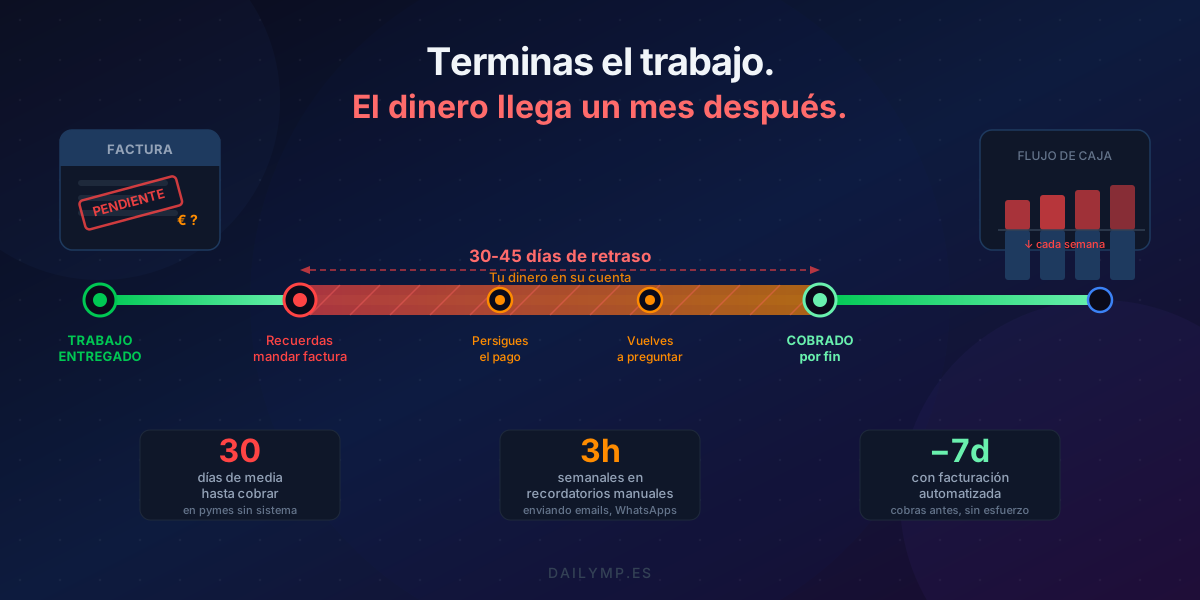
You Finish the Work. You Get Paid a Month Later.
You finished the project on Friday. Delivered it properly, the client was happy, everything looked good.
Monday morning you have ten urgent things on your plate. You send the invoice Tuesday. Or Wednesday. Or at the end of the week when you finally remember you haven't sent it yet.
The client receives it. Says they need to review it internally. That the accounts manager is away this week. That their payment cycles run at 30 days.
And your money — which you earned two weeks ago — is still sitting in their bank account.
The delay nobody measures but everyone suffers
There's a widespread belief in small businesses: late payments are just part of the deal. Clients pay when they can, payment cycles are what they are, and chasing invoices is just part of running a business.
That's not quite right. Or more precisely: it happens all the time, but it doesn't have to.
What is inevitable when there's no billing system in place is this:
- The invoice goes out late because someone had to remember to send it
- The reminder gets delayed because chasing payment feels awkward
- Tracking what's paid and what isn't requires manually checking emails, spreadsheets, or the accounting software
- Every payment conversation gets handled by a different person with a different tone
- Some invoices have been sitting open for months without anyone actively following up
This has a name: involuntary cash flow erosion. Your business does the work. The money takes time to arrive. And in the meantime, you cover that gap yourself — with your reserves, your business card, the funds you had set aside for the next project.
What every week of delay actually costs
Put a real number on it. Say you have three open invoices totalling £12,000. They've been outstanding for an average of 20 days.
That £12,000 isn't in your account. It's sitting in your clients' accounts. It's working for them, not for you.
If your business needs that money to pay salaries, suppliers, or invest in the next project, the delay has a direct cost. If you don't need it urgently, the cost is less obvious but just as real: money you can't reinvest, financial capacity you're not using, growth that's on hold.
Then there's the time. The time someone on your team — or you yourself — spends every week chasing payments:
- Reviewing which invoices are overdue
- Writing a reminder email that doesn't sound aggressive
- Following up if they haven't replied
- Calling when there's no response
- Keeping track of where each invoice stands
That's two to four hours per week in businesses of 10 to 30 people. More than a hundred hours a year spent asking for money you've already earned.
Why manual billing always fails in the same way
This isn't a discipline problem. It's a design problem.
The invoice depends on someone remembering to send it. If that person is busy, on holiday, or just having a rough day, the invoice gets delayed. There's no system that triggers it automatically when the work is marked as delivered.
Chasing payment is uncomfortable. There's a real tension between maintaining a good client relationship and pushing for payment. The usual result: follow-ups get delayed, softened too much, or simply don't happen.
There's no clear visibility. To know which invoices are outstanding, overdue, or in dispute, someone has to actively look. There's no system that flags when something has been sitting too long without movement.
Every client is different. Some pay in 15 days, some in 30, some "when they can." Without a system that handles those variations automatically, someone has to remember each client's terms and act accordingly.
Put all of that together and you get the pattern you probably recognise: work delivered, money delayed, hours lost to follow-up, unnecessary tension with clients.
What changes when the process runs itself
Imagine that when you mark a project as delivered, the invoice is automatically generated and sent to the client within hours. Without anyone having to remember.
Three days later, if there's been no confirmation of receipt, the client gets a brief, neutral follow-up. Not a demand. Just a "wanted to make sure this arrived."
At fifteen days, if the invoice is still unpaid, someone on your team gets an internal alert to make a personal contact. Not aggressive collections — just to check if there's a problem or question.
At thirty days, if silence continues, there's a defined process: escalation, credit note, or a management call — whatever you've set up for your business.
All of that happens without anyone reviewing a list, remembering dates, or carefully calibrating the tone of an email to avoid sounding pushy. The system knows where each invoice stands and acts accordingly.
This is exactly what we build with AI automation agents for businesses: invoicing and collections processes that run on their own, connected to the tools your business already uses — whether that's Xero, HubSpot, Odoo, Notion, or your current management software.
Real results
Businesses that automate their invoicing and payment follow-up process see two measurable results from the first month:
They get paid 7 to 12 days earlier on average. Not because clients suddenly become better payers — but because the invoice arrives sooner, the reminder goes out on time, and the process doesn't depend on anyone remembering to do it.
They eliminate 8 to 15 hours of monthly follow-up work. Hours that used to go on reviewing spreadsheets, writing reminders, and making uncomfortable calls. Hours that are now available for work that actually generates value.
And there's a third result nobody expects: client relationships improve. A consistent, professional billing process — where the client knows exactly what to expect — builds more trust than one where every interaction depends on whoever happens to be handling it that day.
How it works in practice
You don't need to change your accounting software. Your team doesn't need to learn new tools. You don't need to hire anyone.
What we do at DAILYMP with AI integration into your existing tools is build the flow that connects your delivery process to your billing process:
- We map your current process: how invoices are generated, who receives them, how follow-up works today
- We identify the friction points: where the process stalls and why
- We connect the systems: so the invoice is generated and sent at the right moment, without manual intervention
- We configure automated follow-up: reminders on the timelines you define, with the tone you want, without depending on anyone to remember
- Your team only steps in for real exceptions: when a client disputes an invoice, when there's an error, when a human decision is genuinely needed
For most businesses, implementation takes less than two weeks.
One concrete question
How many invoices do you have right now in "sent, awaiting payment" status?
How much do they add up to? How many days have they been outstanding?
That figure is the direct cost of not having a follow-up system in place. It's not lost money — it's money arriving late. And that difference has more impact on a small business's cash flow than it looks on a spreadsheet.
If you want to know which part of that process can be automated in your business, I can tell you exactly what would change in 30 minutes.
Let's look at how much time and money we're losing to billing →