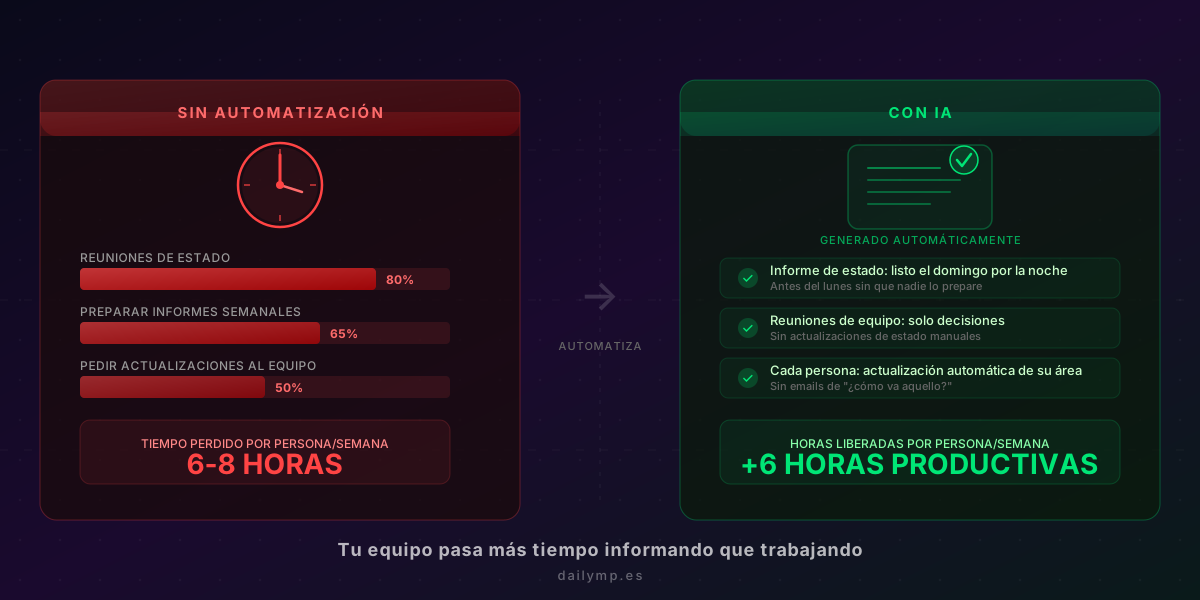
Your Team Spends More Time Reporting Than Working
Count how many hours your team spent last week in status update meetings.
Now count how many of those hours went to listening to people say what they finished, what's in progress, and what's blocked. What percentage of the total was that?
For most companies, the honest answer is somewhere between 70% and 80%.
And the frustrating part isn't the time itself. It's that all that information already existed somewhere. It just hadn't been collected and organized before the meeting.
The Loop Nobody Has Questioned
Status meetings exist because without them, nobody knows exactly where things stand. Is the client A project delivered? Pending review? Blocked? Without a meeting, someone would have to ask around. So the meeting becomes the mechanism for asking everyone at once.
The problem is that this mechanism consumes the entire team.
An 8-person team with a 90-minute weekly meeting loses 12 hours per week just in that meeting. If each person also spends 45 minutes preparing their update, that's 18 more. 30 hours per week for an 8-person team — the equivalent of hiring someone part-time just to report on what's already happening.
And that doesn't count urgent follow-up meetings, the "how's that going?" messages on Slack, project update emails, or the monthly reports someone spends two days preparing.
The Cost Nobody Sees
The trouble with this type of waste is it doesn't appear on any invoice.
There's no line item in your costs that reads "inefficient meetings: €3,200/month." It's distributed across everyone's salaries. It's invisible.
And because it's invisible, it never gets questioned. The Monday meeting has worked this way since the company had four people. Now it has fifteen and runs exactly the same way — except now fifteen people stare at the same screen while someone reads the status of each task out loud.
Worse, all that time spent reporting doesn't fix the underlying problem: nobody has real visibility into what's happening without having to ask. Every week starts the same way — with the same uncertainty, the same information-gathering meeting, the same manual summary.
What Changes When Reports Generate Themselves
You don't need to eliminate meetings. What can change is what they're for.
An automation agent connected to the tools your team already uses — Notion, Trello, Asana, Linear, Jira, Slack, whatever you run — can generate every Sunday evening a full status update across all active projects:
- Status of each task and who owns it
- What was completed last week
- What's blocked and why
- What has deadlines in the next 7 days
- Alerts for anything running late
That report reaches whoever needs it before the week starts. Without anyone preparing it. Without anyone having to ask.
The Monday meeting, if it still makes sense to have one, takes twenty minutes. Because nobody needs to update the rest on what they did — everyone read it before walking in. The meeting is used for the one thing no system can do: making decisions, unblocking problems, reprioritizing.
You can see how this works in detail in our AI agents and automation service.
The Reports Nobody Should Be Preparing
The weekly meeting is the most visible case, but not the only one.
In almost every company, someone spends time each week or month preparing reports: sales, support, operations, projects. That person opens a spreadsheet, copies data from three different systems, formats it, double-checks the numbers, and emails the document around.
That process can be almost entirely automated. The data already lives in your systems. What's missing is the agent that collects it, organizes it, and presents it in the format each person needs.
When this works, the report is ready at 7am on the day it's needed. Without copy-paste errors. Without anyone having to remember to do it. Without the anxiety of "I forgot the Friday report."
The person who used to prepare it gets those hours back for work that actually requires their judgment.
If you want to understand how this connects to the systems you already have, the AI integration for businesses service covers the full process.
How Much Time Can Actually Be Recovered
Not every reporting process is the same, but the numbers we typically see in 10-to-50-person companies give a sense of the potential:
Automated project reports: 2-3 hours/week recovered per project manager.
Shorter status meetings: 40-60% reduction in total meeting time when the team arrives with the information already read.
Client updates without manual intervention: the client receives project status without anyone having to write a custom email.
Monthly business reports: what used to take half a day is ready in minutes.
For a 10-person team, recovering 6 hours per person per week means 60 hours back into value-generating work every week. In a month, that's over 240 hours.
Real Results
Companies that have automated their reporting cycles tell us the most noticeable change isn't the time itself — it's the quality of the conversations. Meetings that used to be for "catching up" become meetings for making decisions. The team walks in already knowing where everything stands. The energy goes into solving, not reporting.
Where to Start
You don't need to overhaul every meeting and every report at once. The first step is identifying the single reporting process that consumes the most time in your company right now: it could be the Monday meeting, a specific area's monthly report, or the weekly project updates to clients.
Once that's identified, that process can be automated in under two weeks. Without changing the tools the team already uses. Without special training.
Want to talk through which reports or meetings make the most sense to automate for your business?