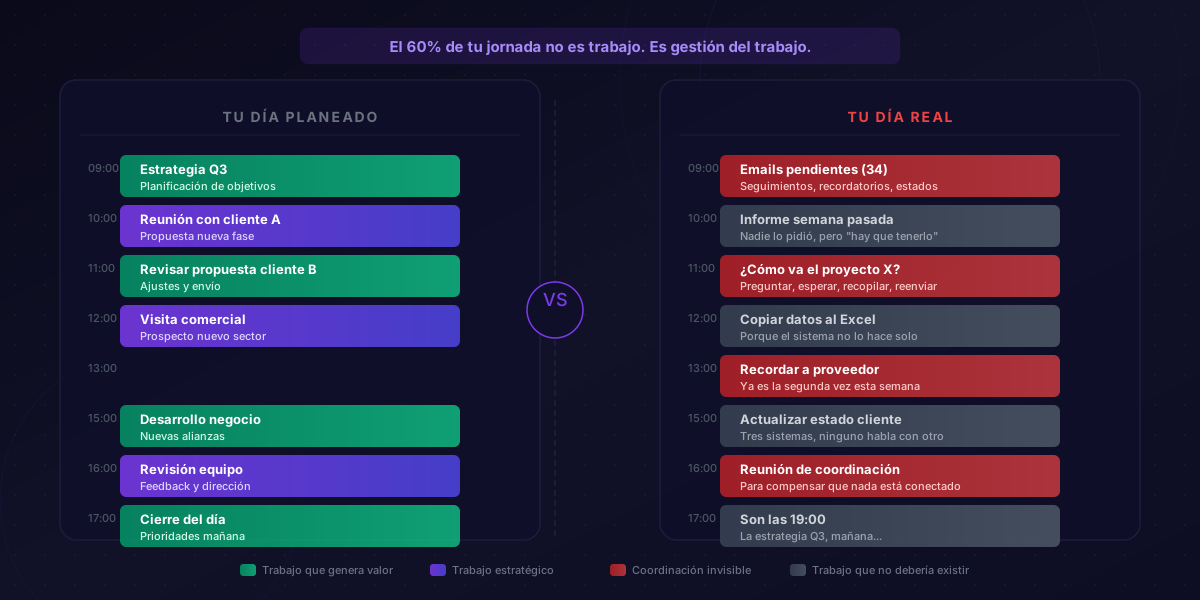
60% of Your Workday Isn't Real Work
It's Wednesday morning, 11 AM.
In your head, today was going to be a good day. You planned to close the proposal for that new client, review this quarter's strategy, and finally have that conversation with your team that's been postponed since last week.
It's 11 AM. You've been working for two hours. You haven't done any of those three things.
What have you done? The usual:
- Caught up on the emails that piled up yesterday afternoon
- Reminded the supplier — again — that they still haven't sent the documents
- Dug through three different tools to find where a project stands so you could answer someone's WhatsApp message
- Pulled together the weekly summary you send on Wednesdays, which nobody explicitly asked for but "has to be done"
- Copied data from the management system into the spreadsheet your finance team uses
It's 11 AM. You've spent two hours doing things that aren't really your job.
The Problem Nobody Put on the Org Chart
There's a type of work that exists in every business but doesn't appear on any job description, any report, or any budget.
It's called coordination. And in most SMEs, it's done by the person with the most value: you.
Emails to check how something is going. Meetings to align what should already be aligned. Status updates someone has to gather before someone else can make a decision. Reminders for things that should happen automatically but don't.
This work produces nothing. It doesn't move any project forward. It doesn't generate a single pound or euro. It exists only because your systems and your people aren't connected in a way that lets information flow on its own.
And you're the one doing it. Not because you're the only one who can. But because nobody else does it if you don't.
The Real Cost That Doesn't Appear on Any Spreadsheet
Do the math. If you spend just three hours a day on this kind of work — coordination emails, reminders, status reports, hunting for information that should be accessible — that's 750 hours a year.
At $50 an hour — and your time is probably worth more — that's $37,500 a year in work that doesn't sell, doesn't grow, and doesn't produce anything.
Thirty-seven thousand dollars. In follow-up emails and reminders.
But the real cost isn't just financial. It's strategic.
Every hour you spend coordinating is an hour you don't spend thinking about how to grow. How to differentiate. What project could change your business next year. That's the cost that never appears on any spreadsheet but shows up in the pace at which your business grows — or doesn't.
The Pattern That Repeats Across Every SME
The interesting thing isn't that this happens to you. It's that it happens exactly the same way to the leader of any business with 10 to 50 people.
The pattern is always the same:
Your tools don't talk to each other. The CRM knows the client situation. The project tool knows the status. The spreadsheet knows the hours. But nobody connected them, so someone has to bridge the gap every time a complete picture is needed.
Information doesn't flow on its own. When a project progresses, the client doesn't know unless someone writes to them. When something changes, the team doesn't know unless someone calls a meeting. When a supplier misses a deadline, the reminder depends on someone remembering to send it.
The owner is the system. Instead of having processes that run themselves, there's one person — usually you — acting as the glue between all the moving parts. When that person is unavailable, coordination stops. When that person is overloaded, coordination falls behind.
This isn't an organisation problem or a discipline problem. It's a design problem.
What Changes When Coordination Runs Itself
Imagine the client automatically receives a project status update every Friday — without anyone drafting it.
That when a supplier deadline is approaching, the reminder goes out on its own, three days before.
That when a team member needs to know where a project stands, they look it up in one place where information is always current, without asking anyone.
That the weekly report generates itself from the data that already exists in your systems, without anyone copying a single row.
This isn't wishful thinking. It's what happens when you connect the tools you already have and put coordination on autopilot.
Alignment meetings decrease because they're no longer needed to compensate for information not flowing. Follow-up emails disappear because the system sends them automatically. Reminders trigger at exactly the right moment.
And you, for the first time in a long time, reach Wednesday at 11 AM having spent the previous two hours on what you actually planned.
What We Do at DAILYMP
We don't ask you to change your tools. We don't ask your team to learn anything new. You don't need to hire anyone.
What we build is the automation layer that connects what you already have:
- The systems you use start talking to each other and information flows to the right place without manual input
- Follow-ups that depended on someone remembering them send themselves at exactly the right time
- Status updates that used to require a meeting appear automatically where each person needs to see them
- Reminders to suppliers, clients, and team members trigger automatically based on the timelines you define once
The result isn't just time saved. It's a business that doesn't depend on you being at the centre of everything for things to happen.
You can learn how this works in our AI integration for business processes and our automation agents for SMEs.
Real Results
Businesses that automate their coordination layer recover an average of 2 to 4 hours per day in management time. Not by working less, but by stopping work that was never theirs to do.
What we hear most often after a month: "I can't believe I was doing this by hand every single day."
A Question for This Week
How many hours of your last week were real work — work that produces value, moves projects forward, changes something — and how many were coordination?
If the answer makes you uncomfortable, you already know what the next step is.
Tell me what you coordinate manually and I'll show you what can be automated →