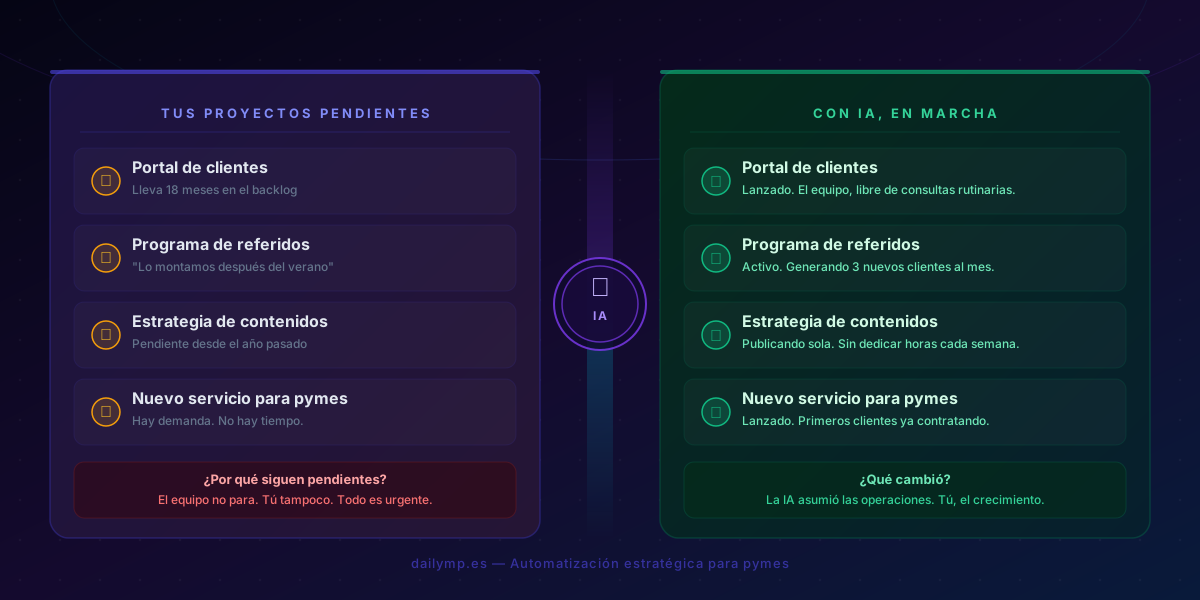
You Have Ideas to Grow. Two Years of No Time to Execute.
It's Sunday afternoon. You open that notebook — or that Google Doc, or that iPhone note — where you keep your business ideas.
Some of those items have been sitting there for a long time. A very long time.
That client portal that was going to simplify everything. The referral program you thought of in a meeting eighteen months ago. The content strategy to attract new clients without relying on ads. The new service you spotted real demand for but never got a launch date.
Good ideas. Ideas that are still there. Untouched. Not one step forward.
It's not that you lack motivation. It's not that the ideas are wrong. It's that you reach Sunday running on empty after a week of firefighting, and Monday starts the exact same cycle all over again.
And at some point — without anyone deciding it — that list of strategic projects became a museum of things that never happen.
The Bottleneck That Doesn't Show Up on Any Org Chart
Your business works. That's a real achievement — don't take it for granted. There are clients, there's work, there's a team. The machine runs.
The problem isn't that the machine doesn't work. The problem is that the machine consumes everything you have.
Your team is at full capacity. You're at full capacity. Everyone is managing the urgent, handling what comes in, keeping what needs to run running. And when everyone is maxed out on today, there's no room left for tomorrow.
This isn't an attitude problem or a talent problem. It's a capacity problem. There's a ceiling to what can happen in a business when every person — including you — is using all their energy to maintain the operation.
Strategic projects don't fail because they're bad projects. They fail because they require something that doesn't exist in any business running at full speed: sustained attention, time without urgency, the ability to think and execute without constant interruption.
And that, in most businesses of 10 to 50 people, doesn't exist naturally. It has to be created.
What That Paralysis Really Costs Your Business (Without Anyone Noticing)
The cost of not executing strategic projects doesn't show up in any report. There's no line in the accounts for it. Nobody sends you an invoice that reads "missed opportunity: €5,000 this month."
But it exists. And it compounds.
Think about the referral program you never launched. If it had brought two new clients per month for the last twelve months, what does that add up to? Put a number on it. It's probably not small.
Think about the content strategy that's still pending. There are businesses in your sector that have been generating visibility for months — ranking in searches, building an audience that brings them enquiries without effort. Every month that goes by without your own content is another month of advantage for them.
Or that new service. You knew there was demand. But there was no time to launch it properly. And someone else launched it.
These losses aren't visible because they leave no obvious trace. But they accumulate. And they have a name: the opportunity cost of not growing.
The business you have today is the result of what you did over the past few years. The business you'll have in two years is the result of what you start doing now. If what starts now is exactly the same as what's been happening — managing the urgent, handling what comes in, keeping the machine running — in two years you'll have basically the same business. With the same ceiling.
The Most Common Mistake When People Talk About AI
When someone mentions automating with AI, the image that usually comes to mind is: complicated systems, risk of something breaking, months of implementation, training the whole team.
That's not what happens.
What happens in practice is much more concrete: you identify the tasks your team does today that don't require real human judgment — the ones that are always the same, always follow the same steps, always produce the same expected result — and those tasks stop consuming people's time.
They don't disappear. They keep happening. They just happen on their own.
Answering the same client questions. Weekly status reports. Following up on sent quotes. Publishing content on social media. Syncing data between the tools you already use. Onboarding new clients.
All of that can work without anyone doing it manually. And when it works on its own, the time and attention it used to consume reappears somewhere else: in the hands and minds of the people who used to do it.
You're not hiring a robot. You're freeing up capacity that already exists in your business but is trapped in tasks that don't deserve it.
What That Space Becomes
When your team doesn't need to produce the same report every Monday, that slot disappears from the calendar. There's no new meeting, no new task. There's space.
When routine client questions have automatic answers, the person who used to answer them has that time available. Not for more urgencies — for projects that never had room before.
When quote follow-up happens without anyone having to remember, the person who used to chase them can spend that time closing larger contracts instead.
This is the shift that's hardest to visualise before you experience it: it's not about doing the same things faster. It's about capacity appearing for things you couldn't do before.
That's the difference between efficiency and growth. Efficiency lets you maintain what you have with less effort. Growth requires capacity for what's new.
AI delivers efficiency. But what it really unlocks is strategic capacity.
What Can Be Automated in a Business Like Yours (No Jargon)
Without getting technical, this is what we typically do at DAILYMP with automation agents for SMBs:
Routine client support. Questions that are always the same — order status, service terms, availability, how something works — answered automatically, 24 hours a day, in the channel your clients already use: WhatsApp, email or your website.
Automated reports and summaries. Instead of someone spending time each week pulling data and preparing a status report, the summary arrives on its own for whoever needs it, with real-time figures.
Sales follow-up. Sent quotes get automatic follow-up. Proposals that have been sitting without a response for days trigger an alert or a message. New leads enter a process without anyone having to remember to activate it.
Content publishing. The content strategy you've been meaning to execute for months can run with a system that creates, schedules and publishes — without anyone having to remember to do it every week.
Tool coordination. If you have data moving manually between systems — from a CRM to a spreadsheet, from a form to your management platform — that transfer can happen automatically, in real time, without errors.
None of these changes require your team to learn new technology. None require switching the tools you already use. They require initial implementation time — measured in weeks, not months — and then they run on their own.
Real Results
The businesses we work with at DAILYMP typically free up between 20 and 40 hours per month of operational work when they automate their most repetitive processes. This isn't time that appears out of thin air — it's real time that was previously consumed by manual tasks.
What changes when that time appears: projects that had been in the backlog for months start getting real meetings. Ideas in the notebook stop being ideas and start getting dates. Team members start doing the work they were actually hired to do, not the maintenance work nobody chose.
The most common thing we hear after two or three months: "I can't believe we didn't have time for this before." Not because the idea was new — it had been there for two years. But because finally there was capacity to execute it.
The Question Worth Asking Today
How many hours per week does your business — including you — spend on tasks that are always the same, always produce the same result, and require no real decision?
That number, multiplied by four weeks, is your current ceiling for strategic projects. If it's zero, it's because all that time is already taken up by operations.
Freeing up even half of that time changes dramatically what can happen in your business over the next six months.
If you have a list of pending projects and you've been unsure where to start to create space to execute them, in 30 minutes I can tell you exactly which processes in your business make the most sense to automate first — and what would actually change.