New Client? Now the Invisible Work Begins.
The contract is signed. Client is happy. You are too.
Then someone on your team — or you yourself — sits down to prepare everything that needs preparing every time a new client comes in.
The Same Tasks, Again
Nobody warned you when you started your business: part of the price of every new client is paid by you, in hours of work you never bill to anyone.
Every time a new client signs up, most businesses go through the same routine:
- Create the project folder
- Add the client to the CRM (if someone remembers)
- Send the welcome email
- Set up access to the tools they'll share with you
- Brief the team who'll be working with them
- Create the project in your management tool
- Add them to the billing system
- Schedule the kickoff meeting
- Prepare the kickoff document
- Update the internal active client register
Ten steps. Each one between ten and twenty minutes. Total: two to four hours per new client.
If you onboard five clients a month, that's ten to twenty hours of work per month that generates no new value for your business. It just repeats the same thing, every single time.
The Problem Nobody Has Calculated
That time exists. It's happening right now in your business. But it never appears in any report, any profitability calculation, any conversation about "what's costing us time."
It's spread across "just a moment" and "I'll do it now", between the person who usually handles it and whoever covers for them when they're on vacation. Between the client who arrived on a quiet day and got everything set up perfectly, and the one who arrived during a chaotic week and has been waiting three days for their access.
Invisible time has two problems.
The first is the direct cost: real working hours your business pays for that generate no additional value and repeat with every new signup.
The second is inconsistency. When the process depends on someone remembering it and doing it their own way, the result is different every time. Some clients got a great start. Some didn't. And the difference wasn't the quality of your service — it was whether someone was available and focused enough to do a proper onboarding that week.
The First Week Matters More Than You Think
Client retention data shows this clearly: clients who have a smooth, organized onboarding experience retain at much higher rates than those who start in confusion.
Not always because the service is better — sometimes it's exactly the same. But because the onboarding experience communicates things that clients pick up on immediately.
A chaotic onboarding says: "we wing it." A process that runs itself, where the client receives what they need before having to ask, says: "they know what they're doing."
That perception doesn't fade easily. And it forms in the first five days.
What Changes When the Process Runs Itself
Imagine that the moment they sign the contract — or confirm the payment, or complete the signup form, whatever you use as a trigger — the process starts automatically:
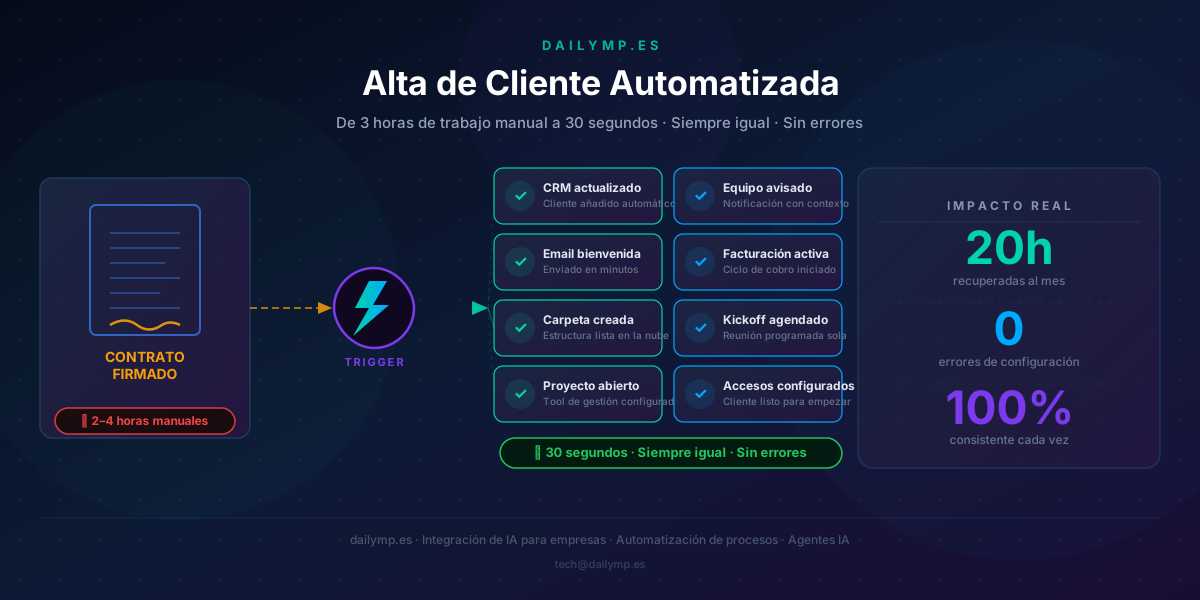
The welcome email goes out within minutes with information specific to that client. The project folder is created automatically with the right structure. The client is added to the CRM with all their data connected. The team gets a notification with the context they need. The kickoff meeting is proposed automatically in an available time slot. The billing cycle starts from day one, without anyone having to remember.
All of that without anyone doing it manually. Without depending on how busy that week is. Without the result varying based on who's in the office.
Always the same. Always right. In less time than it takes to read this paragraph.
How This Gets Built in Practice
You don't need to change the tools you already use. Most businesses have everything they need — CRM, cloud storage, project management tool, billing system — they're just not connected to each other.
What gets connected is the entry trigger (the moment a new client is confirmed) with each of those systems. The agent knows what to do in each one, in what order, and with what specific data for that client.
At DAILYMP we build this through AI integration that connects your sales process with your operations: the signed contract triggers the flow, each system receives what it needs, and your team only steps in when something genuinely requires a human decision.
You can see in detail how our automation agents for businesses handle this type of recurring process, connected to the platforms you already use.
Real Results
Businesses that automate their client onboarding process notice the change in three concrete ways:
Time recovered: between 10 and 20 hours per month that used to go toward manual setup. Hours now available for actual work.
Clients who start better: when the onboarding is consistent and fast, the client's initial perception of your business is higher. And a good first week translates into longer relationships.
A process that scales: if five new clients a month was already an effort, when you reach fifteen the same system works exactly the same way. Without hiring anyone else to manage the setup.
What we most often hear after a few weeks live: "I couldn't believe how much time we were losing on something that can just run itself."
The Question Worth Asking Today
Next time a new client comes in, time how long it takes from confirming the contract to the client having access to everything they need to get started.
That number — multiplied by how many new clients come in each month — is the real cost of a process nobody has calculated.
And that same number is what disappears when the process runs itself.
How much time does your business lose on each new client setup? Tell me →