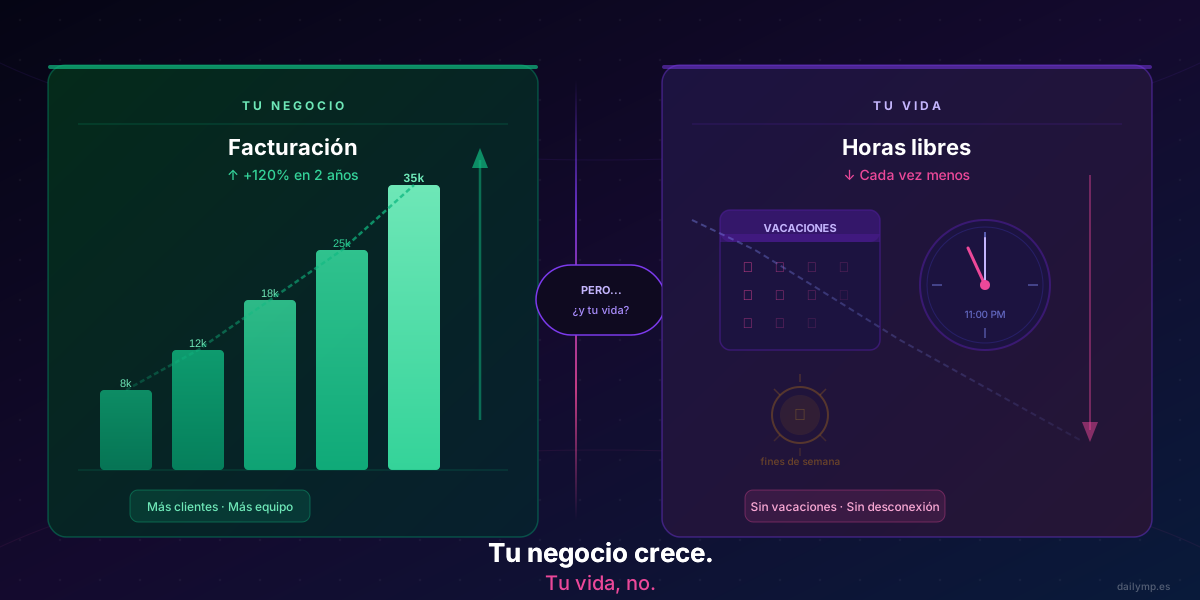
Your Business Grows. Your Life Doesn't.
When you decided to start your business, you had a clear picture of what your life would look like.
"Once I have my own company..."
Maybe it was: set your own schedule. Travel without asking anyone's permission. Actually be present when the people you care about need you. Stop depending on someone else's decisions.
Now, several years later, count how many of those things you actually have.
The irony is that you've achieved what you set out to do: growing revenue, clients, a team. By almost every external measure, it's working. The problem is that the more it works, the more it needs you.
The false milestone that's always just a little further ahead
Every business owner in this situation recognizes this internal monologue:
"Once I hit €15k/month, I'll have more time."
You hit it. Now it's: "Once I stabilize at €25k..."
You stabilized. Now it's: "Once I hire someone else and finish training them..."
You hired them. And you're still in exactly the same place.
This is the false milestone — the moving target that makes you think your workload problem will solve itself if the business just grows a little more. But it doesn't. Because growth without systems doesn't create freedom. It creates more of the same, at higher volume.
Every new client adds more coordination, more communication, more deliverables, more decisions to supervise. Every new employee adds more management time, more questions to answer, more processes that only you know how to handle.
The business grows. The work grows with it. And your life stays on hold.
Three signs your business has eaten your life
This isn't about staying late or checking email on Saturday. Those are symptoms. The real signs go deeper.
You can't remember your last real holiday. Not a three-day getaway with your phone in your hand. A real holiday: a week completely switched off with nothing falling apart. If you're calculating when that was and the answer is years ago, your business has taken something from you that money can't buy back.
Routine decisions can only be made by you. Not the big strategic ones — those are genuinely yours. The daily management ones: what discount to offer, how to respond to that client, how to prioritize this week. If you're the bottleneck for decisions that shouldn't need you, your business runs on you, not on systems.
The ratio has gone backwards. You work more hours per euro earned now than you did three years ago. Or your revenue per hour of your time hasn't improved even as the business has grown. You're growing in volume but not in freedom. That equation is broken.
Why growing without systems multiplies your workload
Here's the mechanism nobody explains when you start.
A business with manual processes has a direct relationship between growth and the founder's work. More clients means more tasks, more of your hours. It's linear. And the curve only goes up.
A business with automated systems breaks that relationship. Once a process runs automatically — client follow-up, weekly reports, responses to routine inquiries, data moving between tools — it keeps running at any volume. Ten clients or fifty: the process doesn't require more from you.
That's the difference between growing in revenue and growing in freedom. One without the other is the trap you're in.
What automation does — and this is exactly what I build with companies at DAILYMP — is break that direct relationship. Each process that runs on its own is one less thing that scales with your effort. And when enough processes run on their own, something fundamental changes: the business starts working for you instead of requiring you.
What "a business that runs without you" looks like in practice
It doesn't mean disappearing. You're still there — leading, growing, making the decisions that are genuinely yours.
It means:
- The client asking for a project update gets an answer without you acting as messenger between your team and them.
- The lead who filled in your form at 8pm on Sunday receives a well-written, personalized response. Not Monday morning when you open your laptop.
- The weekly revenue summary lands in your inbox at 9am Monday with no one having generated it manually.
- Commercial follow-up — the proposals you sent, the leads that haven't confirmed — runs automatically without you having to remember to do it.
- The usual questions about pricing, timelines, or how the service works get answered 24 hours a day, in whatever channel your client uses, without anyone from your team needing to be available.
None of this is enterprise-level technology. It's exactly what I build in the AI integration service for SMEs: identifying which processes have the most impact when automated first, and connecting them to the tools you already use without changing anything structural.
The calculation nobody does
Pick the five things that consume most of your week but don't require your real judgment. The tasks that are always the same, always produce the same result, that any trained person could do.
Calculate how many hours per week that is. Let's say 8 hours. That's 32 hours per month.
Now calculate what you'd do with 32 extra hours a month. Not more work — I mean the things you already know: that trip that's been on hold for two years. That project you can't seem to start. Those dinners without checking your phone. That Monday morning where you wake up and don't start the day in firefighting mode.
That's not personal aspiration. It's a direct consequence of having — or not having — systems that work without you.
Real results
The companies we work with at DAILYMP usually arrive at this conversation after months in the same pattern: growing in revenue but feeling more trapped, not less. The more the business grows, the more their presence is required.
When we build automated systems for their most repetitive processes, what changes isn't just the hours recovered. What changes is the quality of those hours. The difference between a business that scales and one that exhausts the person leading it isn't working harder. It's having systems that work when you don't.
In concrete terms: companies of 10 to 30 people that automate their most repetitive management flows recover between 20 and 35 hours per month. Not extra work hours — free hours. The ones that finally make possible what's been on hold for months.
The question worth asking today
When you started your business, how did you imagine your life would look in five years?
And how does it actually look?
If there's a gap between those two answers, the problem isn't that you set unrealistic goals. It's that you built a business that hasn't stopped depending on you. And unlike many business problems, that has a concrete, measurable solution.
I want my business to run without depending on me every minute →