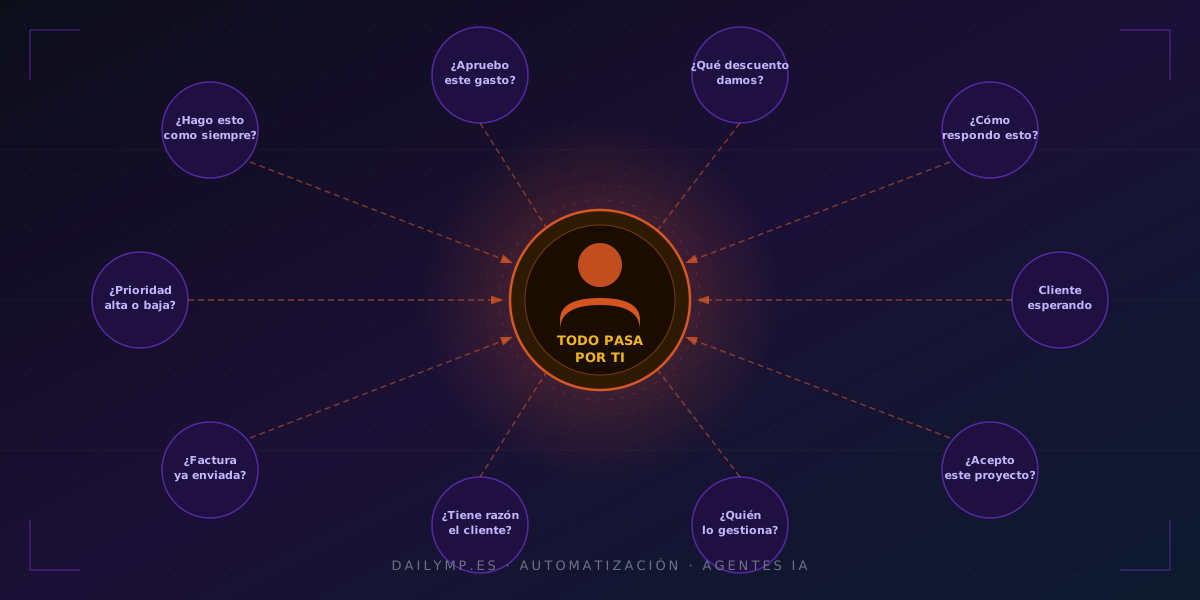
Your Business Can't Run Without You. That's a Problem.
It's Sunday afternoon. You're on the sofa with your family. You've spent ten minutes trying to follow the film, but fifteen minutes thinking about whether that client email arrived before six, whether your team knows how to handle Monday's issue, and whether the proposal you sent Friday needs a follow-up.
Nothing urgent has happened. No crisis. Just the constant background noise of a business that lives in your head — even when you're physically somewhere else.
And the most revealing thing isn't that you're still thinking about work on a Sunday. It's that you've been doing this for years, and you don't even notice it anymore.
Being indispensable looks like a strength. It isn't.
There's a deeply held belief among business owners: if everything goes through you, it's because you're good at what you do. If the team asks you everything, it's because they trust you. If the business can't function without you watching over it, it's because you're the most capable person to make it work.
That belief is a mistake. A comfortable one — it feeds the ego. But a mistake nonetheless.
Being indispensable isn't an achievement. It's a trap that was built slowly, without you deciding it, and that now has consequences that go far beyond staying up with your laptop at eleven at night.
The most visible consequence is time. But the most costly one is invisible: your mind never truly rests.
The work nobody counts: thinking about the business outside of work
I'm not just talking about answering messages on holiday or checking emails before bed. That's only the tip of the iceberg.
The real burden is the background thinking you can't switch off.
You're in an important meeting and part of your brain is calculating whether next week's project has enough margin. You're having lunch with a friend and suddenly remember no one followed up with that client who's been silent for two weeks. You wake up at three in the morning with an idea about an operational problem that isn't urgent — but your brain decided to process it anyway.
That's not dedication. It's the price of being your company's memory, judgment, and approval system all in one.
Every decision that only you can make is a mental load that doesn't switch off when you close the laptop. It lives with you. It interrupts your focus. It consumes the energy you should be using to think big, spot opportunities, actually lead.
And over time, the cumulative effect isn't measured in hours lost. It's measured in presence that never arrives. Conversations you don't remember. Moments that passed while your mind was somewhere else.
The questions that shouldn't reach you
Try this exercise. Think about the last ten questions your team asked you this week.
How many were genuinely new or complex situations? How many were variations on something you've already answered before — the same or very similar?
Most business owners, when they do this exercise, realise that 80% of the questions they receive have answers they've given dozens of times already.
What discount to offer. How to handle this type of complaint. Whether a new client is worth taking on. When to escalate a problem to the supplier. How to word that sensitive reply.
Your team asks you not because they don't know. They ask because you are the only place where the criteria for those decisions lives. There's no guide. No protocol. No system that has captured how you think.
So whenever a situation arises that isn't fully standardised, the most direct path is to ask you. And you answer. Because you always have. And because it works.
The problem is what happens in the meantime: every interruption carries a cognitive cost far beyond the time spent answering. When you're pulled out of deep focus, getting back to that state takes between 15 and 25 minutes. Multiply that by a full day's interruptions, and the result is fragmented, reactive work that never reaches the depth your most important decisions actually require.
You're managing. But you're not leading.
The invisible ceiling you'll hit sooner than you think
There's a limit no one warns you about until you've already reached it.
Your business can't grow faster than you can personally process. Every new client adds questions that go through you. Every new hire adds coordination that goes through you. Every project adds decisions that wait for you.
At some point — and many small business owners have already crossed it without realising — the bottleneck isn't demand, or the team, or the market. It's you. Your availability. Your attention. Your time.
And the result is the worst of both worlds: the business can't go faster, and you can't give more.
You can't escape that by hiring more people. New people will ask you too. You can't escape it by working more hours. You're already working all the hours you have.
The only way out is to build what you never built: a system that operates with your judgment — but without needing your constant presence.
What it means for your business to run without you (without going anywhere)
Here's what many people misunderstand when they talk about this kind of change.
I'm not talking about retiring or stepping away from your business. I'm talking about something much more specific: the decisions that currently stall waiting for your approval — stopping stalling. The questions that interrupt you fifteen times a day — having answers that don't require you to be the one giving them.
Your team having the criteria to handle everyday situations without asking you. Processes that repeat running on their own, at the same quality, regardless of whether you're available. The information you need arriving to you instead of you having to hunt for it.
At DAILYMP, we build agents and automation systems that capture exactly that judgment: how you think, what you value, how you decide in the most common situations. And we turn it into processes that run on their own. Without you watching.
It's not complicated technology. It's doing what should always have been done: documenting and connecting the operational knowledge that currently only lives in your head, and turning it into systems your business can use without depending on your being available.
Real results
Companies that make this change don't just recover hours. They recover something more valuable: the ability to be genuinely present in what matters.
The owner who used to answer twenty questions a day starts answering four. The processes that used to wait for their availability start happening on their own. Evenings and weekends stop being occupied by the background noise of the business.
And something more important: the ability to think strategically comes back. To see the business from the outside. To make important decisions with a clear mind — not an exhausted one.
The first visible effect isn't productivity. It's personal: the business stops living in your head outside working hours. And everyone who's experienced that says it changes everything else.
The question that matters
If tomorrow you couldn't work for three days — for whatever reason — would your business run on its own? Not perfectly. Just run.
If the answer is no, you have a design problem. Not a people problem. Not an effort problem. Not a commitment problem.
Just a design problem. And that has a solution.
Let's talk about which parts of your business run without you — and which still need you →