You're Paying Salaries for Things AI Does on Its Own
There's an exercise nobody does in their company because the result is too uncomfortable.
Pick anyone on your team. Ask them what they do every day. Listen carefully. Then mentally separate the tasks that require their judgment from the tasks that follow the same process every single time.
The first kind justifies their salary. The second kind justifies this conversation.
Because there are tasks that have been happening the same way in your company for years — without anyone asking why a human is doing them instead of a system. Not because they're complex. Just because that's always how it's been done, and nobody stopped to question it.
That has a cost. One that doesn't show up on any report, but quietly leaves your account every month.
The Weekly Report That Takes Three Hours and Nobody Reads
Every Friday, in thousands of companies, someone opens five different tabs.
The management system. The sales spreadsheet. The project tracker. The incident log. The metrics dashboard.
They do it to prepare the weekly status report — data copied from one place, pasted into another, format adjusted, totals double-checked by hand just in case the spreadsheet is off, a brief contextual paragraph added, and sent by email.
Three hours. Every Friday. For months.
Who reads it? Half the time, the report gets glanced at and filed. Not because it's useless — but because by the time it arrives, three conversations have already happened covering what went on that week. The report reaches its own irrelevance before anyone opens it.
What AI would do: connect to all those sources, pull the data automatically, generate the report in whatever format you already use, and send it on its own — at 8 AM Friday, before anyone starts work. No manual work. No copy-paste errors. No "I'll finish it after this call."
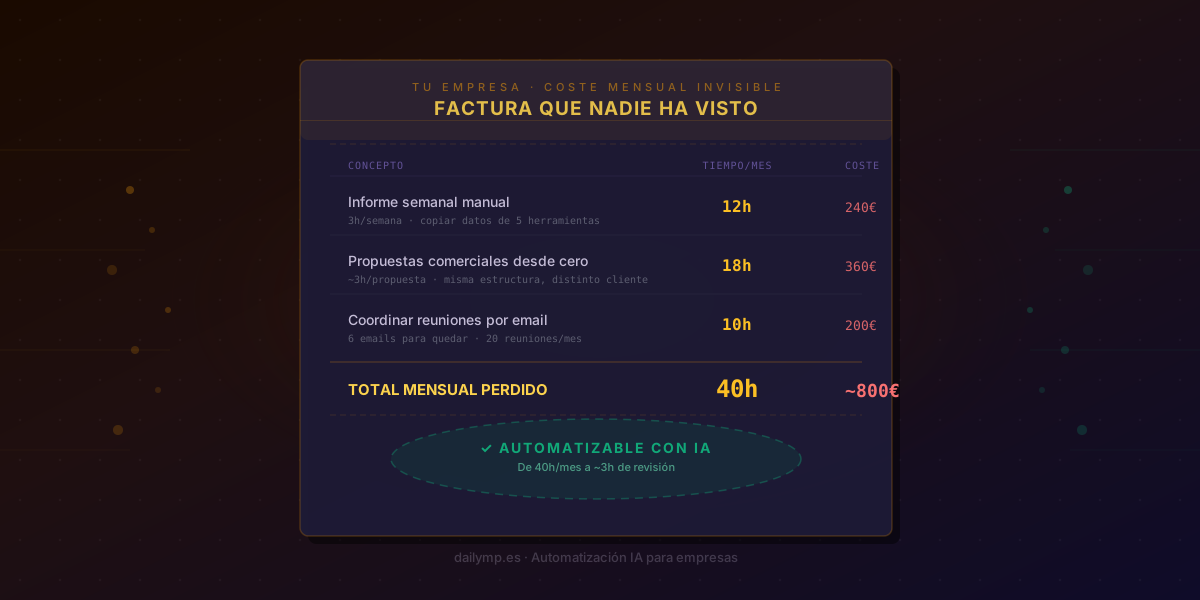
The cost you avoid: 3 hours × 4 weeks = 12 hours per month of work from someone you're paying to think, not to copy and paste.
The Proposal That Always Starts From Scratch
A potential client comes in. There's a meeting. It goes well. Time to prepare the proposal.
Someone opens the last client's document, deletes what doesn't apply, adjusts the text, changes the numbers, adds the specifics for this case, double-checks there are no remnants of the previous client, applies formatting, exports to PDF, sends it.
Four hours. For a proposal that's structurally identical to the previous ones. Eighty percent of the content is the same. Only the client name, the numbers, and two or three personalization paragraphs change.
And each time it starts practically from scratch, because "the template from last time wasn't quite right either."
What AI would do: take the meeting notes or a short briefing form, generate a personalized proposal draft — with the right text, correct pricing, client name in every field where it belongs — ready for a 20-minute review and final polish instead of a four-hour build from nothing.
The cost you avoid: if you prepare 6-8 proposals per month, that's 24-32 hours of work following a repeatable pattern. Conservative estimate: 18 hours per month.
The Six Emails to Schedule a Meeting
"Got any time this week?" / "Tuesday at 11 works for me" / "Not for me, I have a call" / "Wednesday afternoon?" / "Morning's better" / "Thursday at 10?" / "Perfect."
That's seven messages, spread across multiple people, over two days, to book a 45-minute meeting.
Multiply that by the external meetings your business runs each week — with clients, suppliers, candidates, partners — and you're looking at hours spent on coordination. Not on work. On coordination.
Research on professional productivity consistently shows people spend 4-5 hours per week on communication related to meeting scheduling alone: replying, waiting for replies, confirming, rescheduling.
What AI would do: a smart scheduling link where the client or supplier picks the available slot directly, with no email exchange needed. The meeting gets created, confirmation is sent, it's added to everyone's calendar, and automatic reminders go out the day before. Thirty seconds from the first message.
The cost you avoid: if you coordinate 15-20 external meetings per month, that's 8-12 hours in back-and-forth messages. Conservative estimate: 10 hours per month.
The Total Nobody Has Calculated
Three processes. The ones you just read. Add them up:
| Task | Current time | With AI |
|---|---|---|
| Weekly status report | 12h/month | ~0h |
| Commercial proposals | 18h/month | ~3h review |
| Meeting coordination | 10h/month | ~0h |
| Total | 40h/month | ~3h/month |
40 hours per month. One full work week, every month, from someone on your team — spent on tasks that don't require their judgment, their expertise, or their knowledge of your business.
At €20/hour in labor cost, that's €800/month. At €25/hour, it's €1,000. And that's only counting these three processes.
How many more does your company have?
Why This Has Gone Unsolved for Years
It's not because it's technically hard. It's not because it's expensive to fix. And it's certainly not because your team isn't capable of doing better things with their time.
It's because this doesn't hurt acutely. It hurts in the background.
No one walks into your office and says: "Hey, we just burned 10 hours today on tasks a machine could do." It just happens — every day, distributed across tasks that seem normal because they've always been normal.
The problem isn't that it's hard to see. It's that it requires a moment to stop and actually look.
And once you see it, fixing it doesn't require a months-long project or replacing your entire toolstack. Most of these processes can be automated by connecting what you already have.
What Changes When You Automate It
The person doing the weekly report stops doing it manually. Not because they're gone — because that time is freed up for things that actually require their judgment. Analyzing what the report says. Spotting what needs to change. Having real conversations with the team about the numbers.
The person preparing proposals takes 20 minutes instead of four hours. They have time to review the text properly, to genuinely personalize the details that make a difference, to follow up on the proposals already out there waiting for a reply.
Meeting coordination stops being a job in itself. It just happens. And the team focuses on the meetings, not on organizing them.
This isn't speculation. It's what's already happening in companies that have made the shift.
At DAILYMP, we build exactly this: the agents and connections that turn your company's repeatable manual processes into flows that run on their own. Without your team learning anything new, without replacing the tools you already use, and with implementation timelines that in most cases don't exceed two weeks.
The foundation is AI integration with your existing tools: connecting what you already have so that data, documents, and tasks flow without human intervention.
Real Results
Companies that have automated these three types of processes report between 35 and 50 freed hours per month per team. Not additional working hours — hours that were previously spent on tasks generating no value, now available for what actually matters.
The most common thing we hear a month in: "Our team now has time to do what we used to outsource to consultants."
Because AI doesn't replace your team. It frees your team to be the team you always wanted.
The Decision Is Simple
There are 40 hours per month in your company being paid for by you and spent on tasks a machine could do better, faster, and without errors.
You can keep things as they are. It works, more or less. It doesn't hurt acutely.
Or you can free those hours, reduce that cost, and have a team that spends its time on what actually moves your business forward.
You don't need to start with all three processes at once. Just pick one.