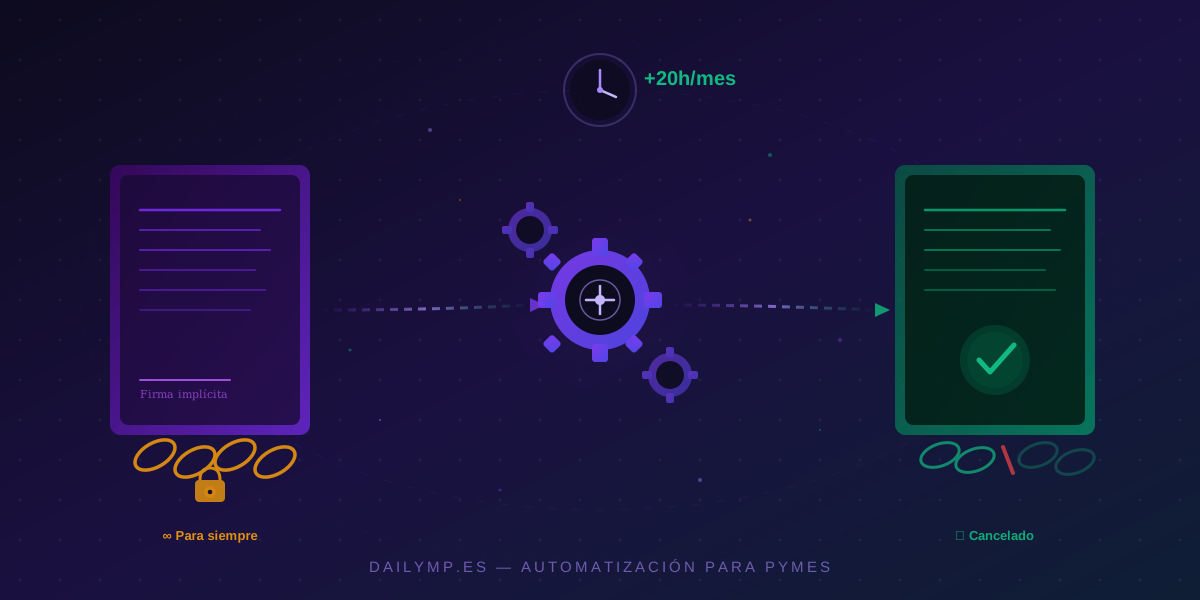
You Unknowingly Signed a Lifetime Contract With Your Most Boring Tasks
There are tasks in your business that you first did years ago.
The first time you prepared that weekly report, it took a little longer because it was new. Now you do it on autopilot. Thirty minutes, maybe an hour, without thinking. Every Friday. Or every Monday. Or whenever it needs to happen.
And that's been going on for months. Maybe years.
What you don't see is what actually happened: the day you first decided to do that manually, you unknowingly signed a contract. A contract that says: I, business owner, commit to spending this time on this task every week for the rest of my professional life.
No paper. Nobody explained it that way. But that's exactly what happens.
The contract nobody signs consciously
Think about the last five repetitive tasks you did this week.
Not the important ones. Not the strategic ones. The usual ones: the follow-up email to the client who hasn't replied in three days. The sales summary someone needs to prepare before the meeting. The data from one system that needs to go into another. The payment reminder that's due.
Each of those tasks has a silent history: someone did it for the first time, nobody asked whether it made sense for a person to keep doing it, and since then it keeps happening the same way. Week after week.
Imagine that every time you do something manually, you sign a small document. You don't see it. But it gets recorded. And if five years from now you open that file, you'll find hundreds of commitments you made without ever deciding to.
The problem isn't that you do those tasks. The problem is that you've never questioned whether you should still be doing them.
The four most expensive clauses in the contract
There are four types of tasks that appear in almost every SMB I work with. Four silent commitments that, added together, represent between 15 and 30 hours per month of work that shouldn't need to exist.
First clause: "I'll remember to follow up."
A client asks for a quote. You send it. Three days pass. No response. Someone has to remember to follow up, find the right email, write a message that doesn't sound desperate.
That "someone" is usually you. Or someone on your team who had more important things to do.
An automated system sends that follow-up on its own. Without anyone having to remember. The unanswered quote gets a message on day three, with the right question, with zero extra effort from anyone.
Second clause: "I'll transfer it from one place to another."
A sale closes in the CRM. Someone adds it to the tracking spreadsheet. Then to the billing sheet. Then to the production system. The same piece of data, four times, through different hands.
Every time someone copies data from one system to another, there are two risks: the time it takes and the error they might make. A connected system moves that information automatically — once, without errors, without anyone touching it.
Third clause: "I'll be available to answer."
Your clients don't ask questions only between 9 and 6. They ask when they have them. And if the answer doesn't arrive within minutes, many of them move on — not with anger, they just keep looking.
An automated response system doesn't replace human judgment. It handles the questions that already have answers — the ones that repeat, the ones that are always the same, the ones that don't need real judgment — and leaves the complex ones for your team.
Fourth clause: "I'll prepare the report."
Every week, someone on your team opens several systems, pulls the relevant data, and organizes it before the meeting. If that person has a bad day, the report arrives late or incomplete. If they're on vacation, someone else has to learn how it's done, urgently.
An automated report builds itself from the period's data. It arrives to whoever needs it, when they need it, without anyone constructing it.
How to cancel a contract you never signed
The good news: these contracts can be cancelled.
Not all at once. And it doesn't require you to understand how the technology works inside — just like you don't need to know how an engine works to get your car repaired.
What you need is someone who:
- Reviews with you what tasks you're doing repeatedly without questioning them
- Calculates how much time they actually take — not in the abstract, but in real hours per month
- Builds systems that handle them automatically — connected to the tools you already use, without changing anything that already works
- Leaves them running — so you never have to think about them again
That's what we do at DAILYMP. We don't sell technology. We cancel contracts.
In the automation and AI integration projects we build for SMBs, the first step is always the same: look at what your team is doing that a machine could do just as well or better. And the result always surprises — not because there's so much to automate, but because there's more than anyone had calculated.
If you want to understand more about how we connect your existing tools so they work together automatically, you can read about our AI integration service — no need to start from scratch.
Real results
Companies that cancel these contracts don't just recover hours. They recover focus.
A 12-person company we worked with had three people spending between 45 minutes and an hour per day on tasks like these. They were different tasks, in different departments — tasks that nobody had identified as "automatable" because they'd just always been done that way.
After automating them: the same three people recovered between 3 and 4 hours per week each. Twelve hours released per week in total. Not to work more, but to do the work that nobody was doing because these tasks were taking up everything.
And something else nobody expects: when the filler tasks disappear, the team works better. Not because anything changed in them — but because they can finally concentrate on what they were actually hired to do.
How many contracts does your business have?
That's the question worth asking.
No complex analysis needed. Just look at the week and ask: what am I doing that's always the same? What does my team do that doesn't need real judgment, just repetition? What has been happening the same way for two years without anyone asking if it makes sense?
In most companies between 10 and 40 people, the total is somewhere between 20 and 40 hours per month. A full month of real work. Every year. Forever.
Unless you decide to cancel them.
Tell me what tasks your business has and we'll review together what can be cancelled →
No forms. A direct conversation about your business.